Posts in Illustration
A Pile of Imperialists

My husband and I were talking about fascism over dinner—like you do—and he said fascism is imperialism turned inward. Directed at a nation's own people. I hadn’t heard it put that way before.

He also mentioned Foucault's boomerang. I've only read Madness and Civilization, and this hadn't crossed my path. (Thank you, art school.) But the idea stuck: the things we do to other nations, we eventually do at home. Other countries become the testing ground. Foucault and others were talking about how Europe ignored colonial atrocities until they came home as fascism.

America has its own long history of atrocities, which includes destabilizing governments and overthrowing regimes. All in the interest of democracy, of course. Depending on who you ask. And what's been redacted.

I'd been thinking about imperialism anyway—setting sights on Venezuela and Greenland, selling arms to warring nations (while hosting peace talks, naturally), creating an enemy in immigrants. It's all more of the same, isn't it?

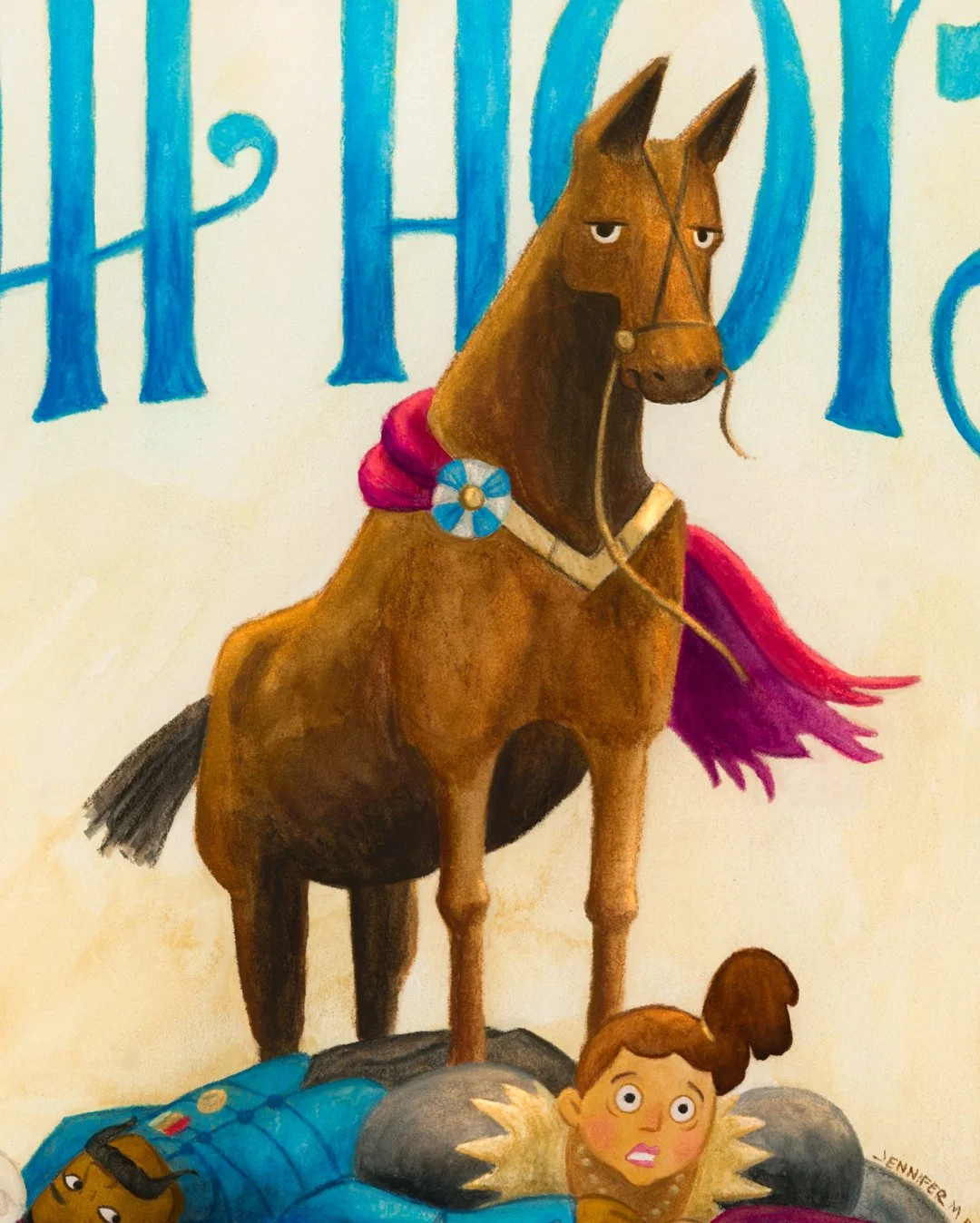
So I made this piece.

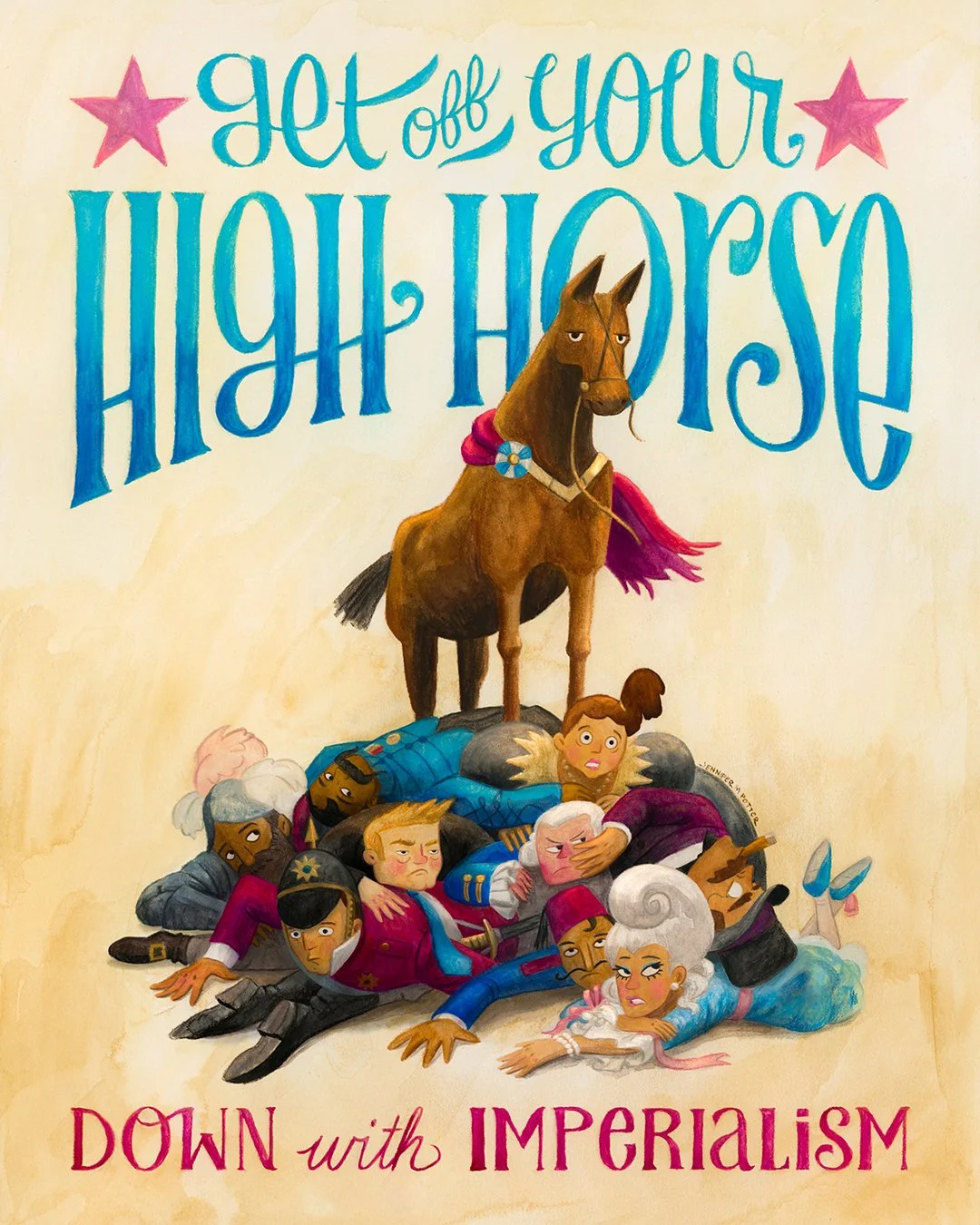
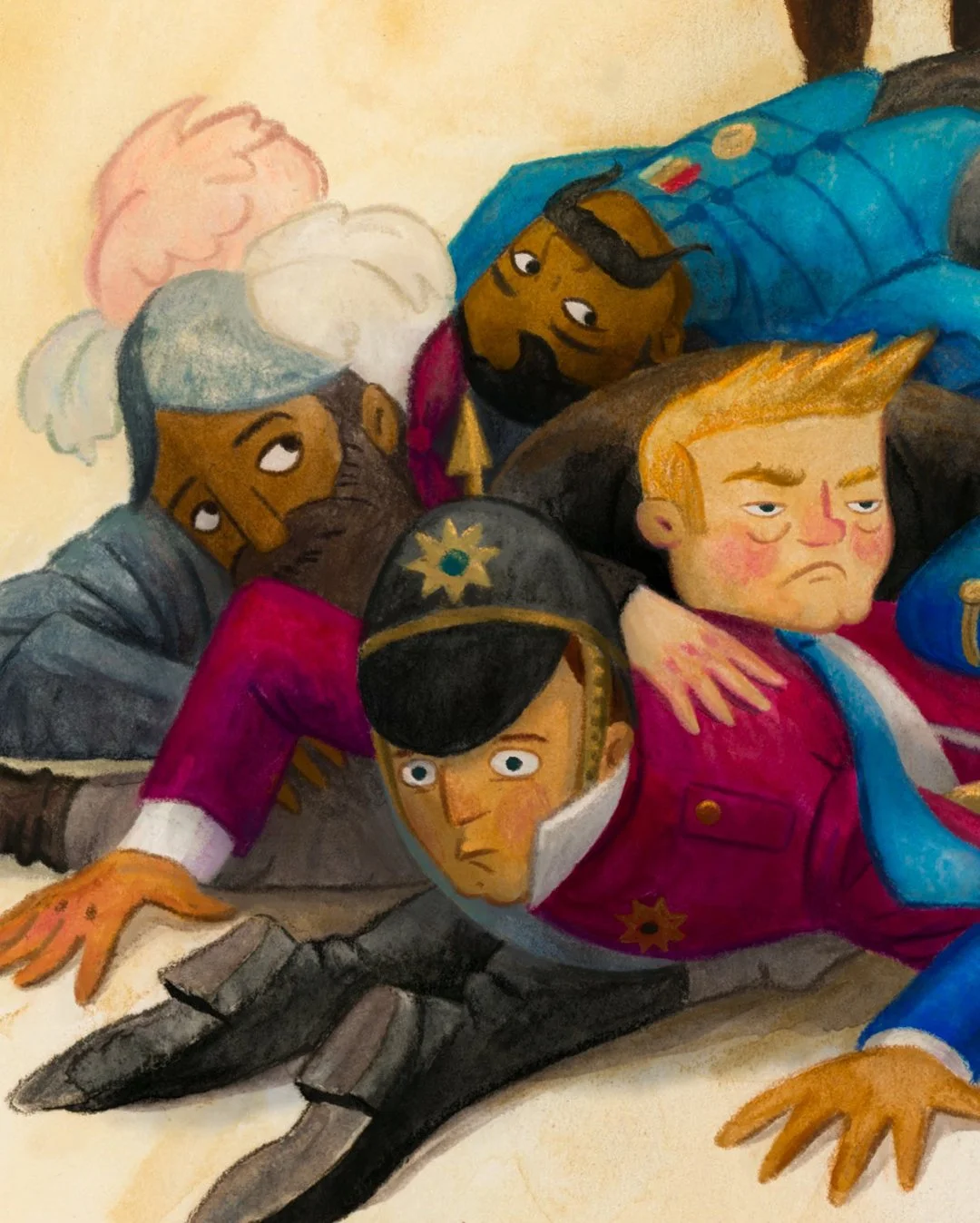
Illustration of a horse standing atop a pile of imperial figures in historical dress, text reads Get Off Your High Horse and Down With Imperialism

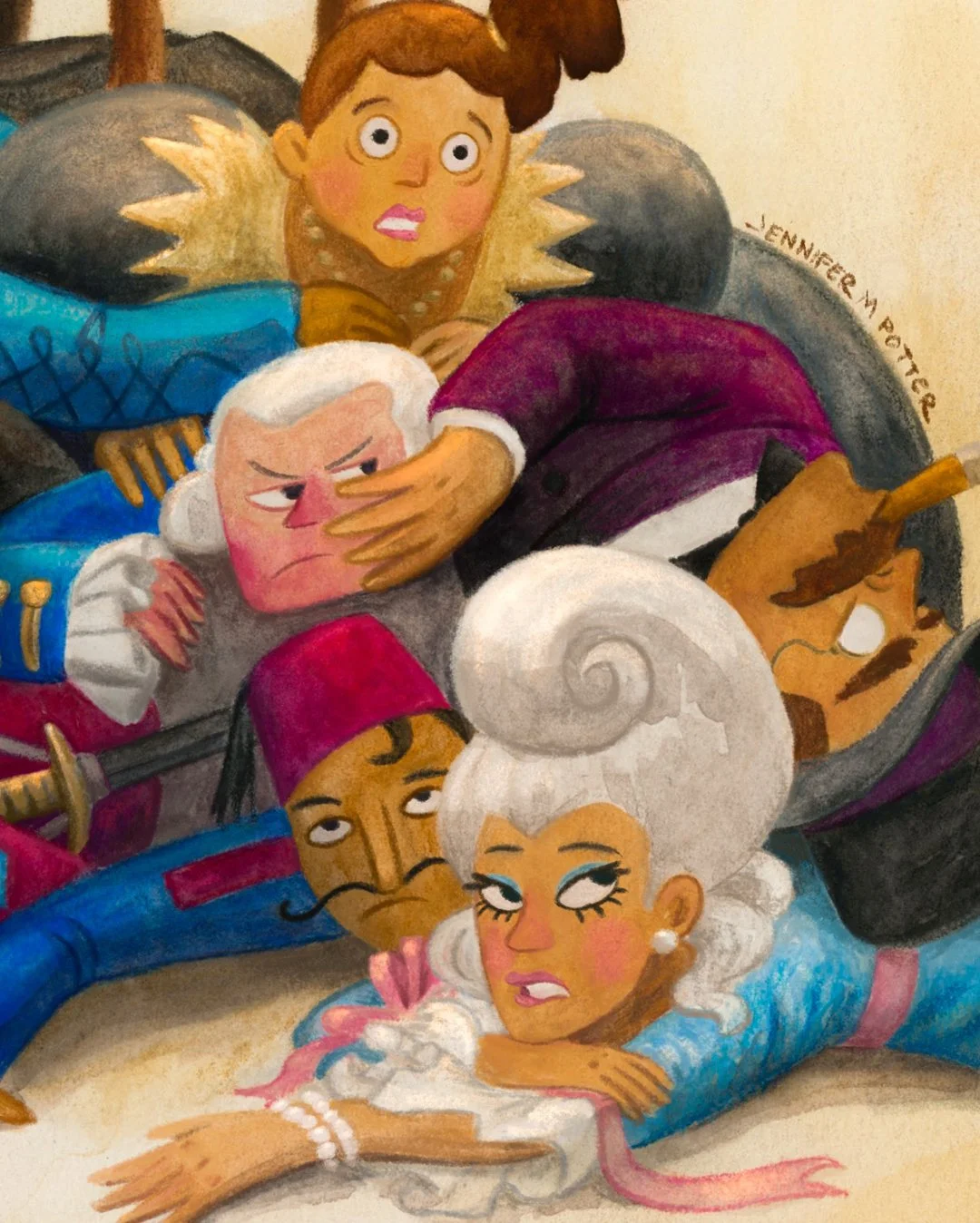
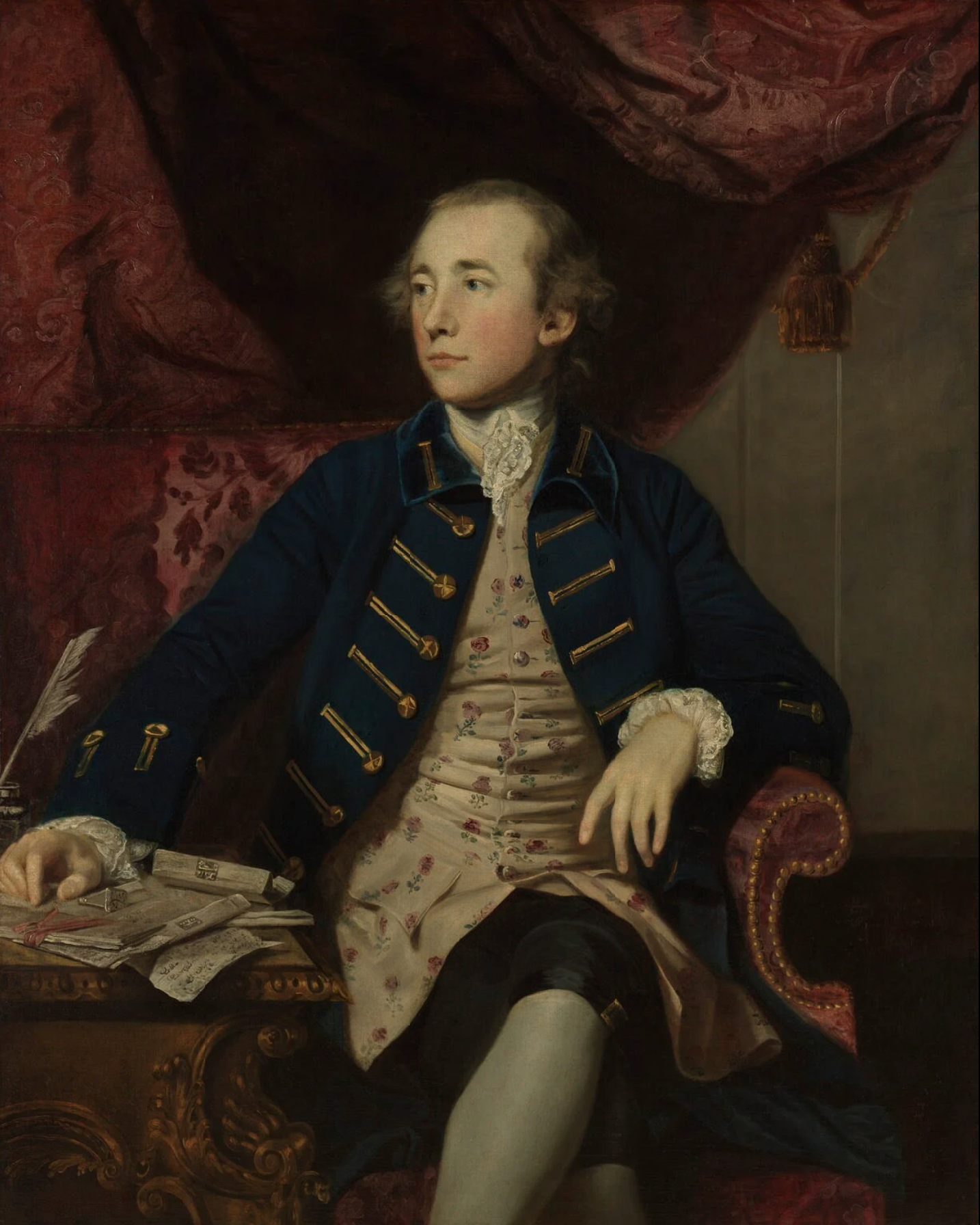
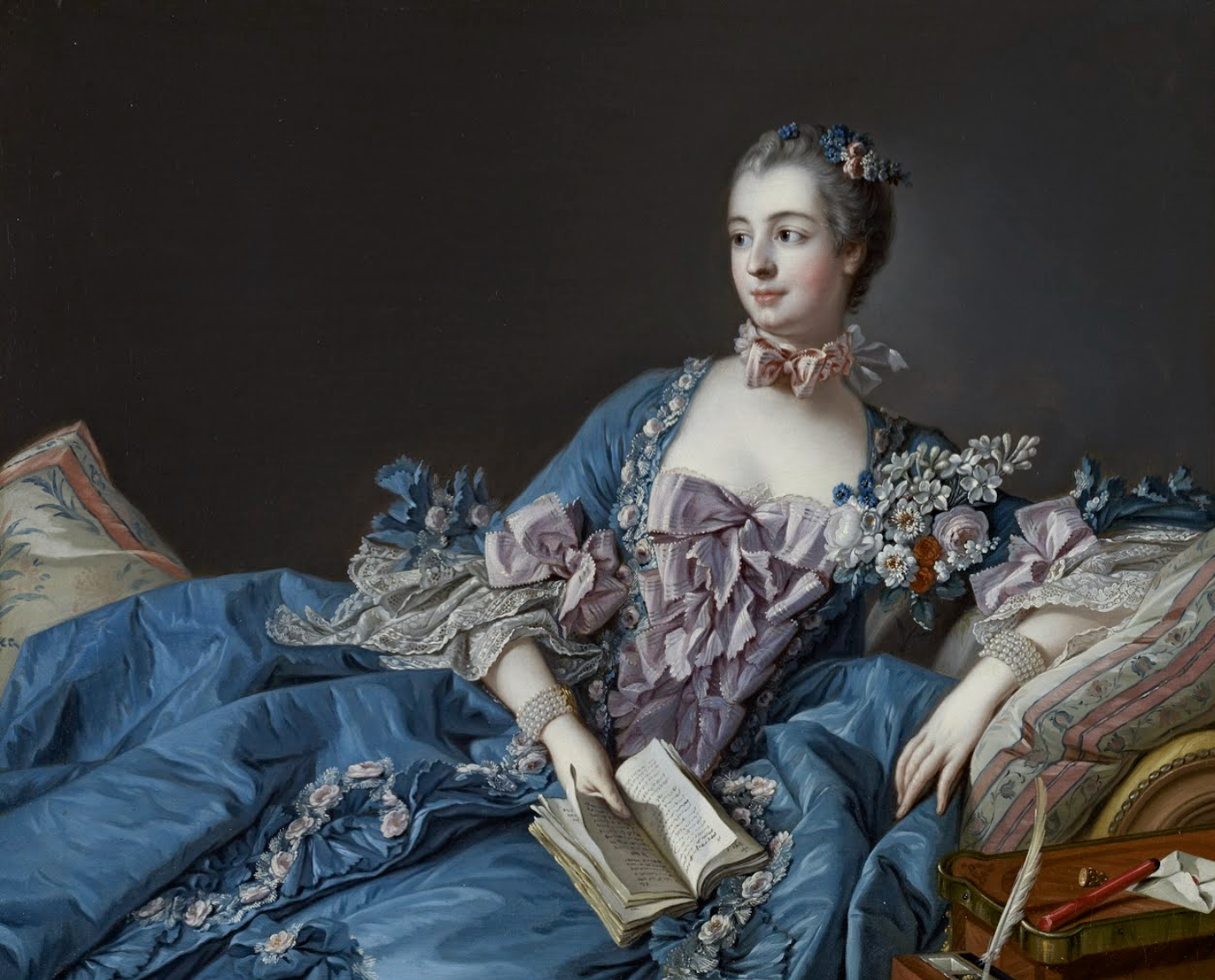
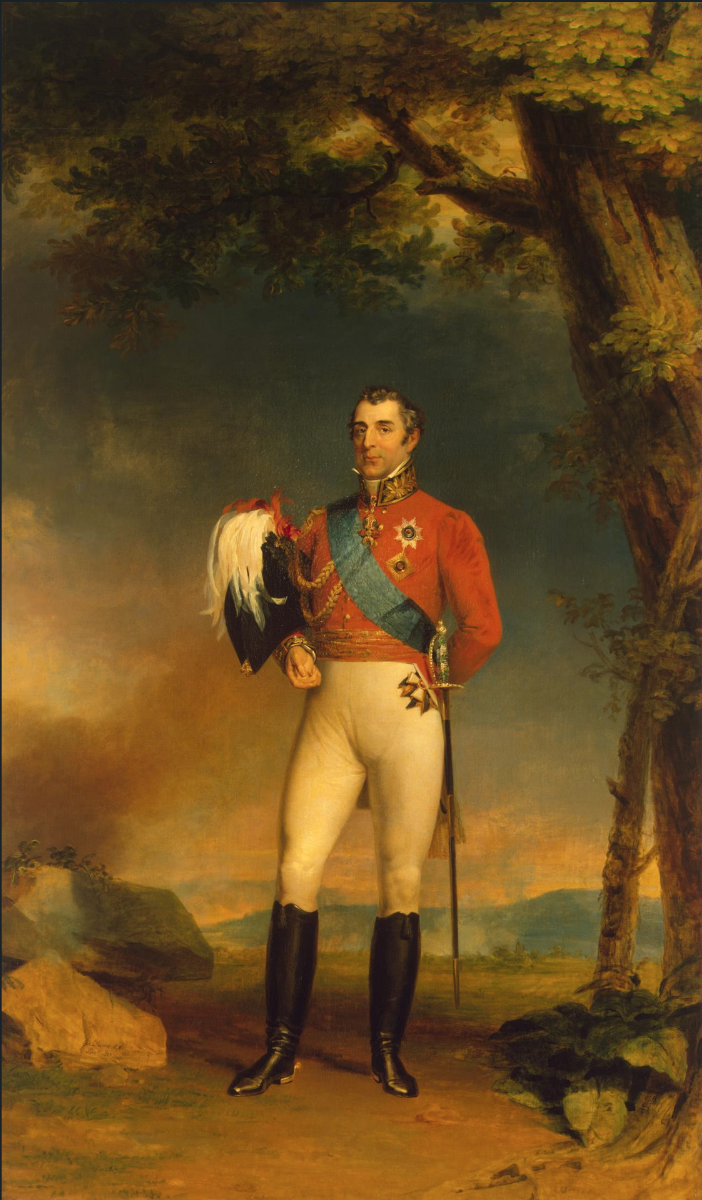
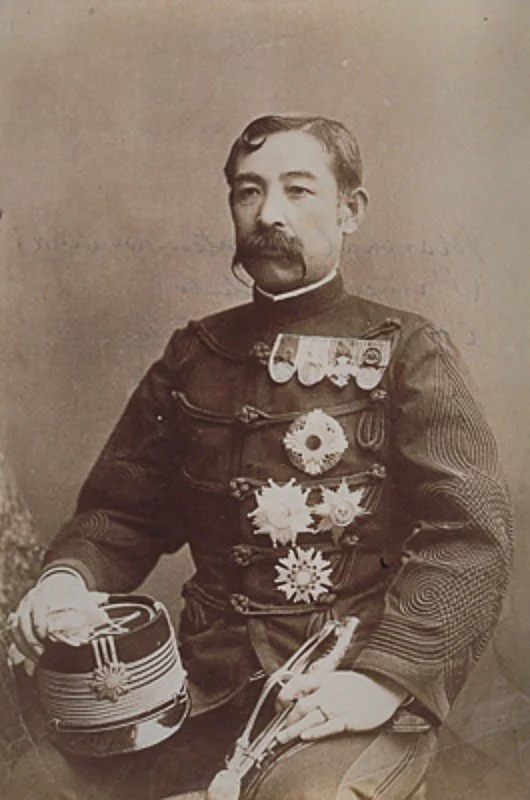
Making it meant diving into images I love. Gilded Age portraits in black silk and lace, rococo oils with ribbons and flourishes everywhere. Ottoman infantrymen in red fezzes, Japanese princes in military regalia, soldiers covered in medals. All that gorgeous fabric and elaborate costume, the wealth and power on display. I admire the aesthetics. And I get that they exist because of imperialism. The wealth that funded them, the systems that made that wealth possible—it's all tangled together

A lot of dark and beautiful things came out of this history. I can love these paintings, study this clothing, use it in my work. And I can still say no more.

I want to live in a world where imperialism is behind us. I don't think that happens unless we work toward it.

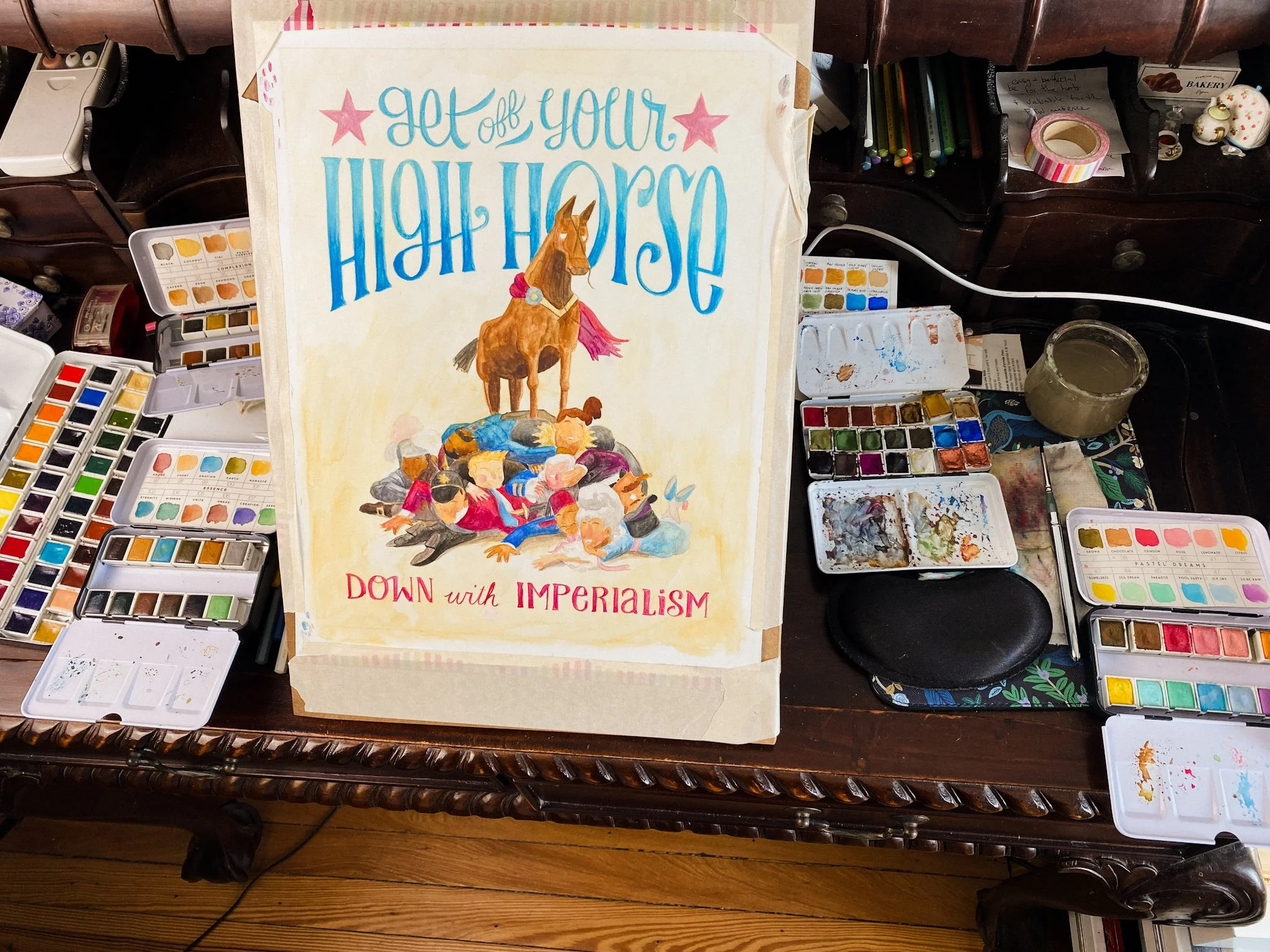
The piece itself is watercolor and watercolor pencil. I had several palettes open, looking for the exact right pigments to complement my pencils. A mix of drawing and painting. Layer after layer—watercolor, pencil, blend, repeat. Always scribbling and blending, drawing out the texture.

Work in progress of the illustration on a desk surrounded by multiple watercolor palettes
Earning Out

I woke up at 3am thinking about royalties.

Royalties and advances and advances on royalties. They're one of those mysterious illustrator things, though I first encountered them back in my band days. You could sign up with a publishing company and somehow you'd get money a few times a year if a song got played on a college radio station.

Free money. With a side of ego-boost. Who doesn’t want that? Me apparently, because I never signed up. I could’ve done something with that $1.31. Le sigh.

For illustrators, royalties come from sales—greeting cards, fabric, books. Do enough things that sell well and you can build long-term income. But most things don't earn out. Getting a good advance is always better. With royalties, you're paid precisely based on how well the item sold. Advances are about hope and good faith—how well the distributor hopes it will sell. You and the publisher both take risks: you accept royalties in lieu of more money upfront, the publisher offers an advance on something that doesn't exist yet. As long as you complete the project, you don’t have to pay it back. So if it doesn't sell well, that’s still real money in your pocket. So get the best advance you can. If royalties come, that's icing on the cake.

Cover of Claude: The True Story of a White Alligator

My cake recently got a few more frosting flowers. After five years, Claude earned out. I thought it might—it's in its 5th or 6th printing now and has a board book edition—so I was feeling confident.

A few weeks ago Julia, the accountant at my old agency, emailed with the good news and sent my royalty statement. That's what woke me up at 3am: the idea that I could show you how to read the damn thing, for when you get one of your own.

I'm not sure it's kosher to share my actual statement. I think we should all talk about money more, but this isn't just my money—it's the publisher's too, and my agent's. So instead, here's a fictional one.

This is Mirabel's statement. She's a squirrel (not that it matters). She wrote and illustrated a book called Acorns & Elegance: A Guide to Seasonal Entertaining. Tiny Tail Press paid her an advance of 1000 leaves. The book was a hit—fourteen moons on the New Oak Times Bestseller list—and she just earned out.

The first page shows the reporting period and how often statements come. This period, Mirabel earned 22.2 leaves.

Here's where it breaks down by sale type. Mirabel gets 6% of hardcover books over 1000 units sold. She got 5% for books 1-1000, but that’s not listed here—a small bump in royalties is a fairly common bonus when a book sells well. She also gets 4% for paperbacks.

Each type is split between regular and discount sales. Different formats and retailers can have different rates. The list price for Acorns & Elegance is 10 leaves, so when a book sells at full price, Mirabel gets around half a leaf per book. For heavily discounted sales (which are common with wholesale pricing), she still gets 4-6%, but of net instead of the list price. Net can be, uh—squirrelly—so be sure to ask how the publisher or manufacturer calculates it before signing anything.

The summary shows what she earned this period, minus money the publisher is holding to cover books that might be returned, plus any money they released from last period’s reserves, and minus what remains on her advance. In other words, the publisher keeps some funds to protect against potential returns while returning any money they no longer need to hold.

If Mirabel still had a lot of her advance remaining, you’d see that under Advances and Expenses. But all that remains is 4.7 leaves. Since that’s less than what she earned this period, she’s finally earning out. Tiny Tail Press will pay her the balance of 22.2 leaves. Maybe that’s 22 big leaves and one really small one. I don’t know rodent economics.

Finally, we see how many total units Mirabel has sold. Not bad! Hopefully it will stay in print for many years to come!

Once you earn out, every statement after that is just money coming in. More icing on your cake, or in Mirabel's case, more maple on her pecans.

Mirabel's hard at work on her follow up, Chestnuts & Charm: A Guide to Gracious Living. Preorder at Tiny Tail Press.

Fresh Picked Cherry Tomatoes

I have a self-professed brown thumb. Or I did. I guess that might not be true anymore as I have quite the container garden on my deck. My crops are huge right now, and my neighbors are impressed, and I think a bit surprised when I tell them this is my first year successfully growing anything more than houseplants.

tomatoes-6.jpg

It’s all thanks to Monty.

Last summer, I was holed up in my one-bedroom apartment feeling absolutely miserable. Don’t get me wrong, it was a great apartment, top floor, lots of light, right in the middle of San Francisco’s Mission District. And because we got it in 2008 and it had rent control, we were paying about half what similar apartments were going for. It didn’t matter that it had no outdoor space, because the whole city was our back yard. But then the pandemic hit. And the heat waves. And the wildfires.

That summer, we couldn’t go anywhere because of lockdown. There was no place to go. And even though we could have gone camping, we chose to heed the guidelines of no unnecessary travel. It wasn’t all bad. During nicer weather, we could bike to the park and have a distanced picnic with friends. But when ash from the wildfires lingered over the city making the air toxic, we couldn’t even open our windows, much less go outside.

So, like a lot of people, I resorted to escapism. I spent a lot of time dreaming about a home with some kind of outdoor space where I could have a garden. That meant looking at homes on Zillow and watching A LOT of gardening shows.

tomatoes-5.jpg
tomatoes-2.jpg

I suspect Monty Don is a household name in the UK, but I’d never heard of him until last summer. I learned a lot from him and his gang on Gardener’s World. I also learned a ton from a show called Grow Cook Eat, which is nicely organized by crop. Even though I had no way to apply what I was learning, it surprises me how much I soaked in. I can identify way more plants now. I even know the latin names for some of them. And the difference between espalier and fan-trained trees. And what stepover apples are!

So when my Zillow journey led us to buy a house back home near family (for less than we were paying for our SF apartment), of course I started a garden of my own. Our yard is by no means expansive, but I’m happy to start small. I put a few containers on the back deck in which I’m growing lettuce, cherry tomatoes, tomatillos, five different peppers (including two we inherited from our neighbors), and a whole bunch of herbs. It’s basically a salsa garden.

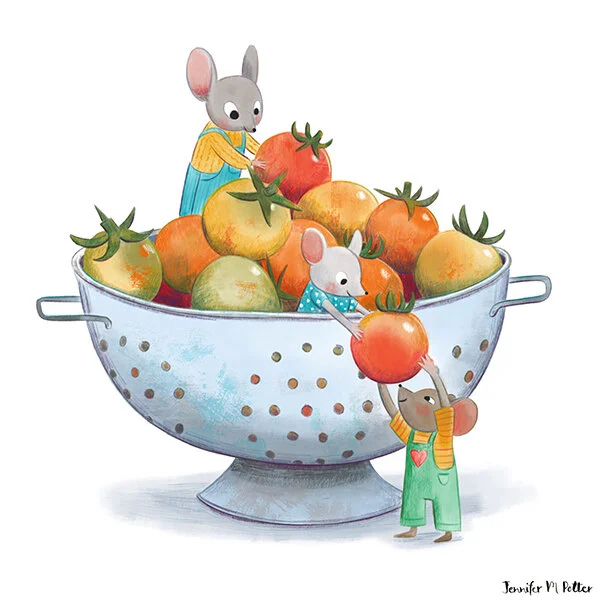
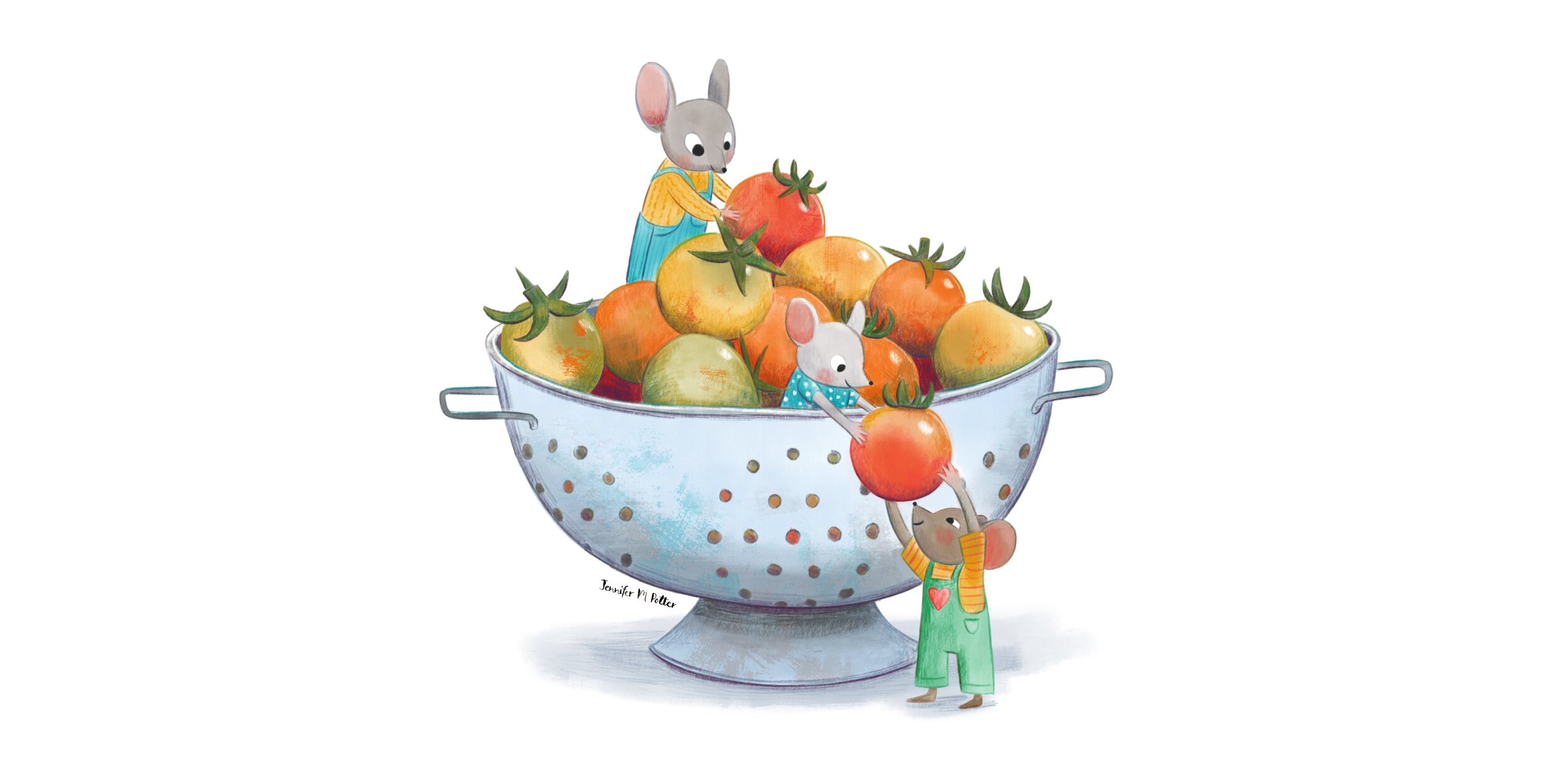
I’ve been planting, watering, pruning, and tying back plants for months and now it’s finally harvest time! It’s a nice feeling going out to water the plants in the morning and coming back in with a colander full of produce.

tomatoes-4.jpg
tomatoes-1.jpg

Next year I’m definitely adding more fruit. I want to have a few different berry bushes, plus some kind of fruit tree. My neighbors have figs, and I kind of want one, but maybe I’ll go with a plum and see if they’ll trade.

Do you have a garden? If not, what do you wish you could grow?

Stop Overthinking. Free the Fish.
sardineTin-banner.JPG

This post is for me, but also for all of you who tend to overthink things. Even now, not even two sentences in, and I find my mind wandering off, evaluating if this is really how I want to begin this post. But nope. I’m done with that. I’ve let it get in the way of things I want to do for far too long.

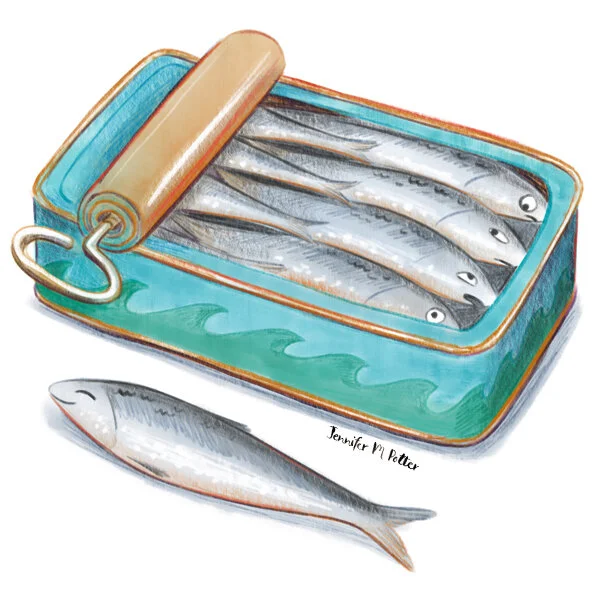
See, I want a blog. I have so many ideas swimming around in my head, and they all want out. I mean it’s completely crammed in there. Like sardines. Little swimming sardine ideas. That’s no way to run a brain. An aquarium? Sure. But not a brain.

So here I am to share my fishy little brain with you, in all its overthinking weirdness. AND, I want to be a good example, because I want your little fishes to get out, too. I know for a fact that I am not the only one who over-analyzes things into oblivion. I’m not the only one that will come up with a solid idea and then think about it so much, trying to make it just right, that eventually my inner critic will talk myself right out of it.

So I’m back. I’m here, I’m gonna share. And I want you to share, too. Give yourself permission. Don’t do it for the ‘gram. Don’t do it for ‘tok or the ‘book or the ‘ter (that’s how that goes, right?). Do it for yourself. Get your thoughts and your ideas and all your lovely, brilliant, psycho weirdness out on paper or text or what have you, and set them free!

I hereby grant myself permission to share imperfect artwork, tutorials, insights, etc. I do NOT give myself permission to chicken out. This isn’t about chicken anyway. It’s about fishes. And the fishes need our help.

Tonko House's Painting with Color and Light: Week 2

Here's some of the work I did for the second work of Tonko House's course over at Schoolism. The assignment was to draw images from life, in grayscale, with overcast/ambient light. I'm fortunate to have a lot of light in my apartment, but that made it hard to find opportunities to draw without strong shadows. I ended up waiting for dusk, but that's a limited time, so I had to work faster than I typically do.

No. 1

This second image is my favorite. It looks fairly photorealistic to me, which means I did a pretty good job capturing the light. The pictures on the wall are prints by Ilya Bolotowsky.

No. 2

Tonko House's Painting with Color and Light: Week 1

No. 1

I've been drooling over the work of Dice Tsutsumi and Robert Kondo for quite a while, so once I discovered their course over on Schoolism, I had to sign up.

If you're not familiar with Dice and Robert, they're both Pixar veterans who served as Art Directors on films such as Ratatouille, Toy Story, and Monsters University. A couple of years ago they went off on their own to form Tonko House, where they made the wonderfully heartfelt and beautiful short film, The Dam Keeper. If you haven't seen it yet, you can stream it over on Amazon. It's worth the three bucks.

The set up at Schoolism is neat. For $144 you can stream any of the courses for a full year (it costs $1 to switch courses). I hesitated a little because I was concerned about getting my money's worth. After all, there are a ton of free tutorials on YouTube, including some from Dice and Robert. So why spend the money on the course? Well, as it turns out, the $144 doesn't just get you access to the lessons, it gets you access to the feedback the instructors gave to former students, which to me, is just as valuable. What's more, both the lessons and feedback are in video. It's enlightening to watch your instructor go into a student work and make it much stronger through hands-on overpainting, all the while reinforcing the week's lessons. The video feedback makes the course feel more like a college course than anything I've experienced online. It is reminiscent of being in a classroom, listening attentively as each student's work is critiqued.

No. 2

Week 1 of Painting with Color and Light focuses on ambient light. The idea is to really observe subtleties in light, shadow, and color in a diffuse light environment. This can be a bit tricky if you live in a one bedroom apartment with east- and west-facing windows, but I made it work. I was fortunate enough to get a few overcast days, which have been troublingly rare in the Mission since the drought began. Thank you, El Niño.

No. 3

It's impossible to be objective with your own work, but in the first week I can see some improvements and some things that I am still struggling with. One of my biggest issues is over-rendering, i.e., doing more with less. I'm not looking to achieve realism, but I am looking to convey the subjects' essence quickly and accurately. I think I got close to that idea with the plate in the first image. Although the fruit needs to be modeled more and grounded with darker contact shadows, I think the bottom left quadrant of the plate is rendered to a degree that sells it's shape without being overly fussy. 

No. 2 and no. 3 were a bit trickier. I tried to challenge myself with more complex compositions, but I took too long with them. The sun came out, and I lost the light, so I had to work on them over the course of a few days. In both images I got a little too absorbed in certain places and rushed others without considering the respective focus of each composition. Just because I'm observing and painting from life, doesn't mean I shouldn't be using creative license to enhance the composition.  

No. 4

No. 5

In nos. 4 and 5 I tried to simplify. I went for a paired down composition specifically so that I could focus on doing more with less. In the fifth image, I got closer to where I want to be.  It's far from perfect, but I think some of the materials—the wood, glass, and metal—read as intended. Compare this to the less-realized study in no. 1, and if feels like quite an improvement. And that's just the first week!