
What a dish costs
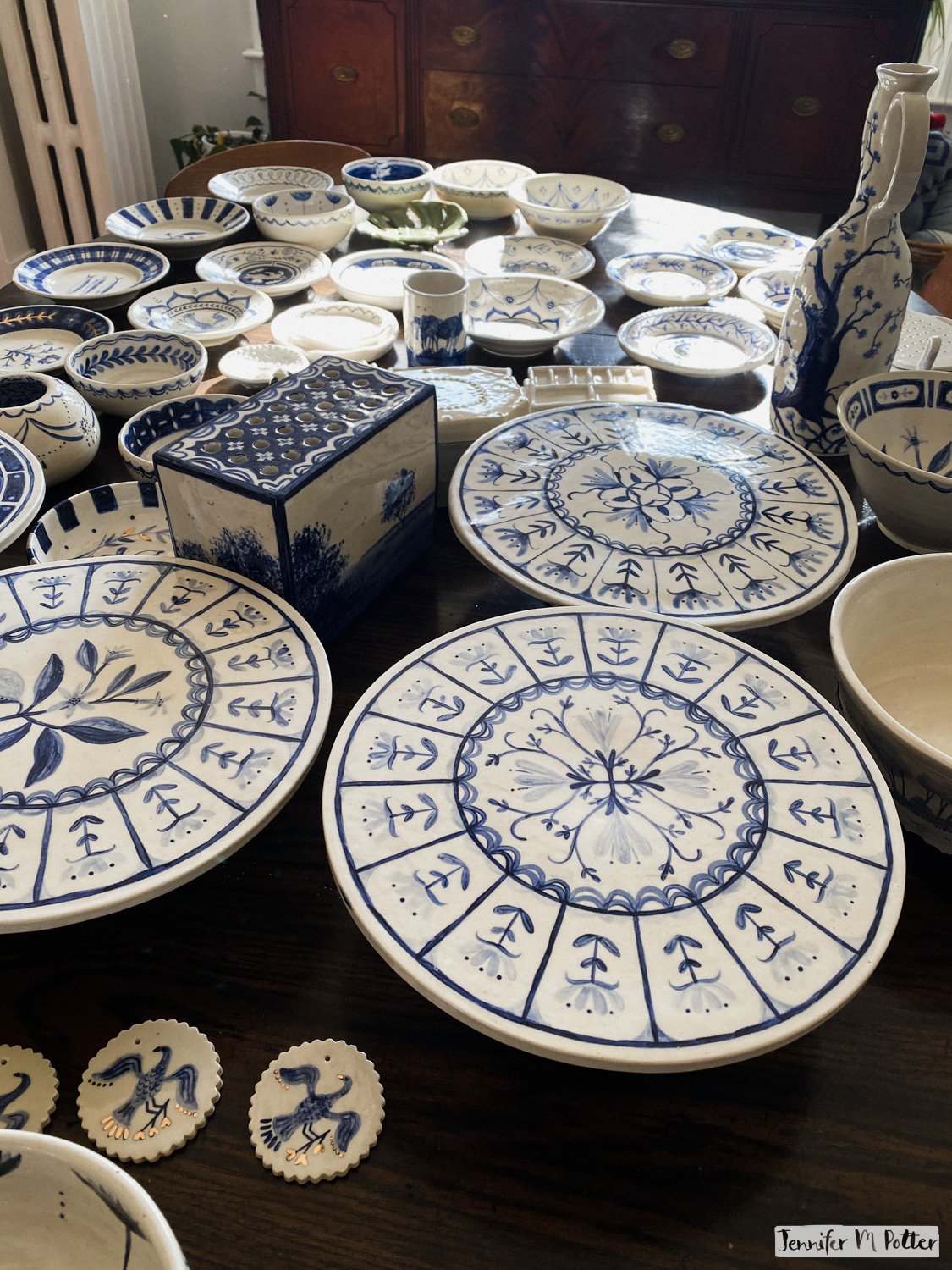
I've been sitting at the dining table with a sheet of price stickers, trying to figure out how to price the ceramics I'm taking to the market this weekend.
It's harder than I thought it would be. I keep starting with time. How long did it take me? Three hours? Five? When I was consulting as a creative director in San Francisco, I got paid $150 an hour. Is that what my time is worth? If so that's $750 on labor alone. But I can't sell a small dish for $750. At the other end, minimum wage would put it at $75—still a lot, and that's without materials. That feels depressing. I don't want to make minimum wage. I have way more specialized knowledge now than I did then.
When someone commissions an illustration, I still think in hourly rates. It's how I know what's fair. But I'm learning that making products is different.
Because I'm two people now. I'm the labor, and I'm the business owner. Worker Jennifer can make $15 an hour. But Entrepreneur Jennifer takes the whole piece—materials and labor—and marks it up to cover overhead and profit. Overhead isn't just clay and glaze. It's market fees, hosting fees, transaction fees, broken pieces, kiln fails, experiments that don't work out, shipping materials, photography, the time spent writing numbers on pricing stickers. If the dish costs $75 in parts and labor, that's just production. Running a business costs more.
Worker Jennifer might get minimum wage right now. But Entrepreneur Jennifer needs to take home a profit on top of that, because maybe someday I'll want to hire help—hopefully for more than minimum wage—and still be able to do things like go out to eat on occasion and buy Christmas presents.
Hiring help! I haven’t done a single market yet and already I’m getting ahead of myself.
I'm a complete noob at this. My business has always been commission-focused, so I've never managed sales and inventory. Many illustrators deal with products and overhead—prints, notebooks, cards, pins. You spend ten hours on an illustration and make infinite prints from it. But you spend ten hours on a pot and you've got…one pot.
But I'm getting more comfortable with it. With the idea that pricing isn't about what I used to make or what feels fair compared to my old life. It's about what it costs to make this thing and run this business and still have something left over.
The market is Saturday. I'll let you know how it goes.