Posts in Ceramics
Underglaze vs. Watercolor

I usually only fire my work twice. A first bisque fire to bake the clay enough to glaze, then a final fire to melt the glaze into solid, shiny glass. But when a piece involves detailed painting, I fire it three times.

I rarely do this. An extra bisque uses extra electricity. Sometimes I even paint straight on greenware—unfired clay. But these pieces took so long—a second bisque sets the underglaze so I can apply glaze without risk of smudging. I’ve done this before. A finger brushed against underglaze that was once dry but was dampened by wet glaze. So frustrating!

A second fire also gives me a chance to correct mistakes. Like if the burgundy comes out too streaky, the way it did in my test tile, I can touch it up before sealing it forever under glaze.

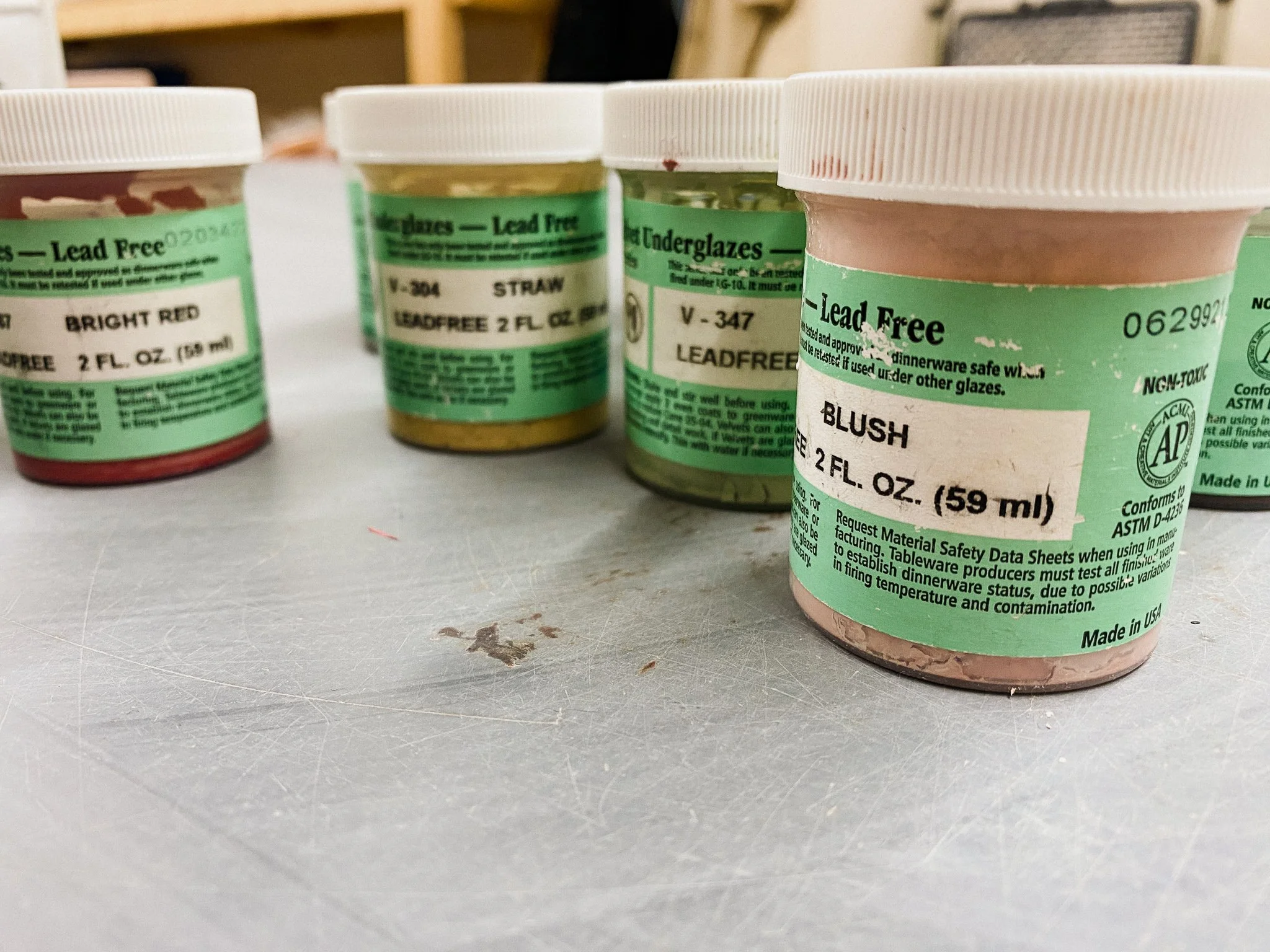
Small jars of Amaco Velvet Underglaze

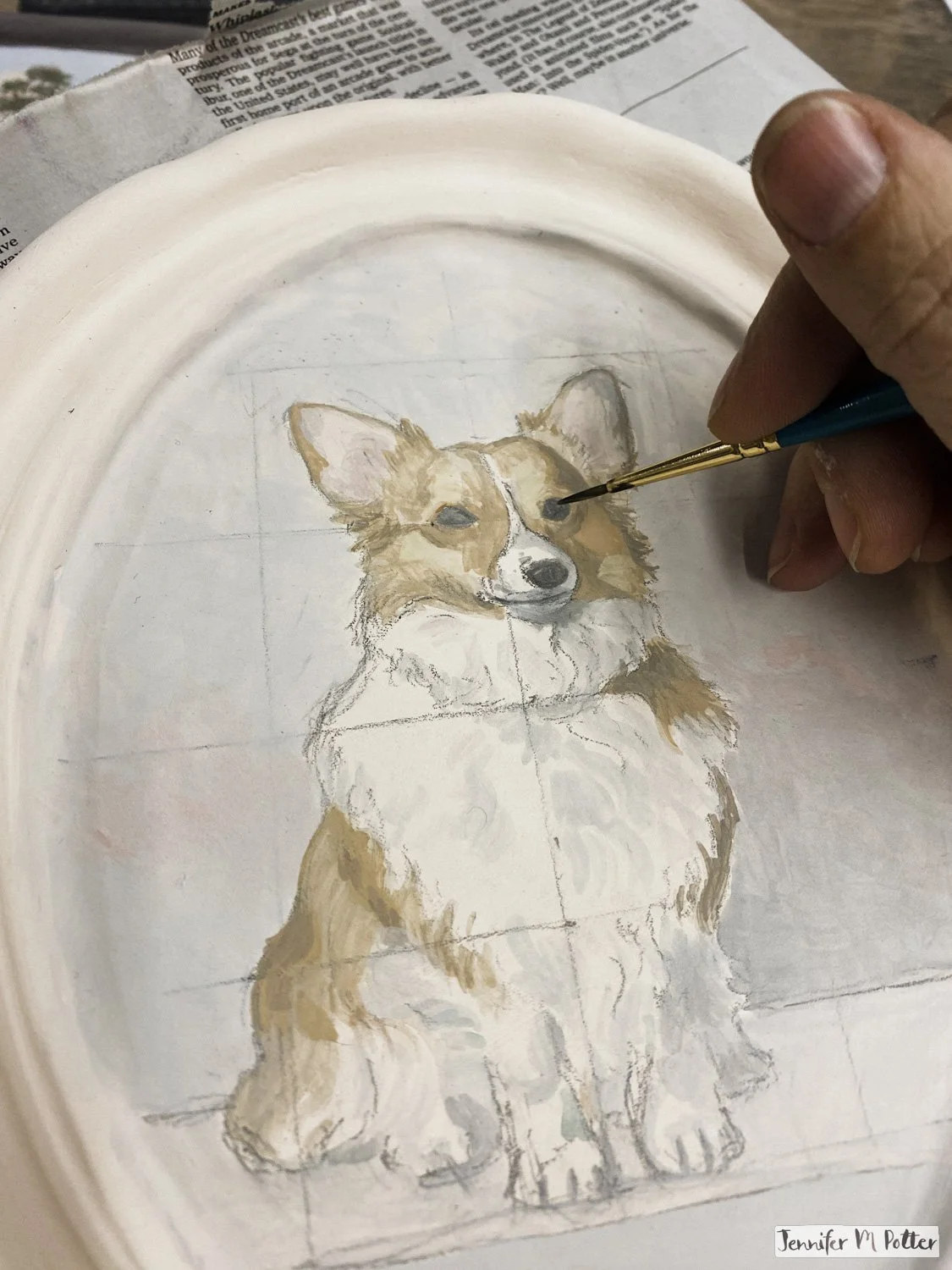
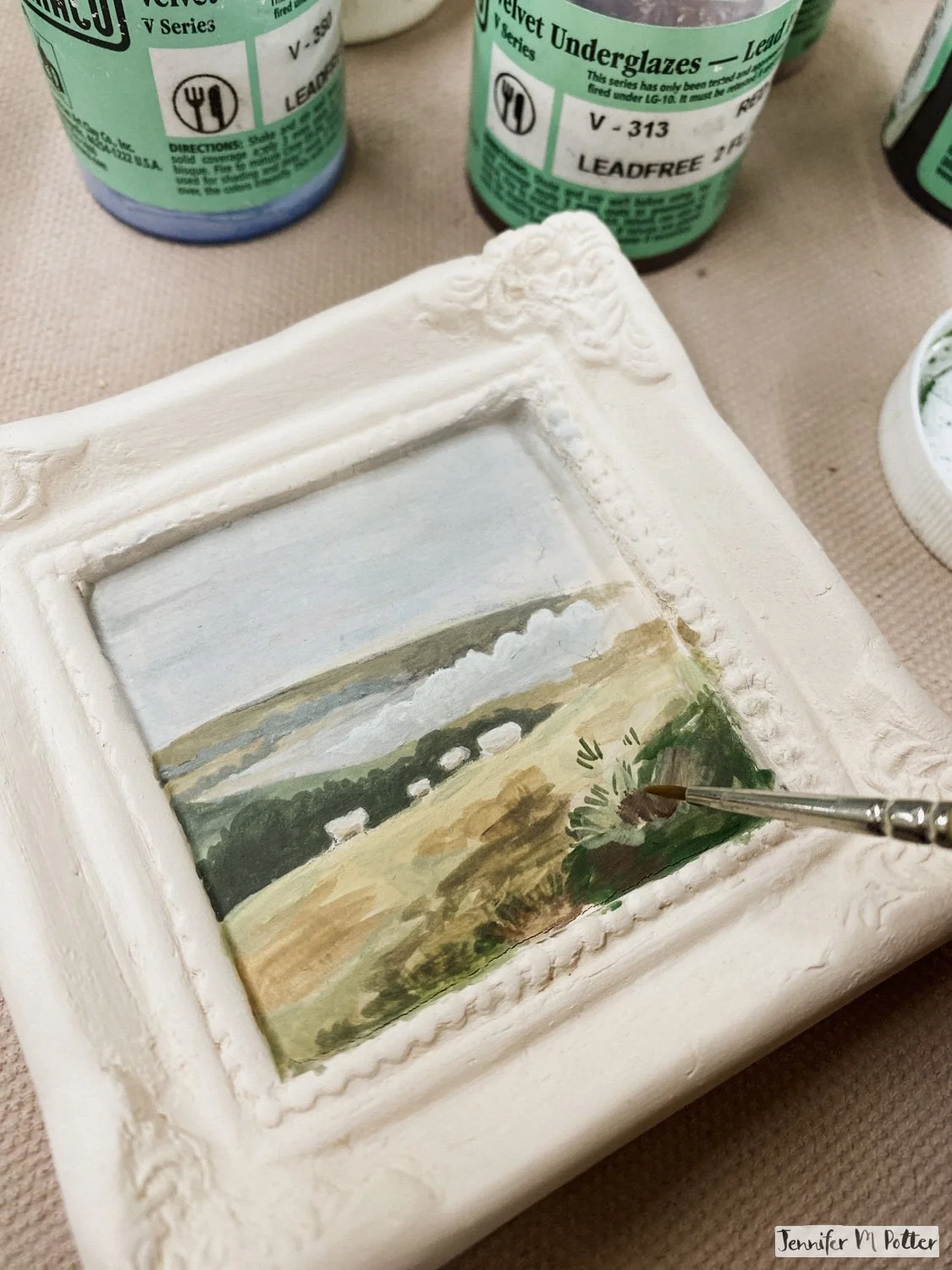
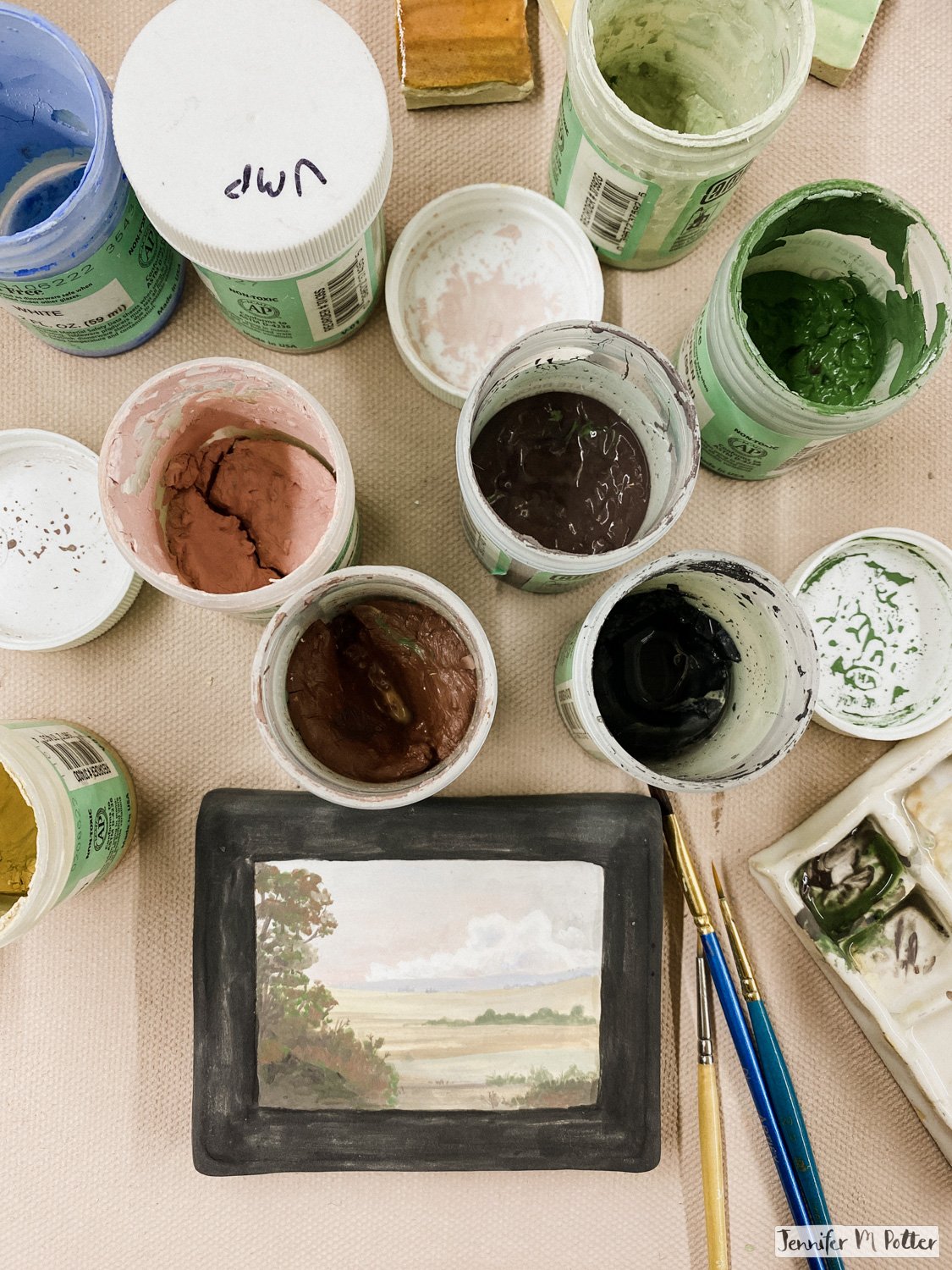
Underglaze is strange. It's like watercolor but also not at all like watercolor. They share the same binder—gum arabic—so you can thin them and mix them the same way. You have to work quickly. Bisqueware absorbs water even faster than cotton rag, each brushstroke disappearing into the clay almost immediately. Wet on wet is next to impossible. And you layer colors the same way, light to dark. You can overpaint light on dark, but when it fires, the dark underpainting bleeds through no matter how many layers you put down. Because the particles move and bleed into the glaze during heating. Because science.

I boldly did a red imprimatura on one of my first ceramic frames, thinking it might show through a little. Oh no. It was a red mess with translucent scenery floating over it. You can see it in the photo below. I eventually put a gold luster rabbit on it and gave it to a friend. Lesson learned.

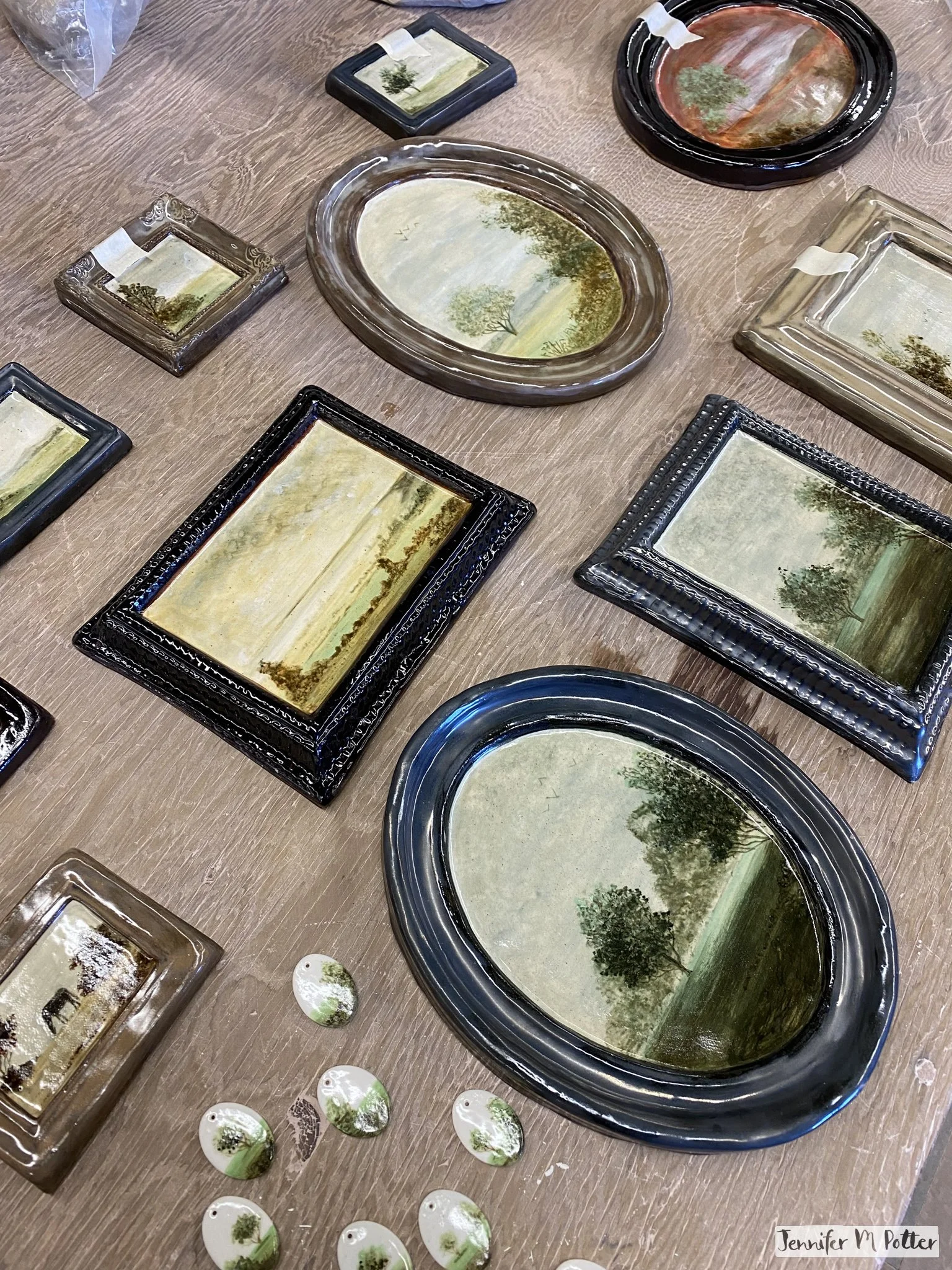
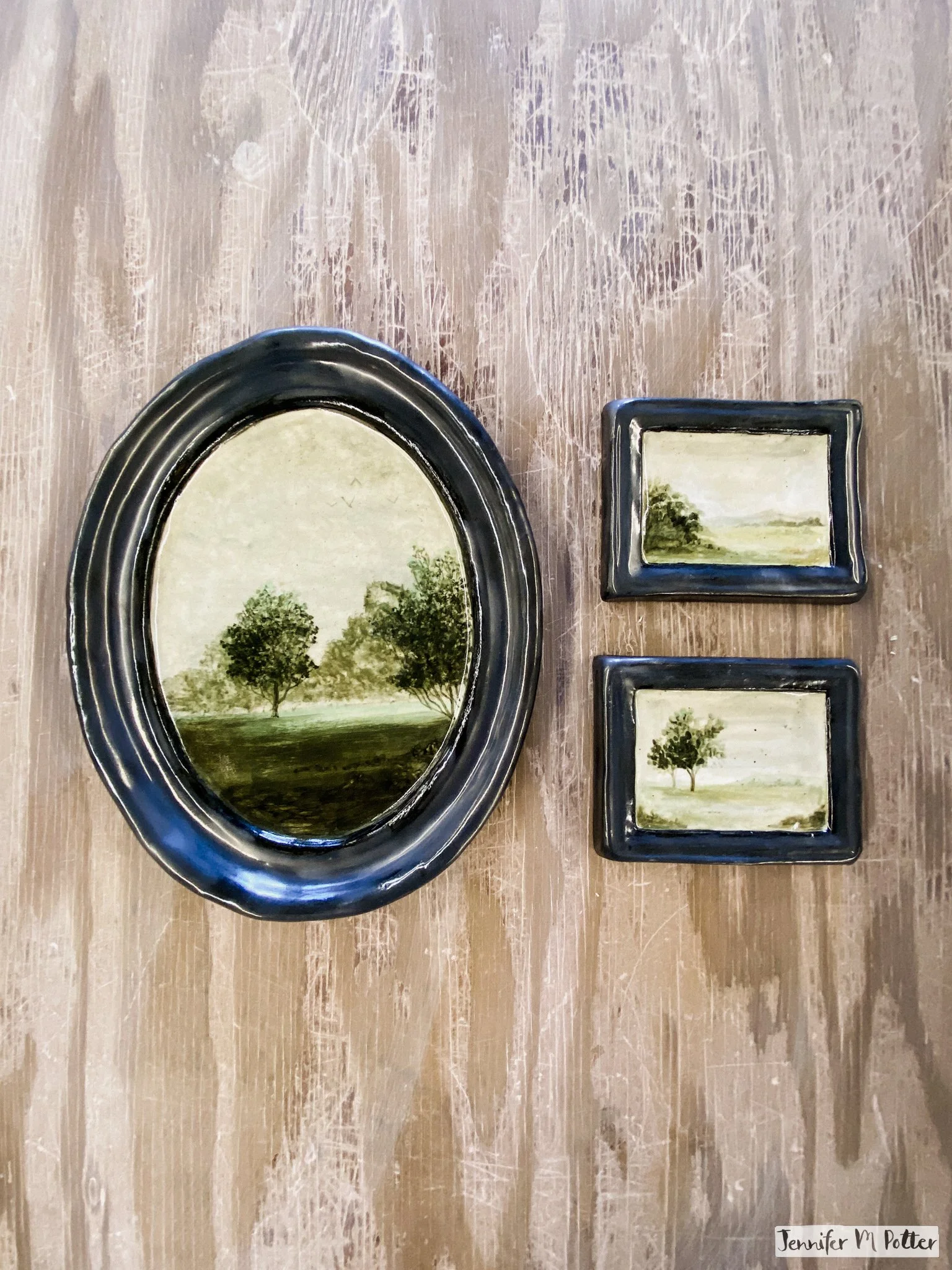
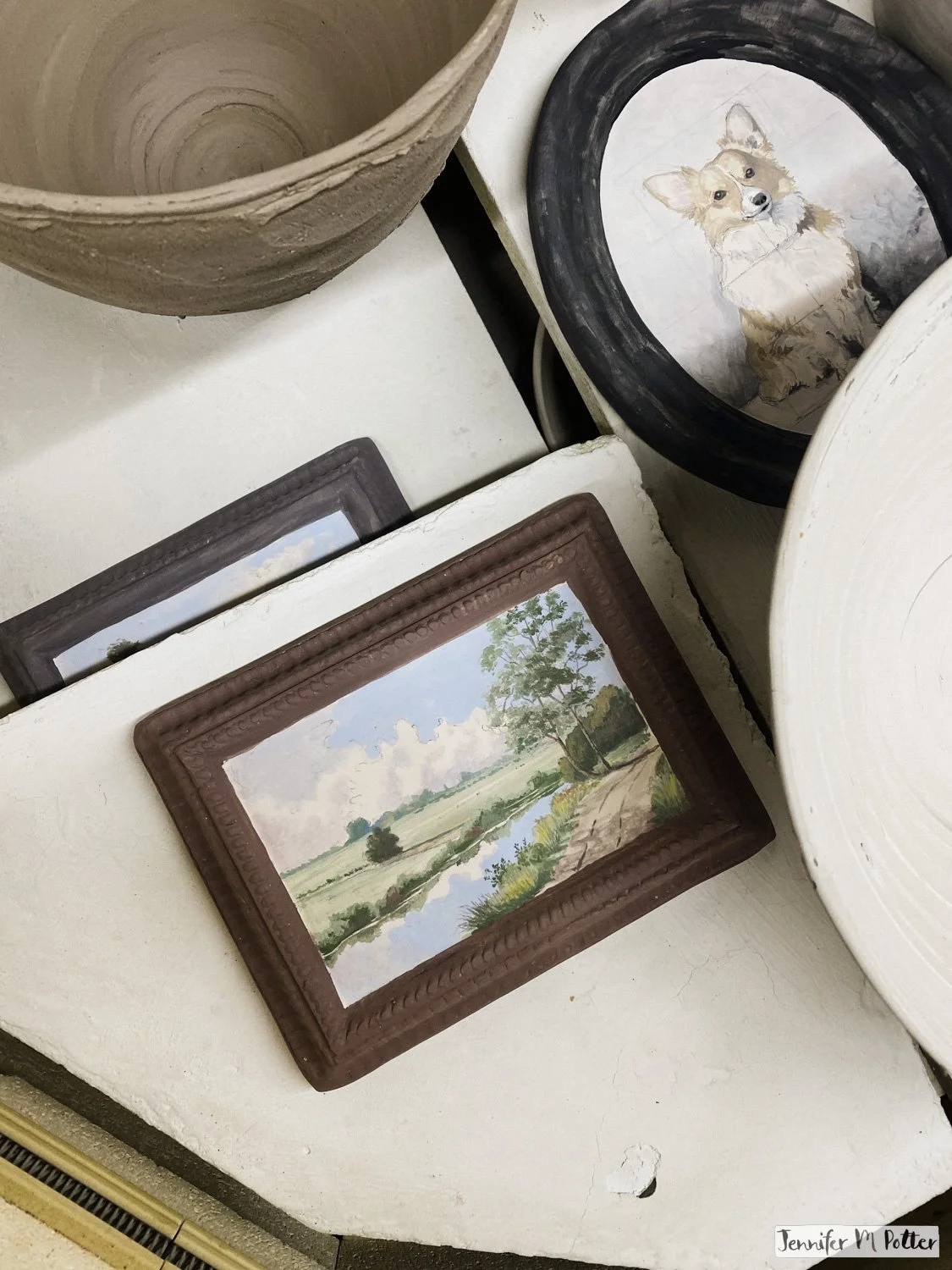
Glazed and fired ceramic paintings laid out on a work table. One painting is messier and very red compared to the others.

I use high-quality brushes for watercolor—brushes that hold water for long fluid strokes, brushes that keep a fine point. For underglaze I aim for the same, but the clay absorbs water so quickly there's no such thing as a long fluid stroke. And high-quality brushes are useless since the clay particles in the underglaze get trapped in the bristles and sabotage the fine point pretty quickly. I reach for smaller and smaller brushes so that even when they're splayed from clay, they're not too wide.
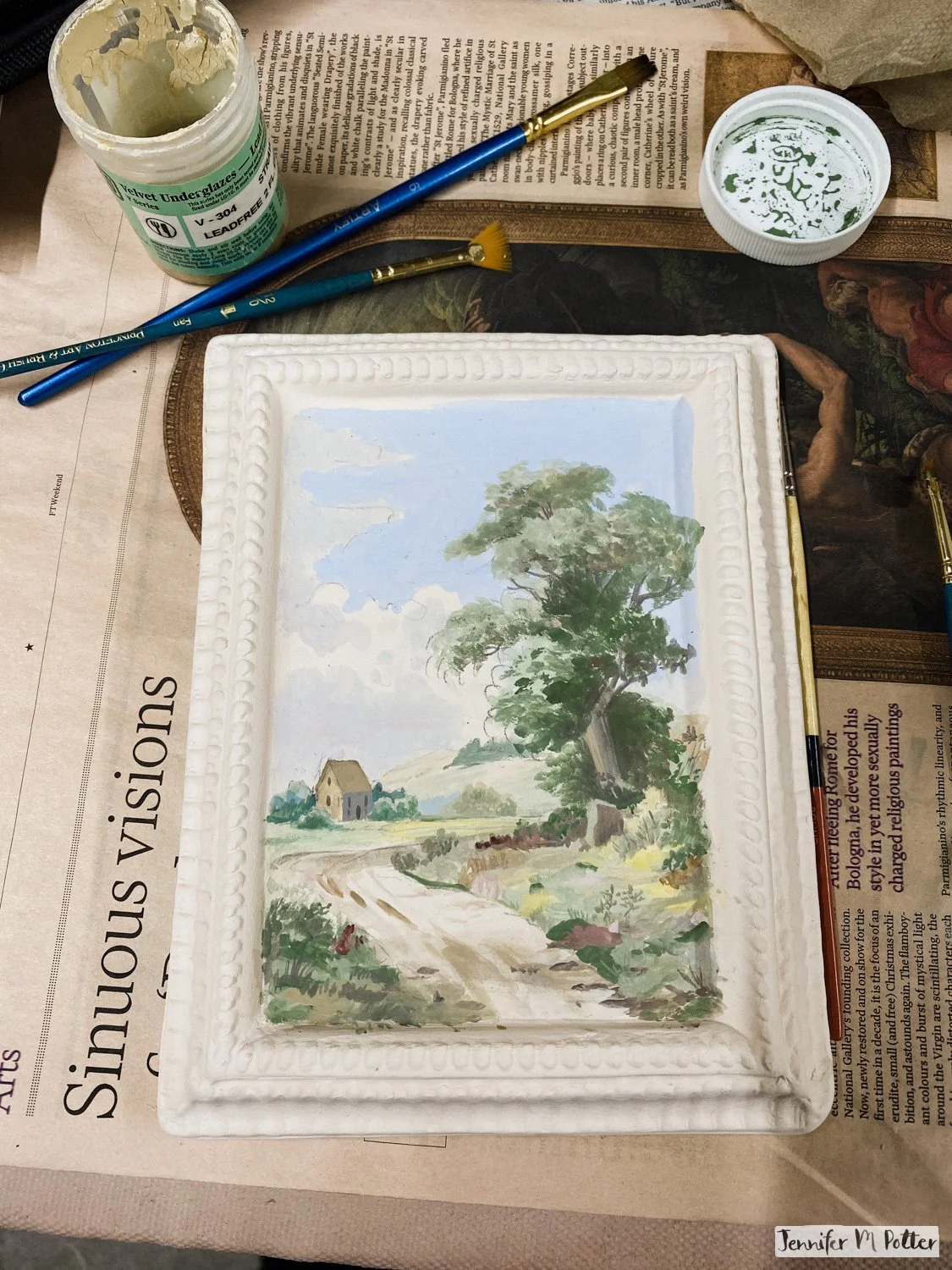
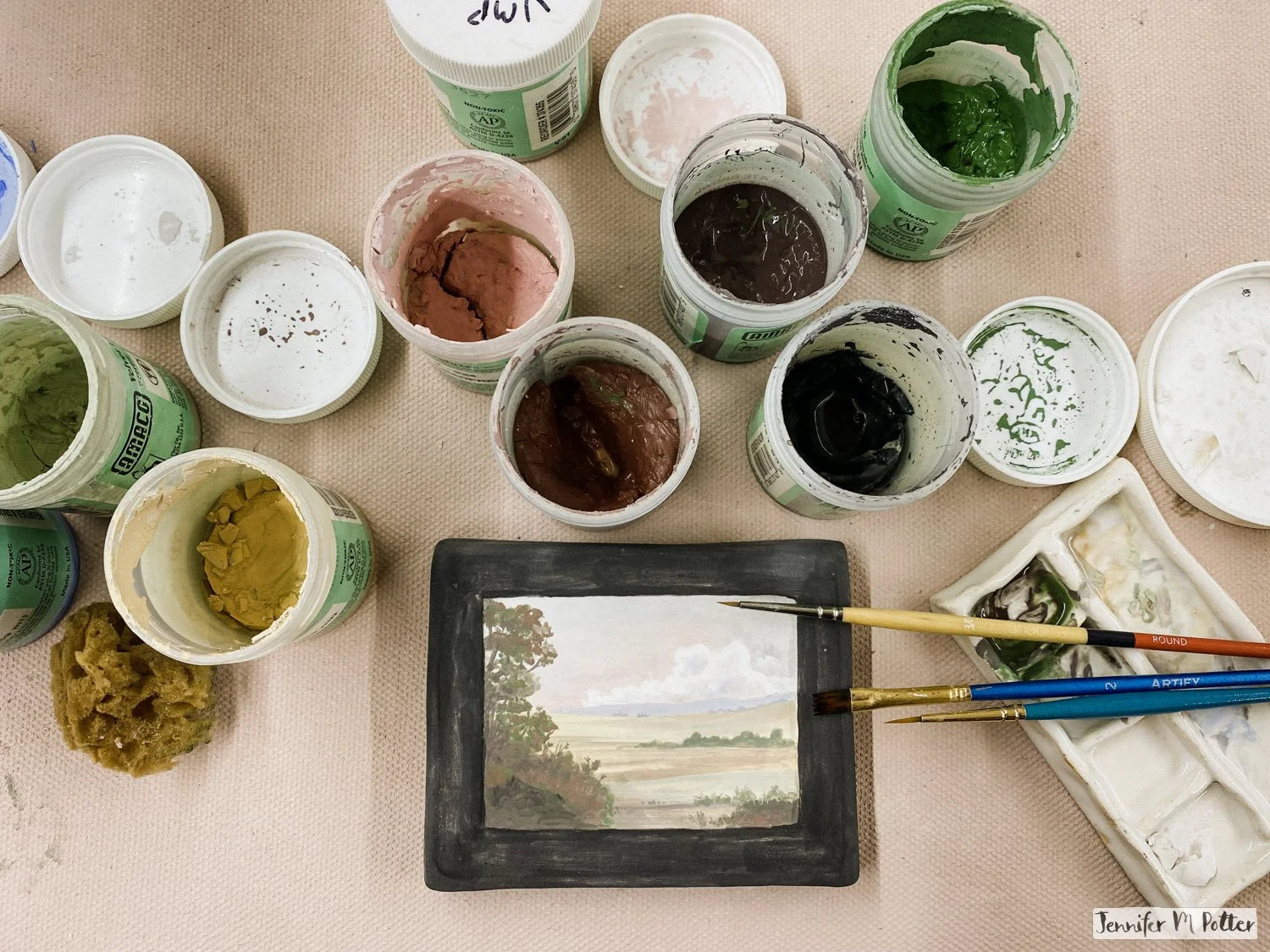
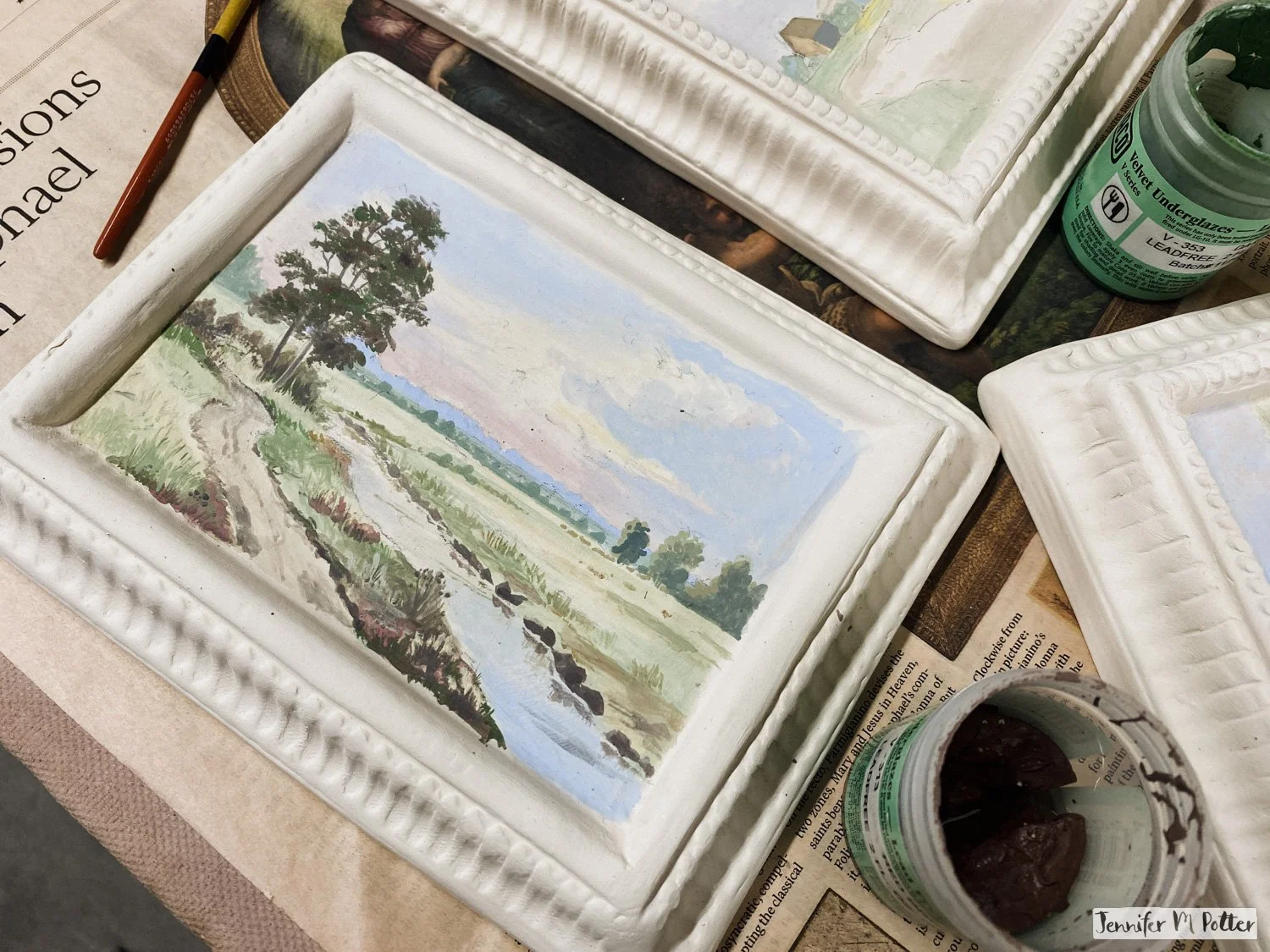
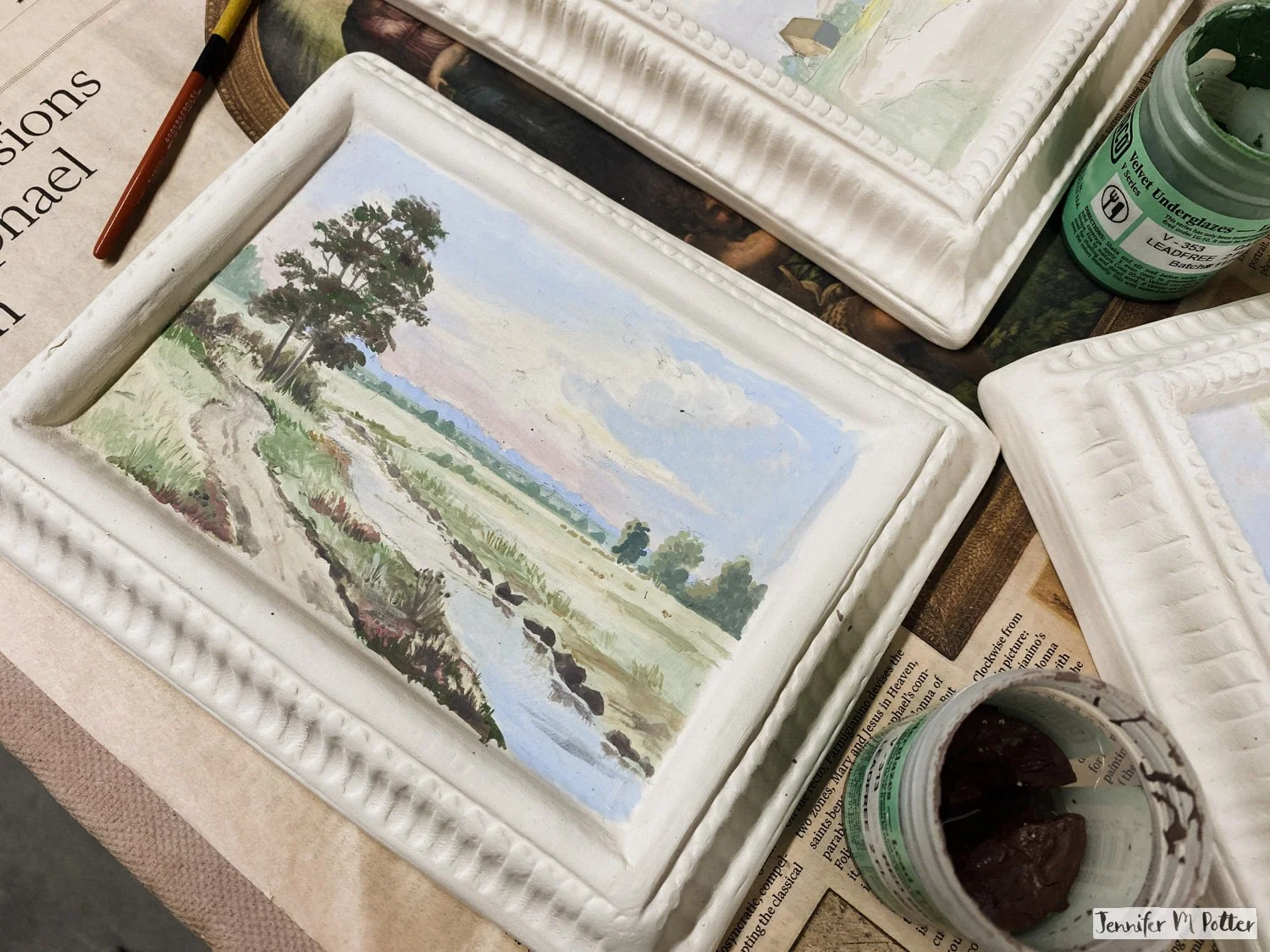
A small unfired landscape painting in underglaze on a bisque framed canvas. It is surrounded by small jars of underglaze, paintbrushes and a small hand-build watercolor palette.

The biggest difference is how colors change during firing. With watercolor, what you see is what you get. With underglaze, the end result will be much darker. Or sometimes lighter. Sometimes it barely shows up at all. Your carefully planned color theory can fly out the window as soon as the kiln shuts. Science again.

Several landscape paintings on unfired bisqueware.
A few simple glazed and fired ceramic landscape paintings.

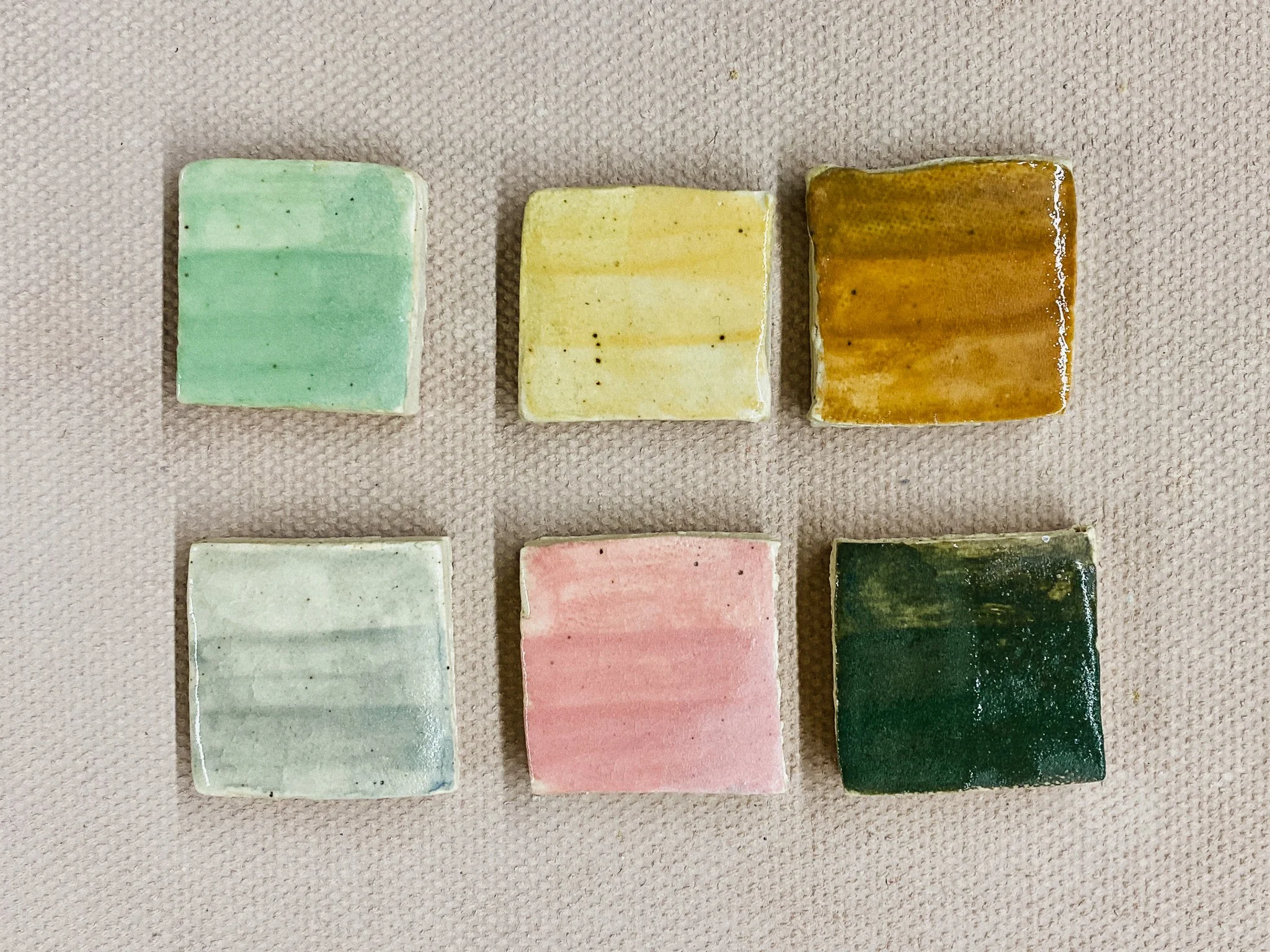
I made test tiles. Little pieces of Standard 182 clay with one, two, and three coats of each color. I keep them on my table when I paint, a tiny taste of before and after. It gives me an idea of what to expect, which colors will be reasonably accurate and which will need more care.

Six colorful test tiles in pistachio, straw, light brown, pearl gray, blush, and dark green

We'll see.

Ceramic Paintings

I got into ceramics because I wanted to draw on three-dimensional forms, to make hopefully-beautiful sculptural things for my home. So much of what I do is for other people—commissions for books, cards, gifts, the occasional magazine. These are for me.

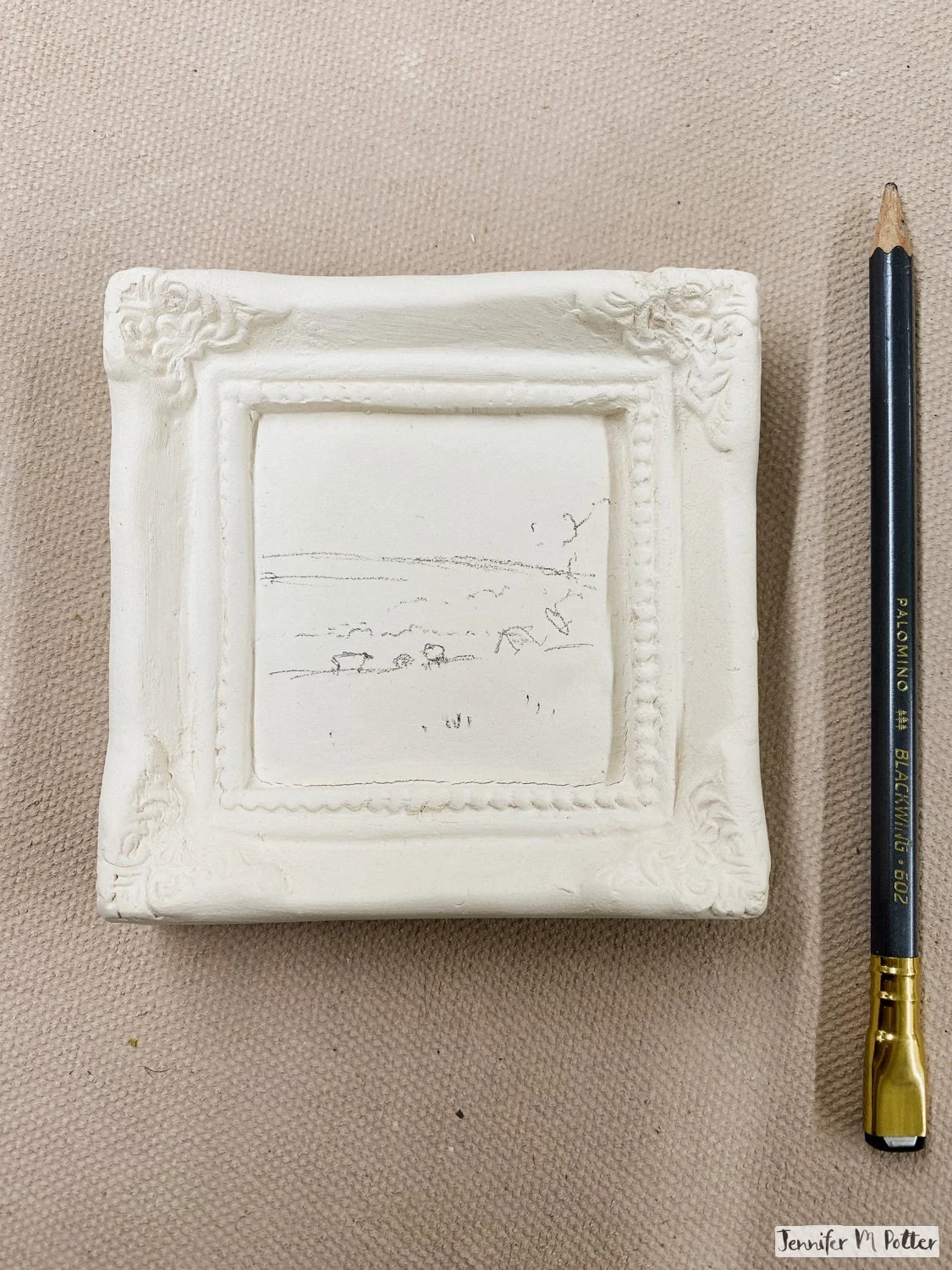
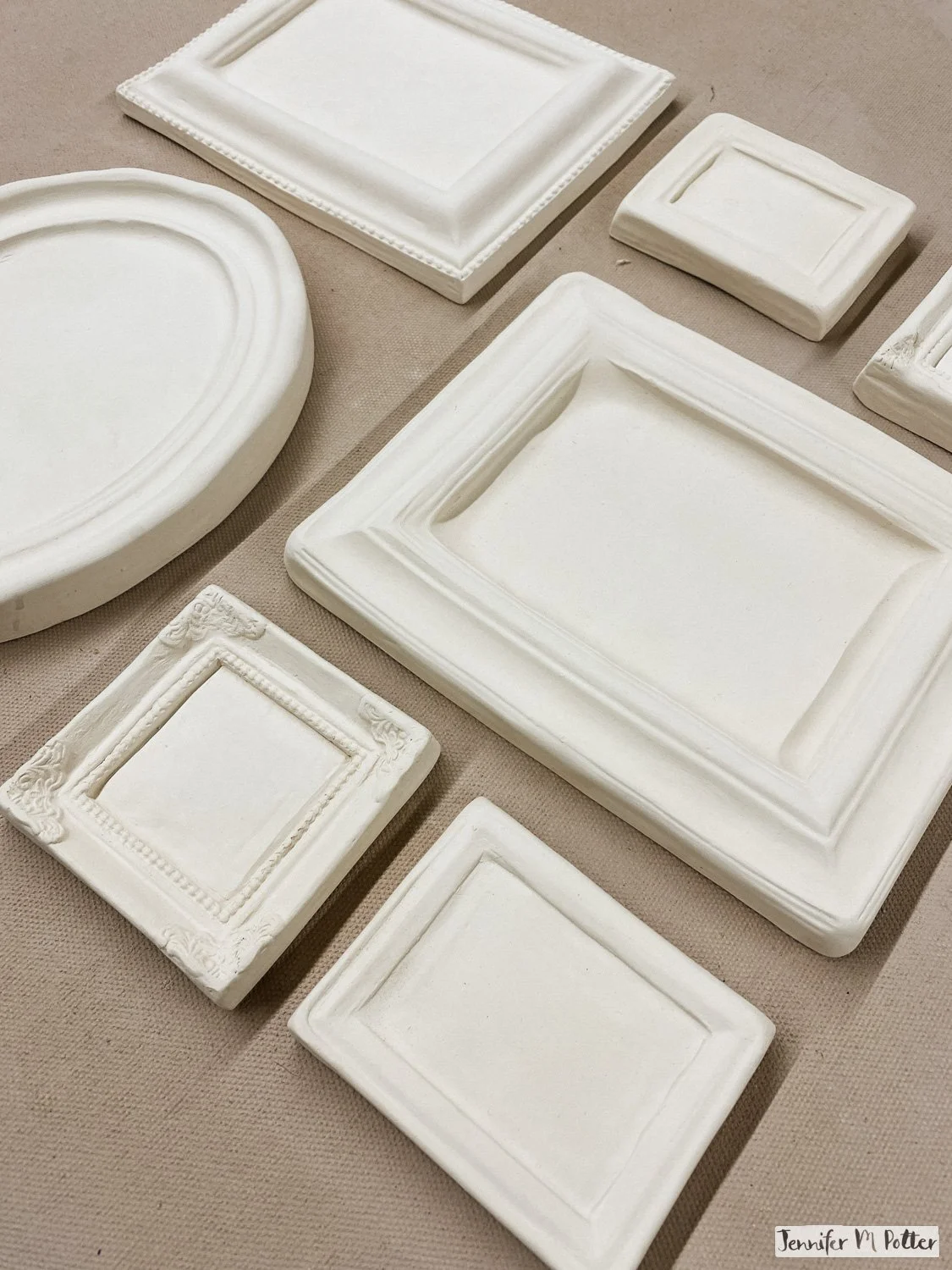
Blank white ceramic framed painting that have been bisque-fired and are ready for paint.

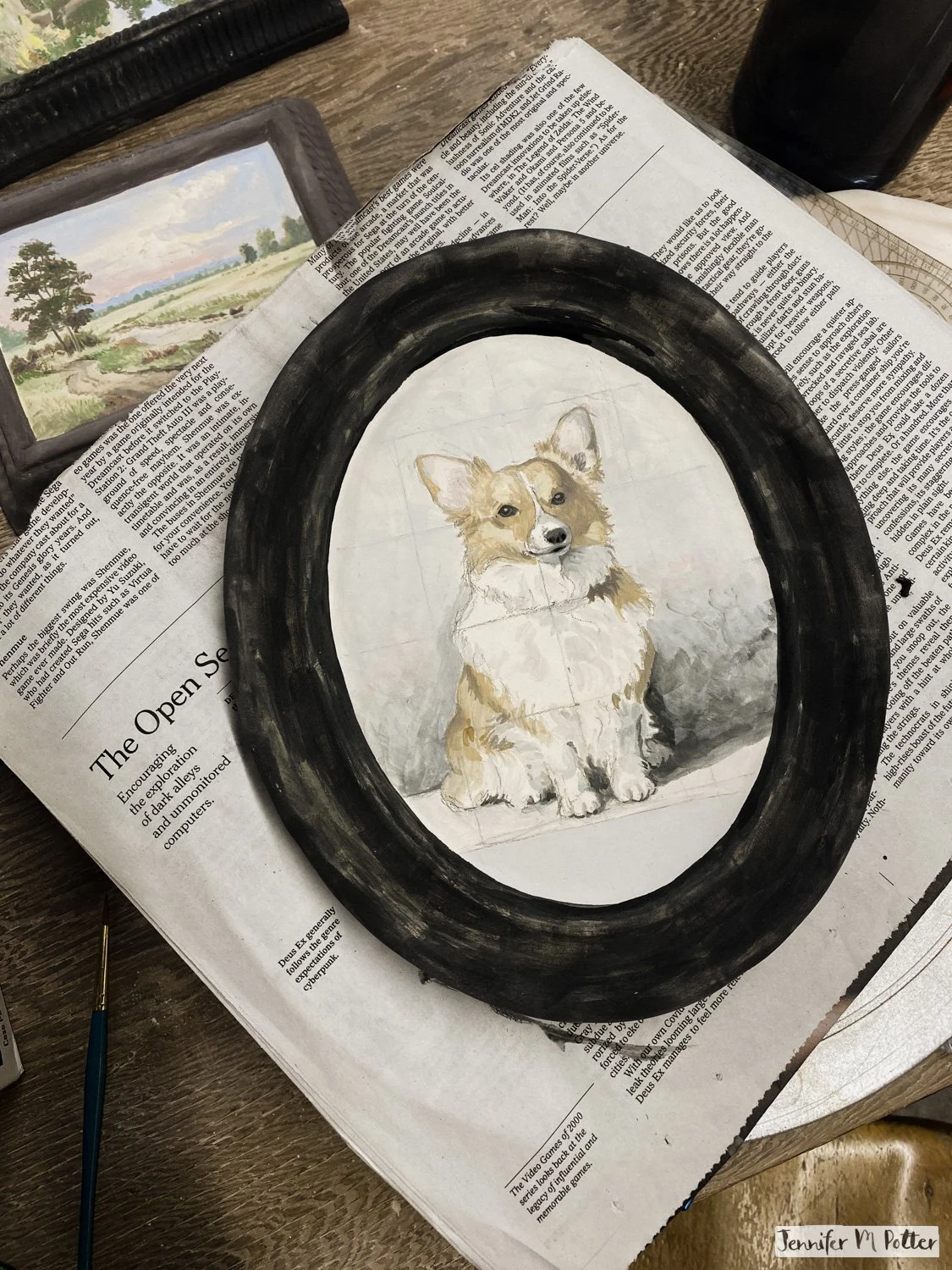
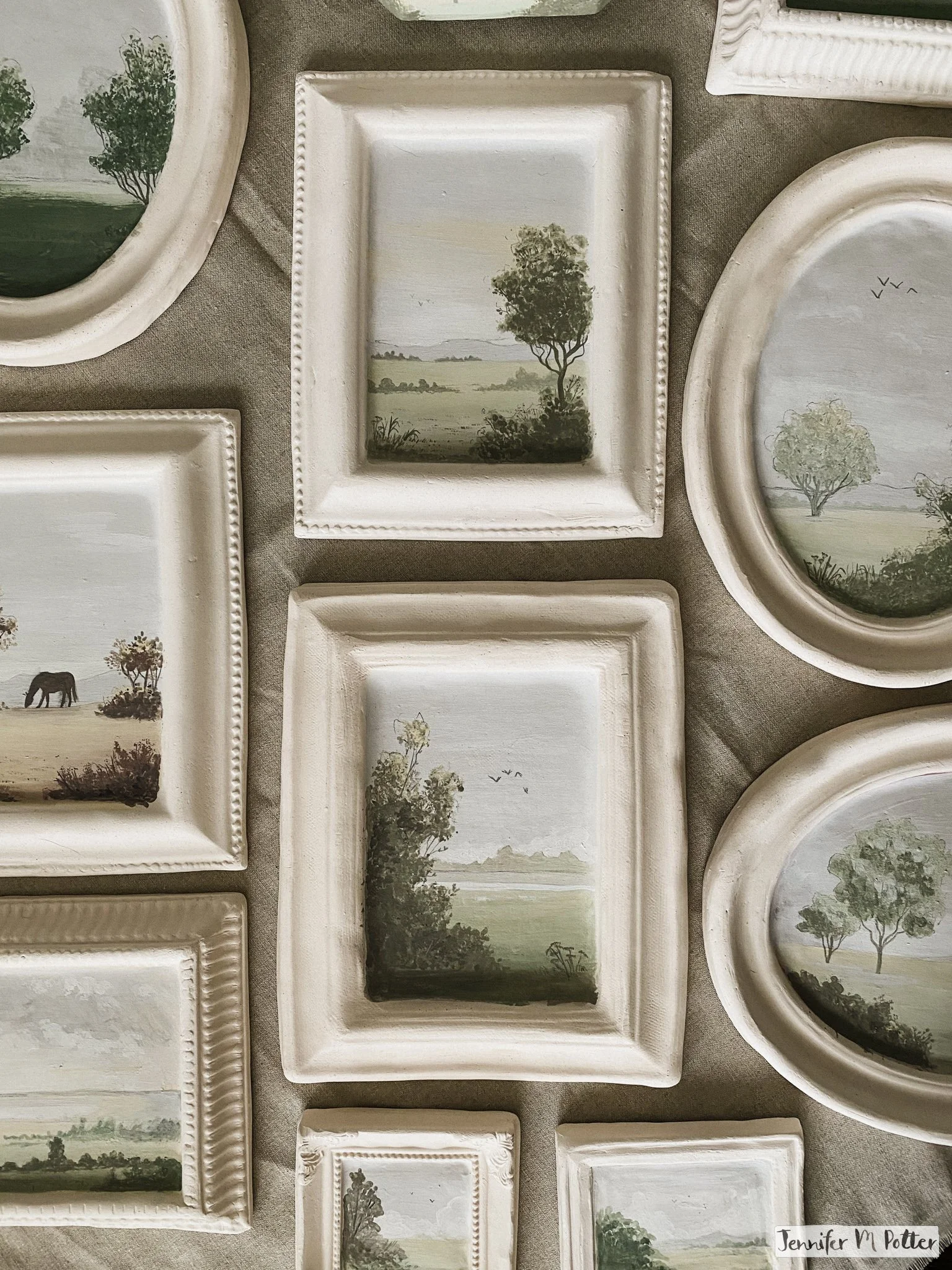
Which makes it strange that the project I'm most drawn to is a series of ceramic framed paintings. I take the time to mold three-dimensional canvases just so I can paint on them in two dimensions anyway. But also not strange at all. Few things move me more than an old framed canvas.

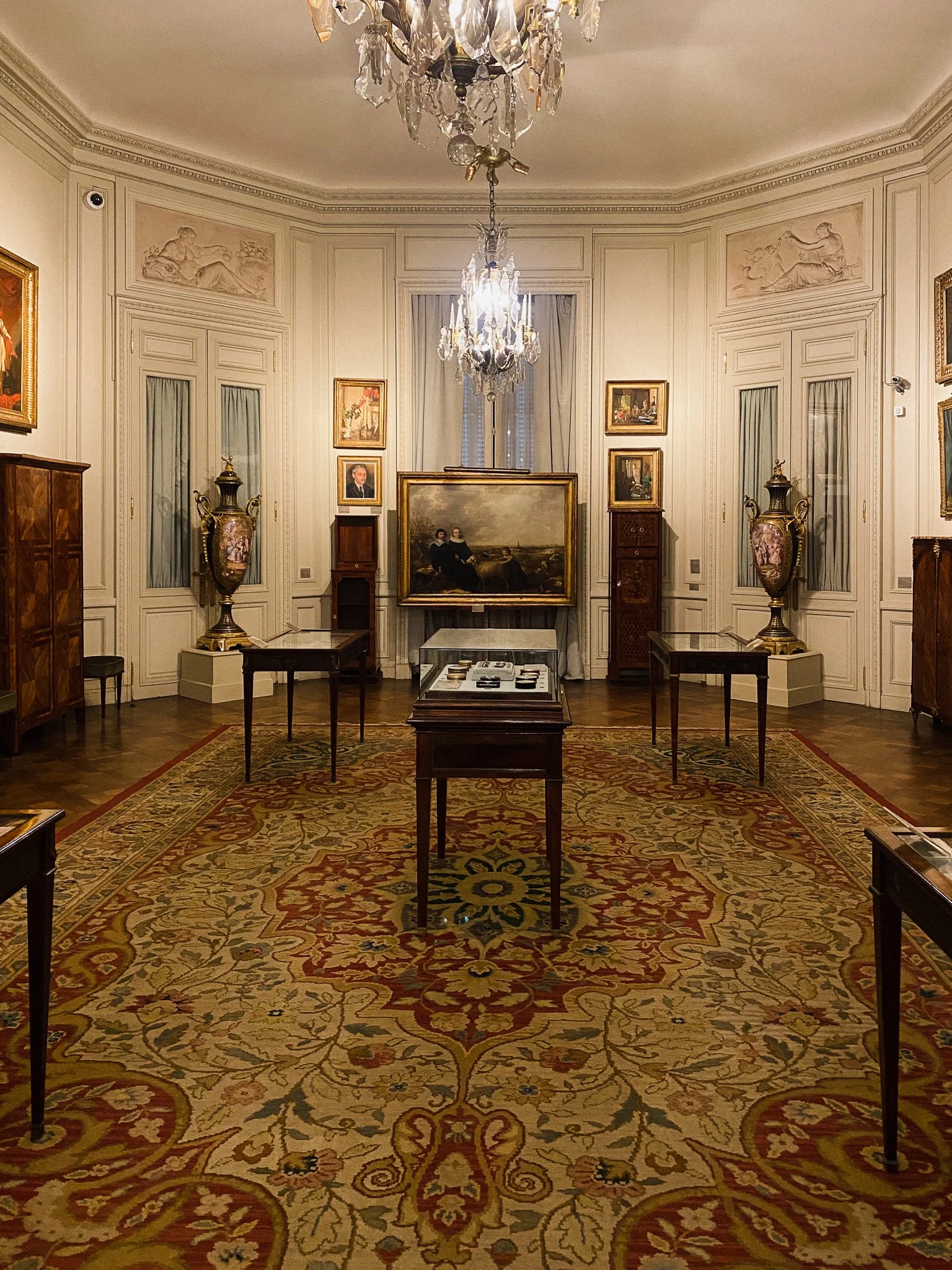
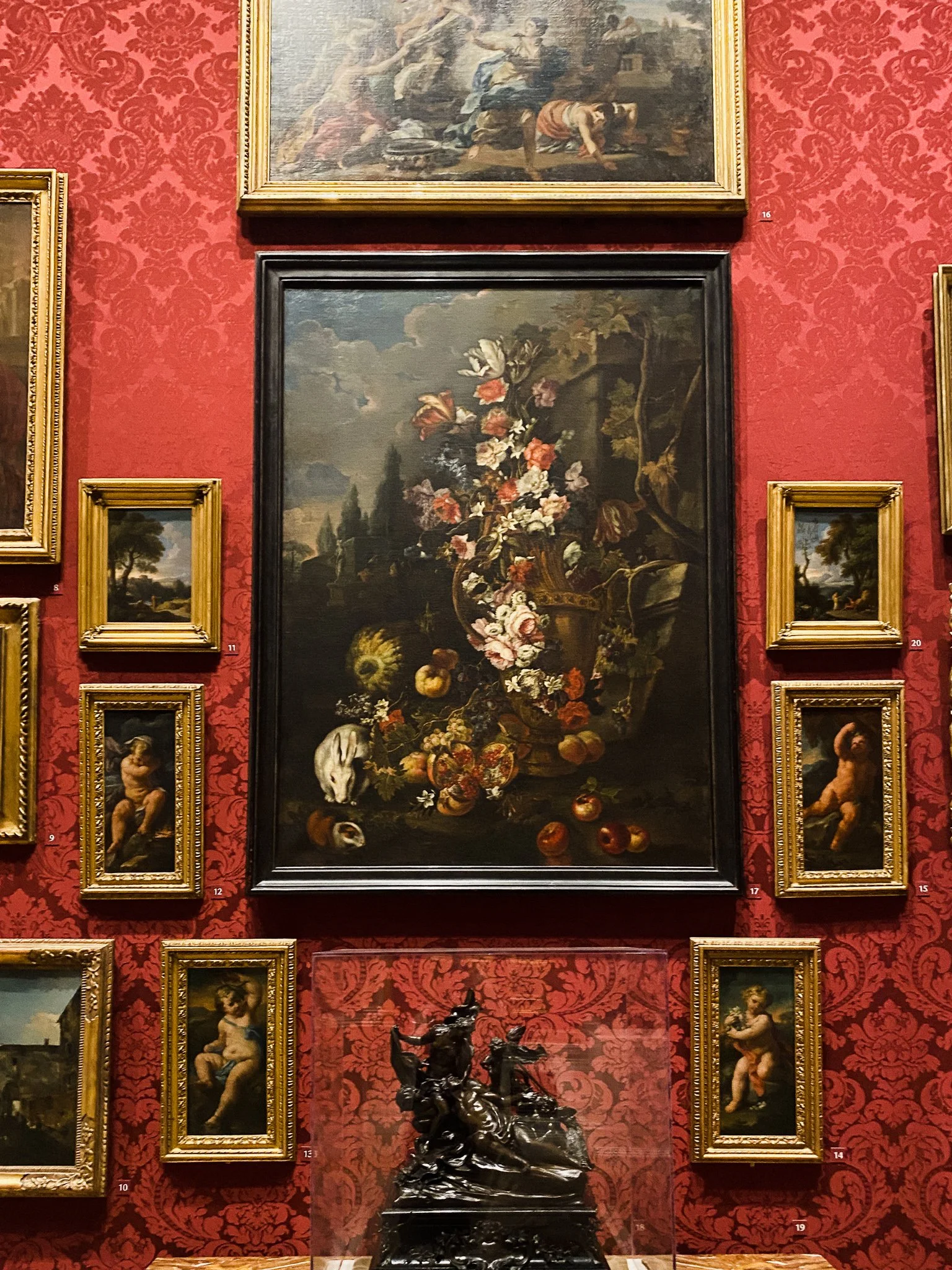
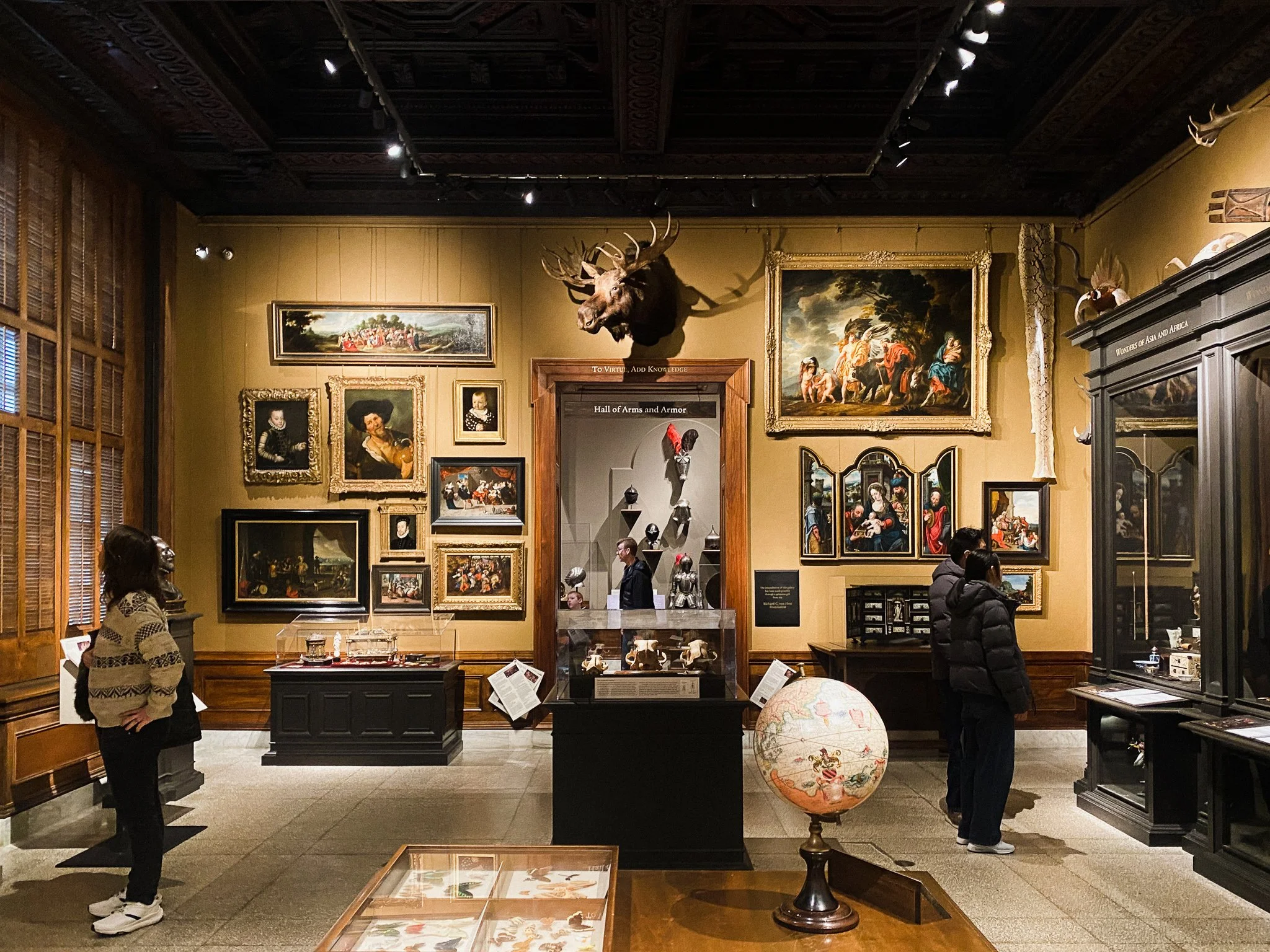
A gallery room filled with paintings and objects from the natural world at the Walters Museum in Baltimore.

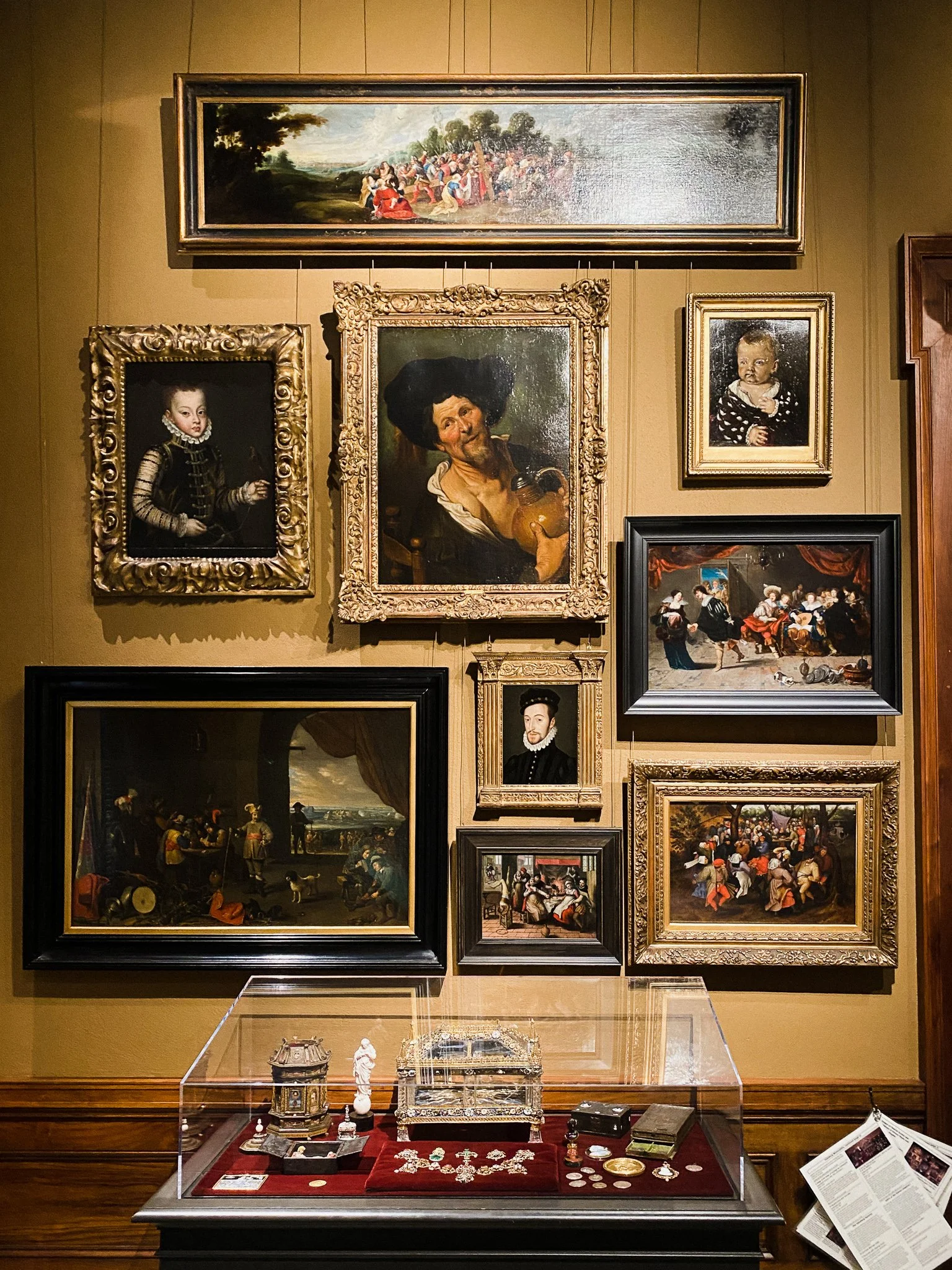
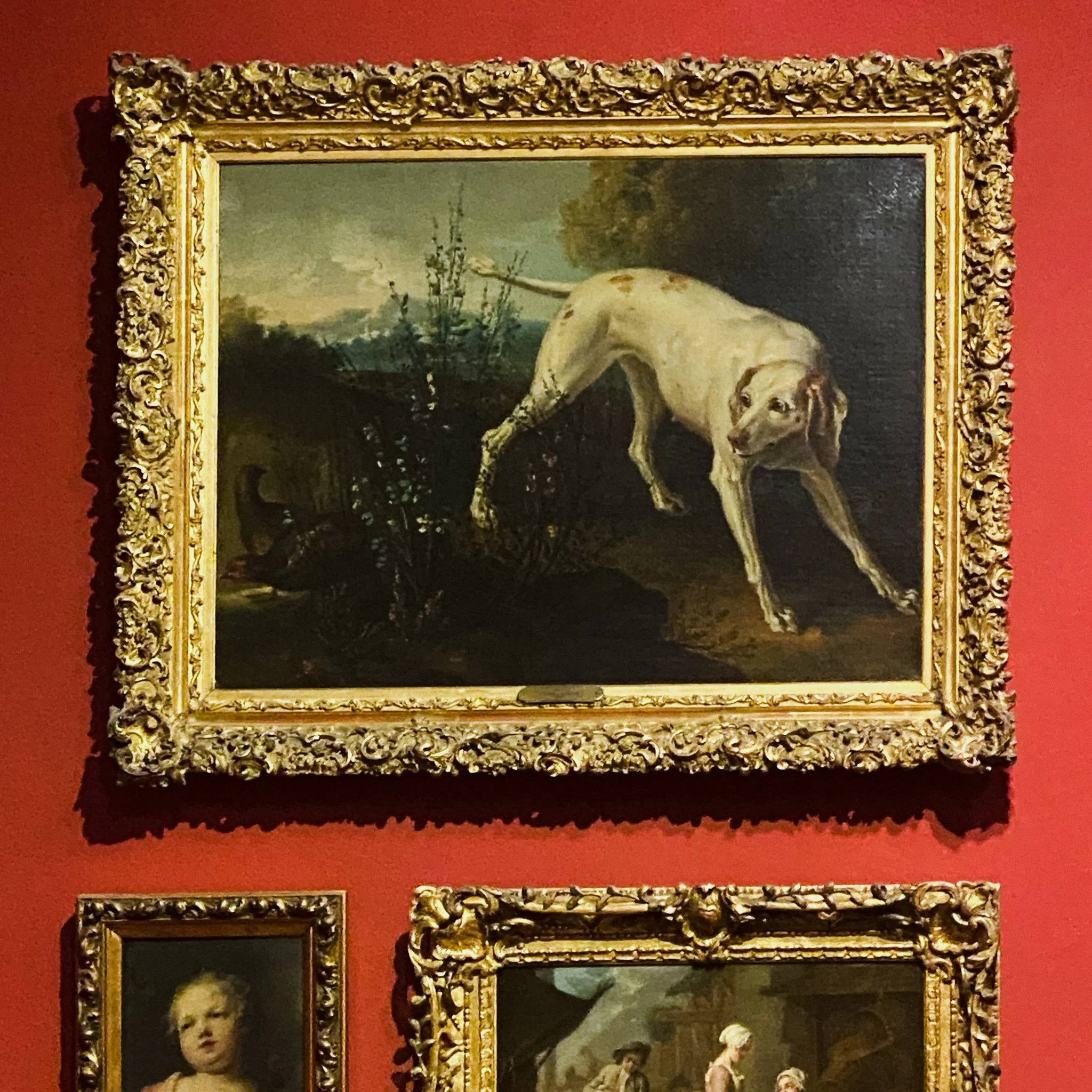
I love old paintings. The feeling of standing in a museum, surrounded by exquisite art hung salon-style on jewel-toned walls. The Walters in Baltimore does this—grand rooms where paintings and curios are displayed the way they might have been in their time. Light peeking in from tall, shuttered windows. The cabinetry. The quiet. The sense of stepping into a world gone by.

Painting a detailed landscape on the bisque canvases.

These tiny ceramic paintings are an homage to that.

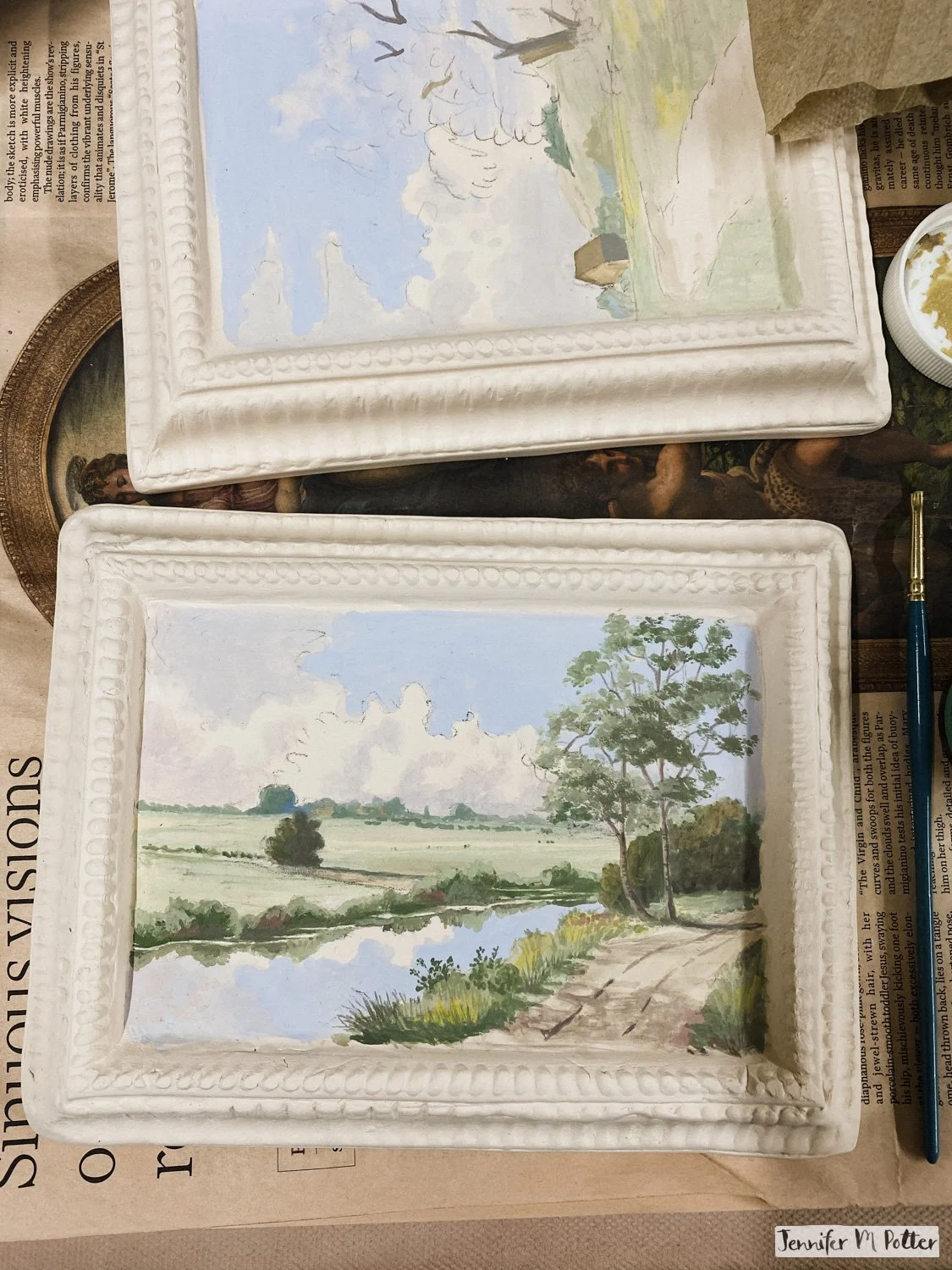
Two underglaze landscape paintings in progress

The latest set is in the kiln now, getting a second bisque fire. I'm hoping the colors warm up without getting muddy—sometimes brown pigment takes over during firing, swallowing the greens and blues I mixed so carefully. I’ll share them when they’re done and we can compare together. I'm hoping the details hold.

Layers of pottery, including a few ceramic framed paintings, in the kiln
Day Before, Day Of

I did it. I tabled at my first market.

A friend asked me how I'd measure success at the market. I had a number in my head—$1,000 would feel like success, though I had no idea if that was realistic. “In this economy?”

So I started thinking about how I wanted to feel instead. I wanted to feel good about selling things. To be motivated to keep going. Feels more important than any metric.

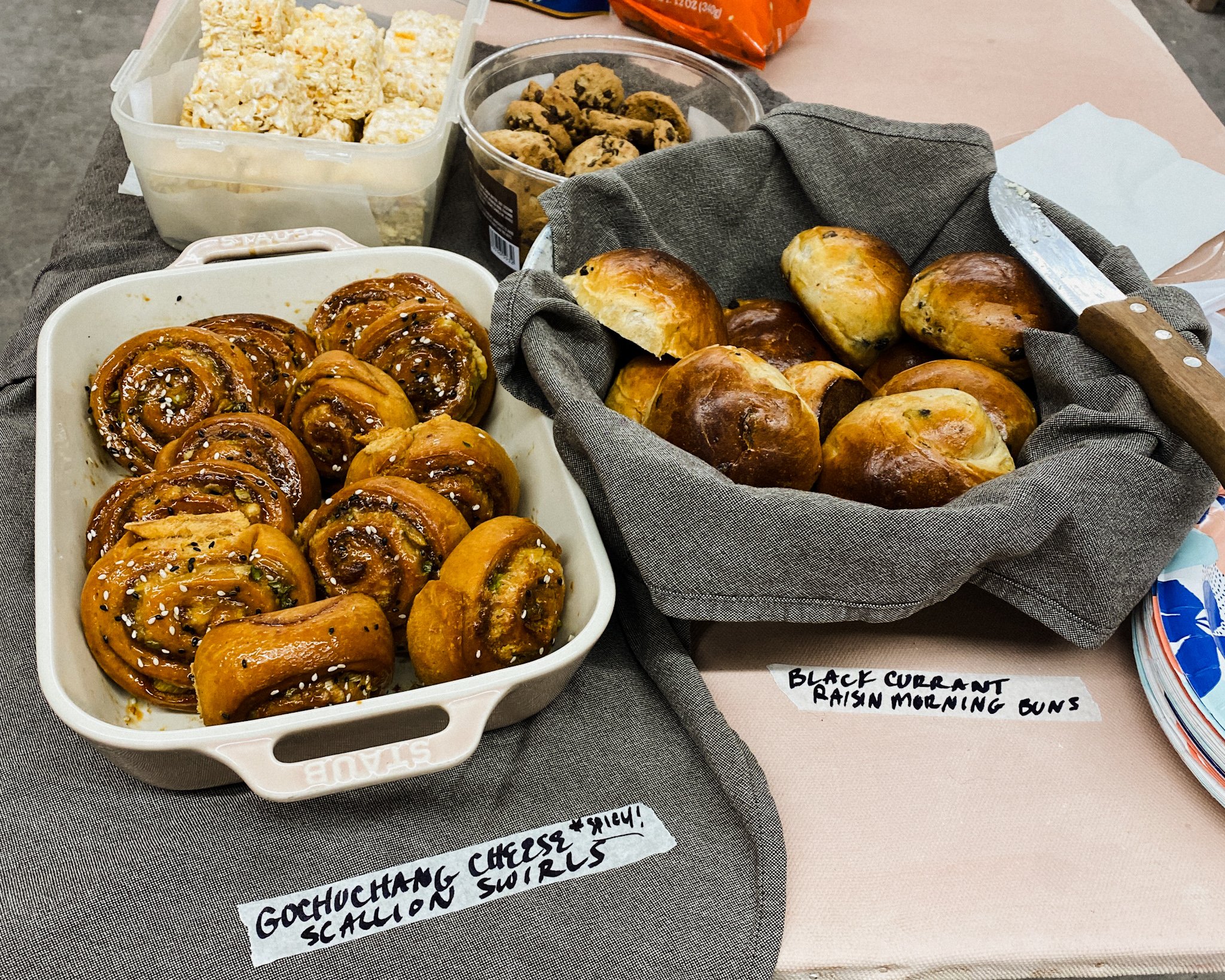
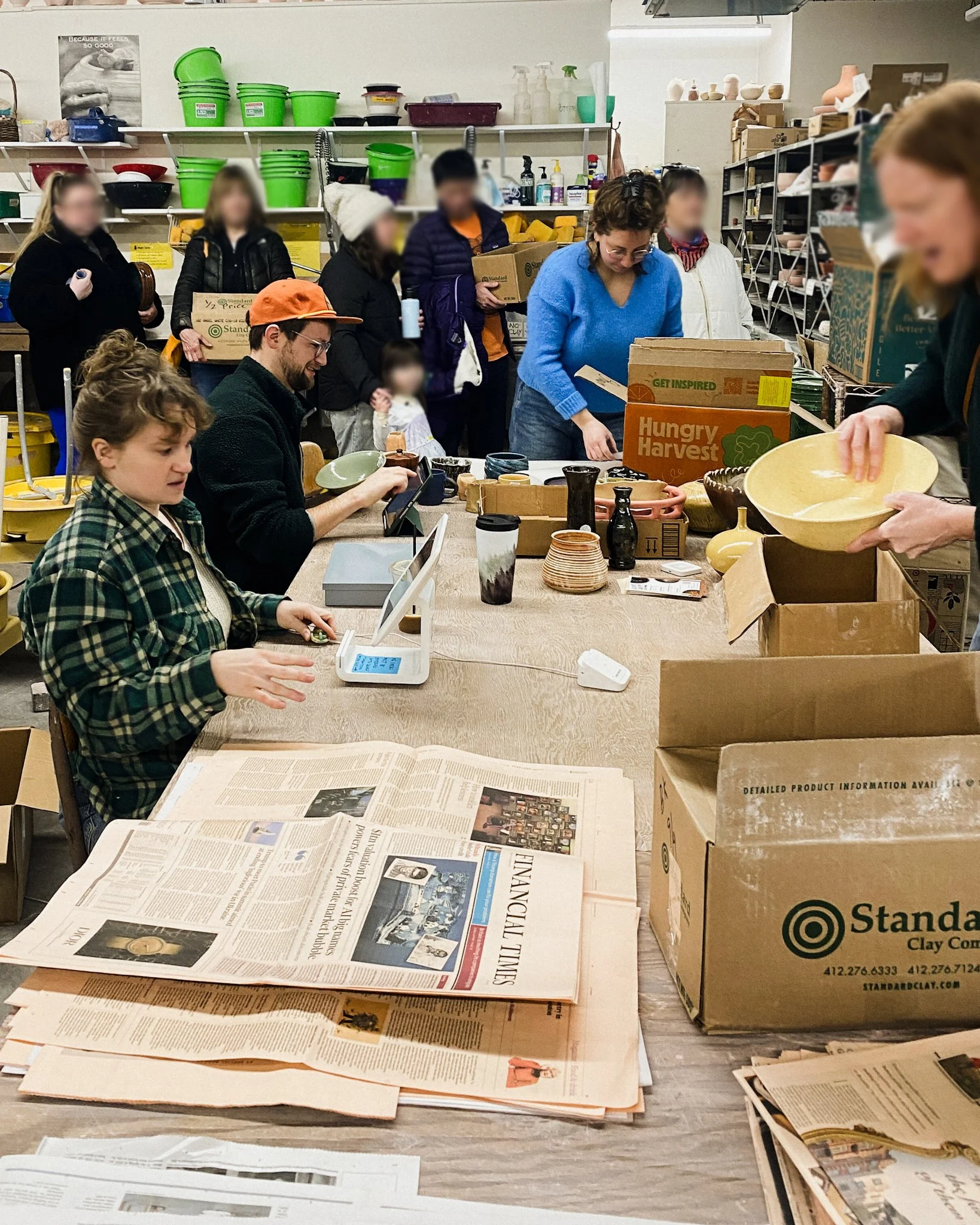
The day before, I was at the Potters Guild helping set up. We lifted pottery wheels onto rolling platforms and wheeled them into the clay alley. Mopped the floors. Drank wine, and snacked on cheddar and chocolate babka. Robin brought challah bread from Motzi. Freshly made, soft and just a little sweet.

Potters Guild members pulling ornaments from a crate

Setting up.

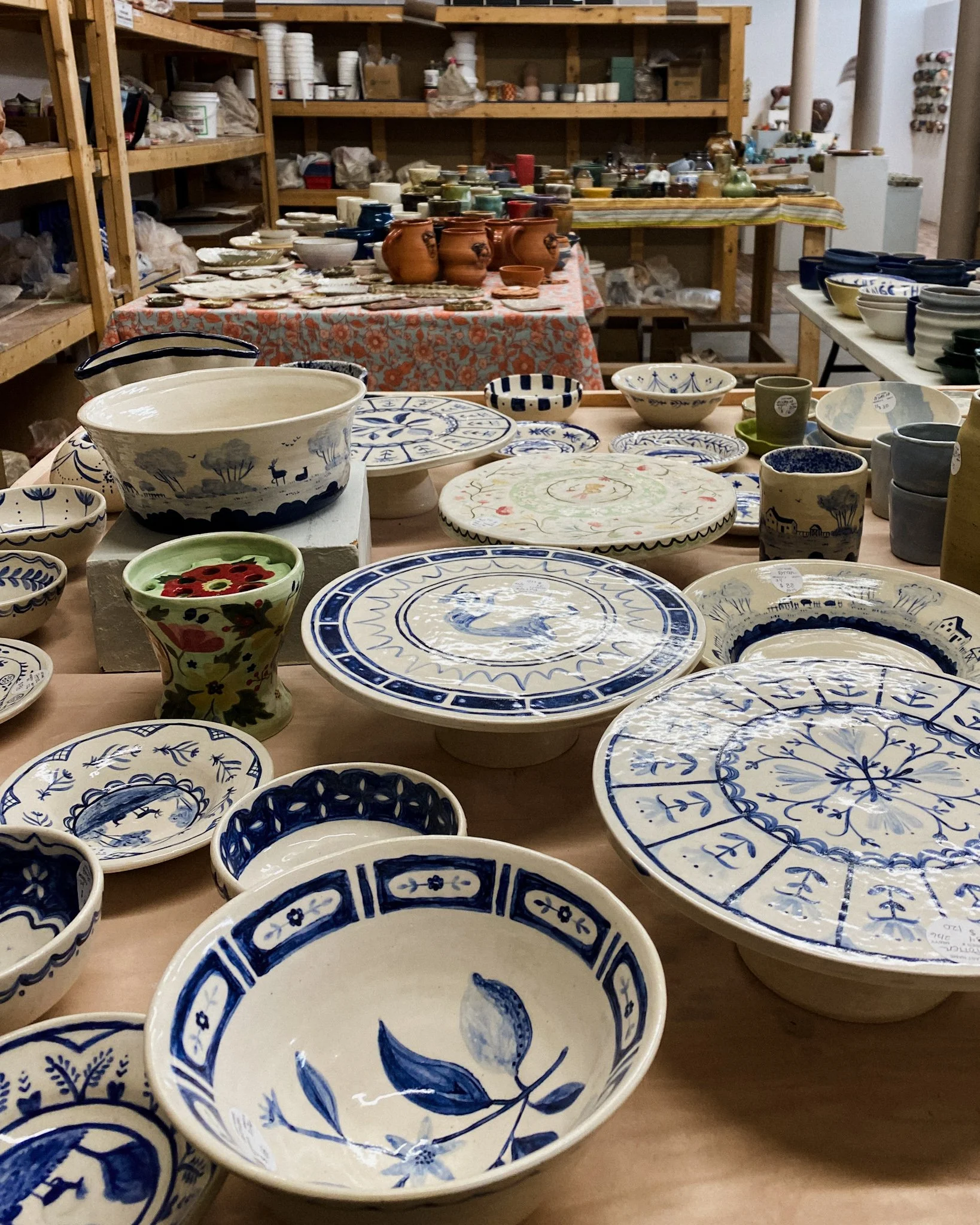
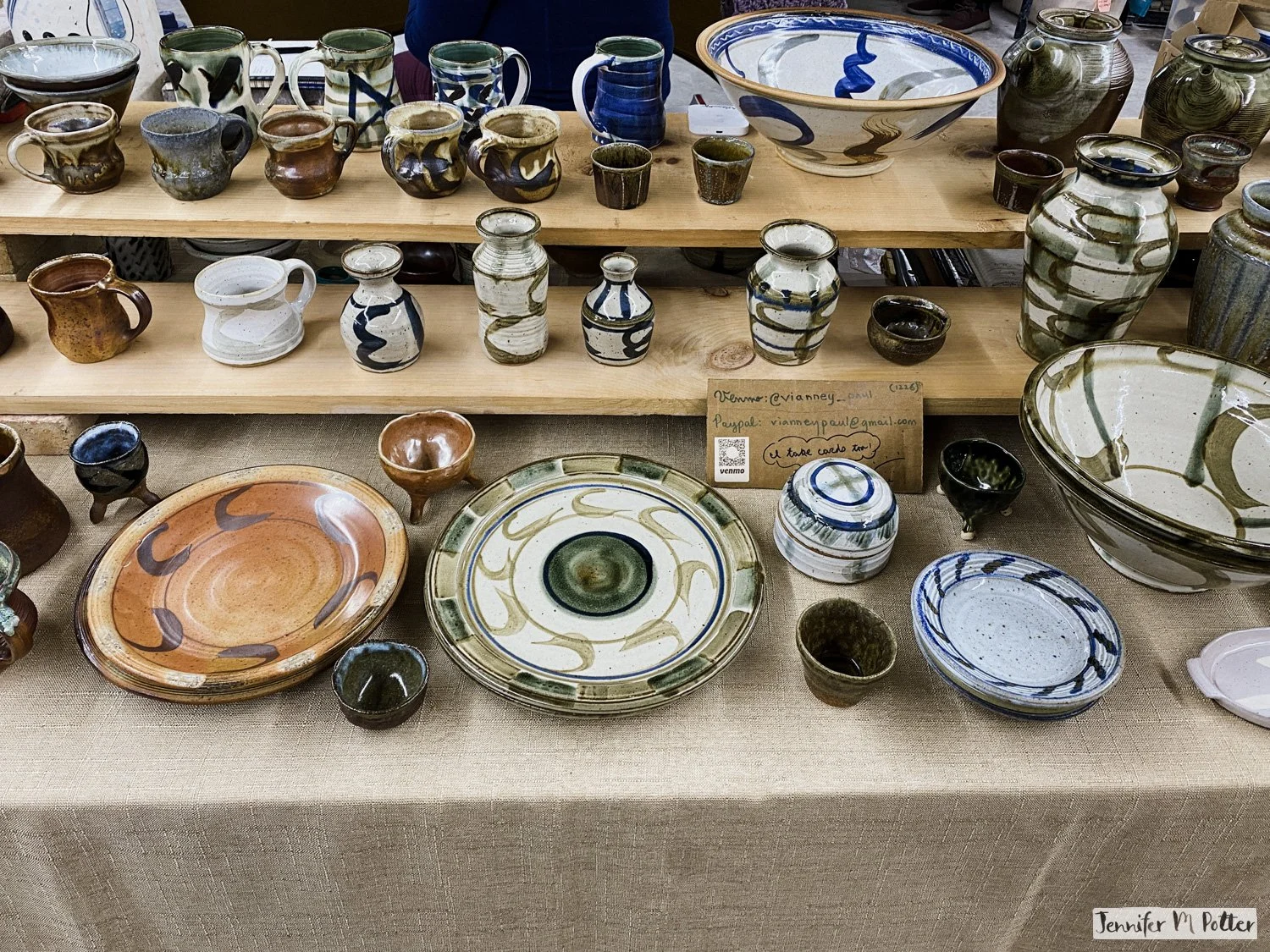
A display of pottery thrown and decorated by Vianney Paul

Vianney Paul’s multi-tiered display.

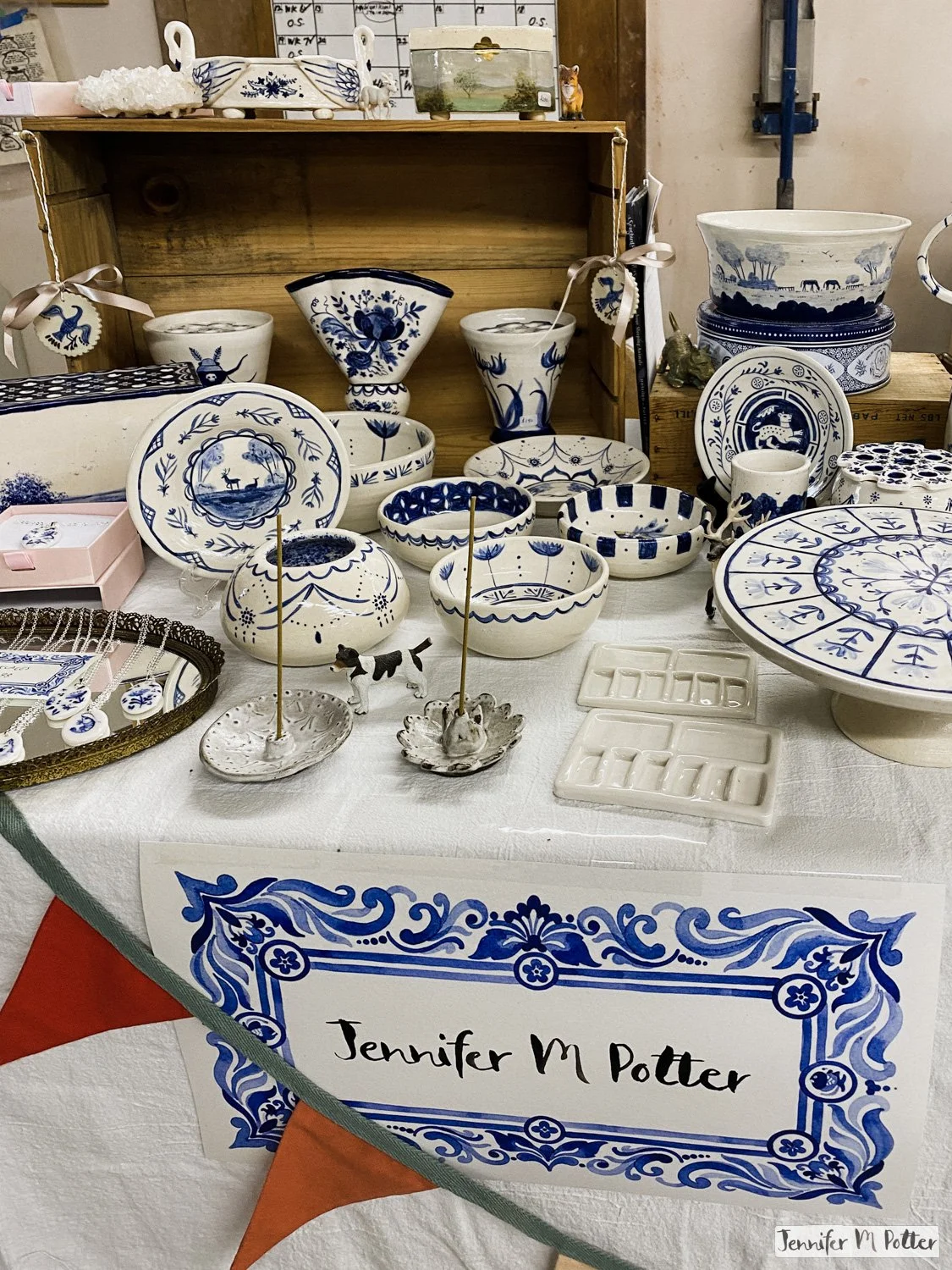
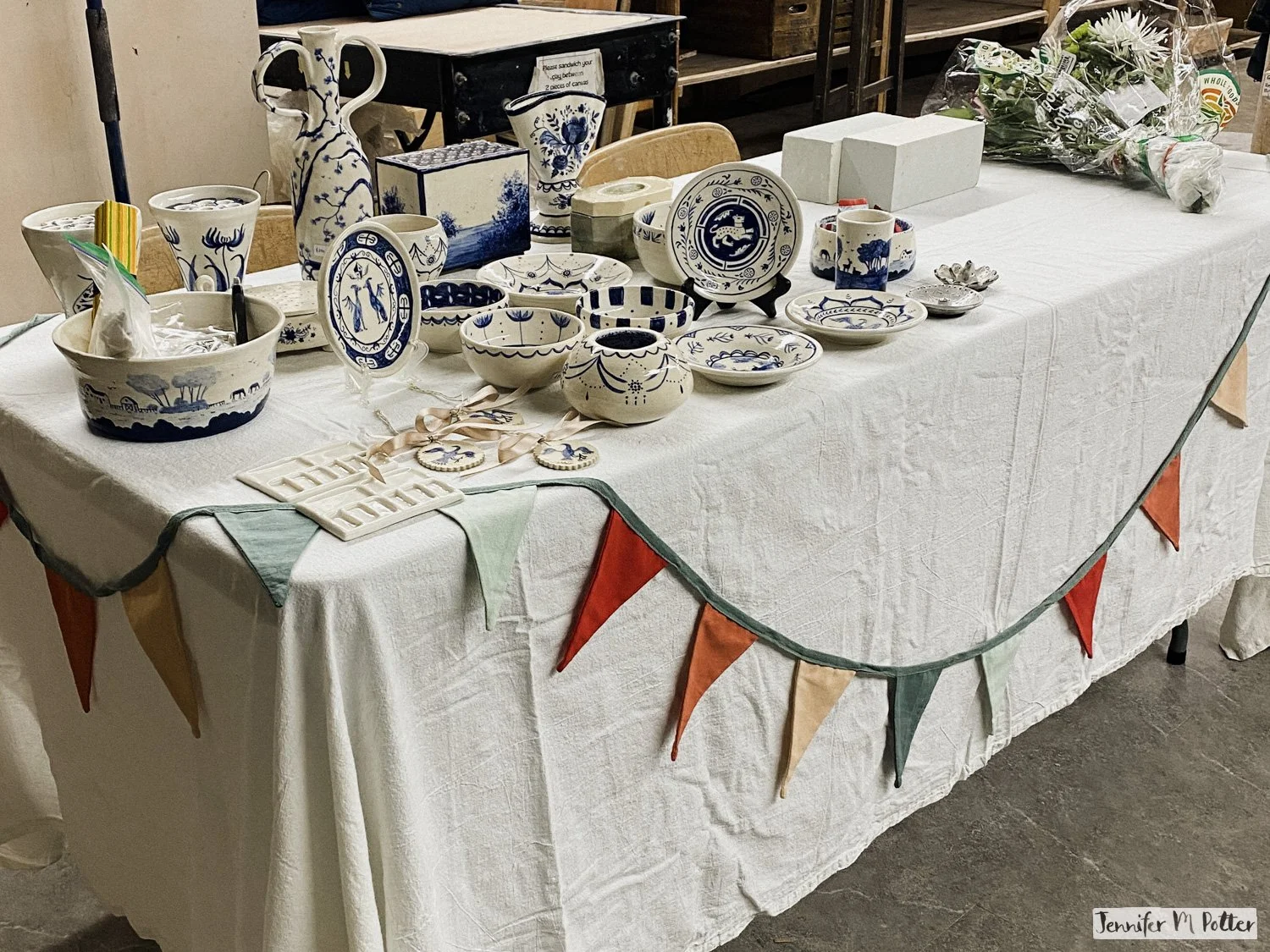
I set up my table. Laid out the linen tablecloth, wrapped it in bunting, arranged my pieces. I watched other people set up and I examined their displays. I definitely needed risers. My bowls needed height or no one would be able to see the detail on the sides.

Sorting out how to display my blue and white ceramics on the table

Looking a little samey.

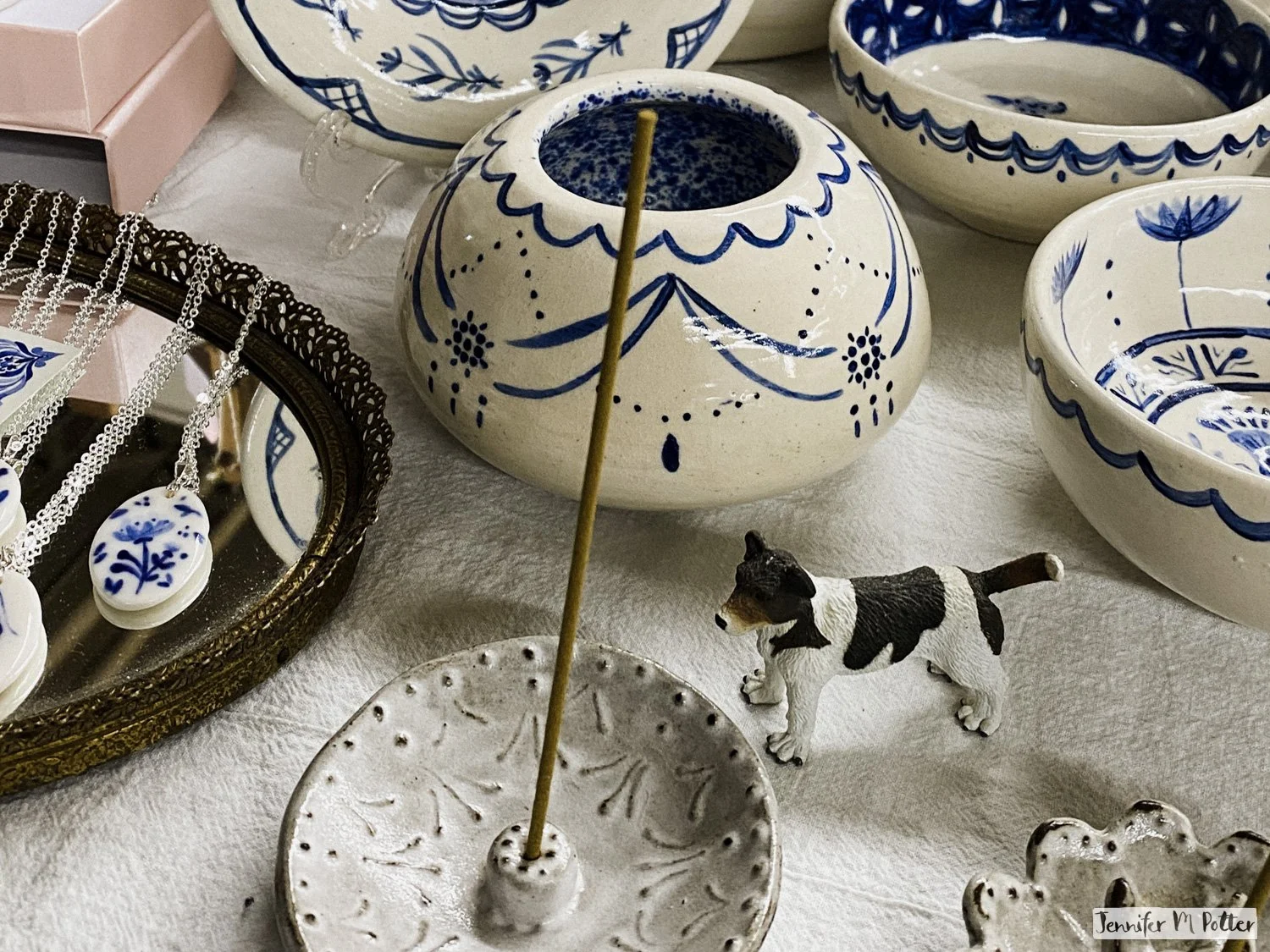
At home I pulled an old wine crate and vintage wooden cheese boxes out of the basement. Dusty and unused since our move from San Francisco, but I couldn’t part with them. I dusted them off, then grabbed a few tins to use as platforms. I went on a shopping spree through my house, picking up little things that felt like me. Mise en scène. Goose feathers I brought home from Buenos Aires. Tiny plastic woodland animals because I like them. An old brass dog I call Chester. First ever market support animals.

A small plastic dog nestled in among my ceramic pieces

Ready for orders.

I still needed signage. The morning of the market I somehow managed to whip up a semi-professional sign for the table, an email signup sheet, and small place cards for pricing. Putting those old graphic design skills to the test. Luckily I had all the paper I needed and my printer just worked.

I was going to make sandwiches but forgot to take the bread out of the freezer. Just have to figure something else out. Maybe I’ll be too busy to be hungry.

I got to the space at 10am. Doors at 11. Got the signs and risers sorted. Not enough time to put out the flowers I'd bought, but everything else was in order. There was a line of people waiting outside!

My final set up, incorporating signs, crates, tins, and small animals.

A little more lifted.

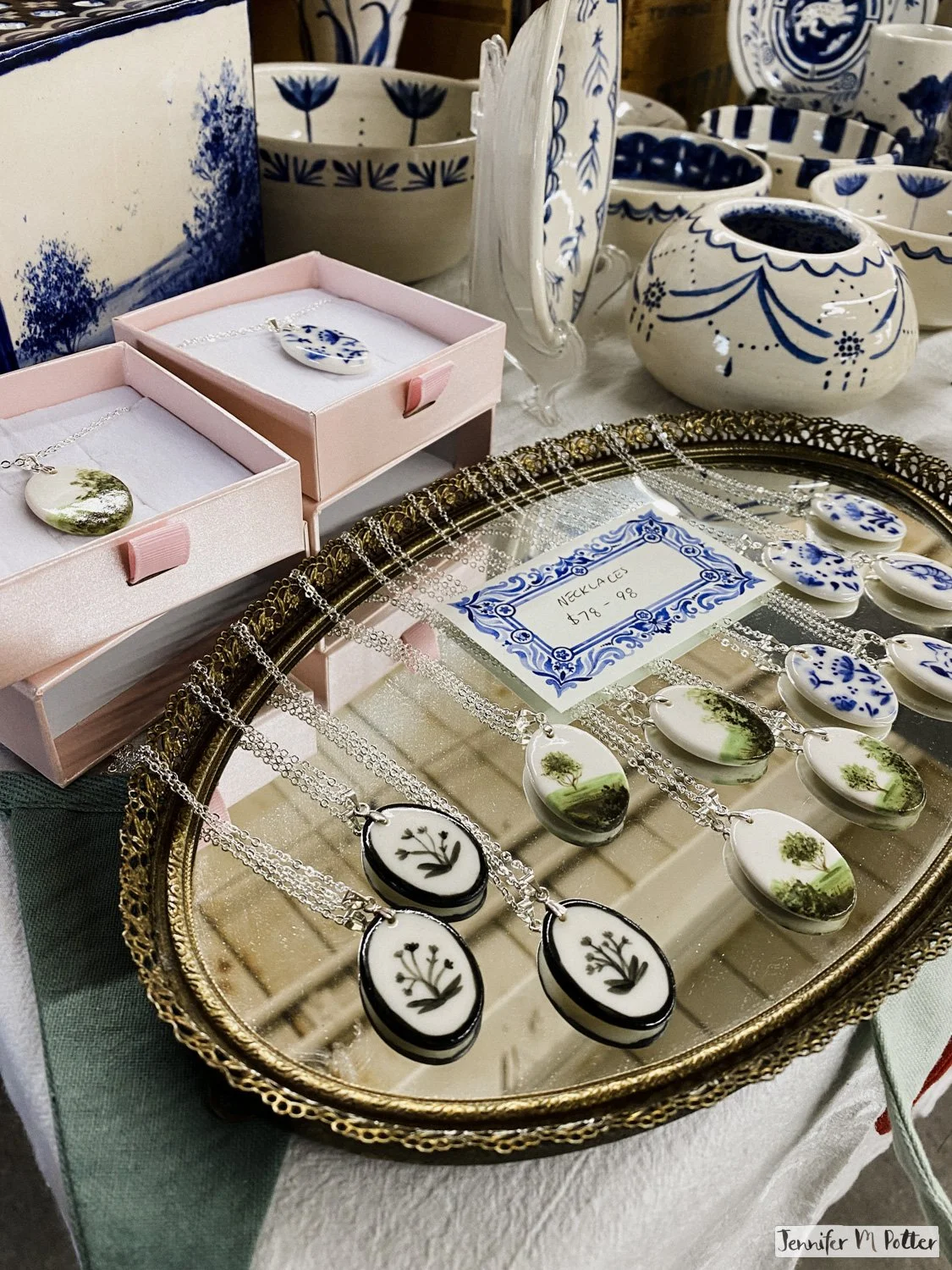
My porcelain necklaces displayed on a vintage mirror

Need to invest in a necklace stand, but this mirror I swiped off my dresser works for now.

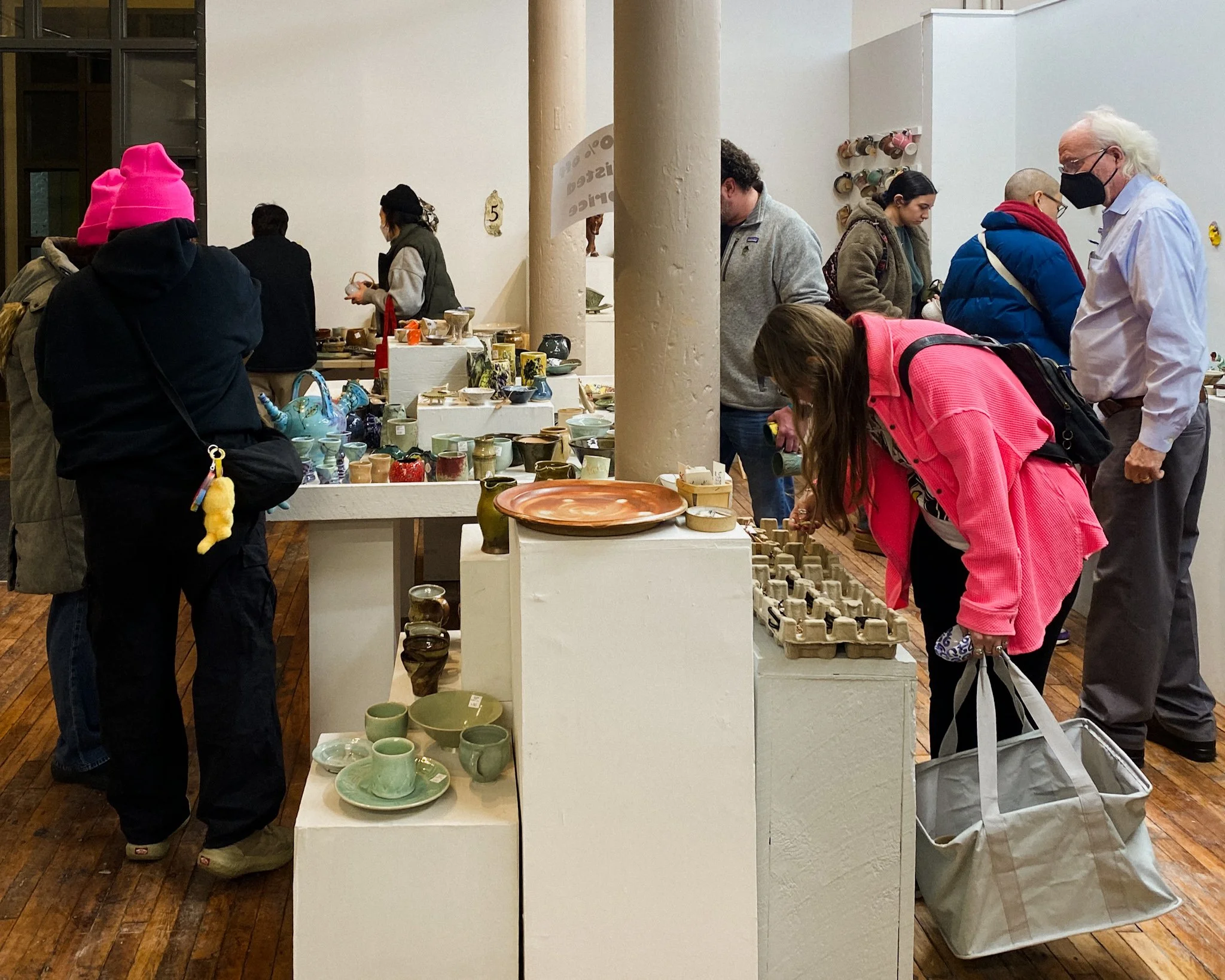
They opened the door and it stayed open. So cold! I made a couple of sales right away—very new to the Square system, to making transactions and packaging things up, but it worked. After I think the third sale, Van—who I was sharing a table with—told me I was supposed to take the price tags off before boxing my ceramics. “Because they’re gifts.”

After half an hour I had to put on my parka. I wanted to wear my mittens too, but I needed my hands.

Jesse sold refreshments at her table. She hooked me up with a cup of hot chai and it was exactly what I needed. Warm, sweet, cozy. Then Barb closed the door and we warmed up again.

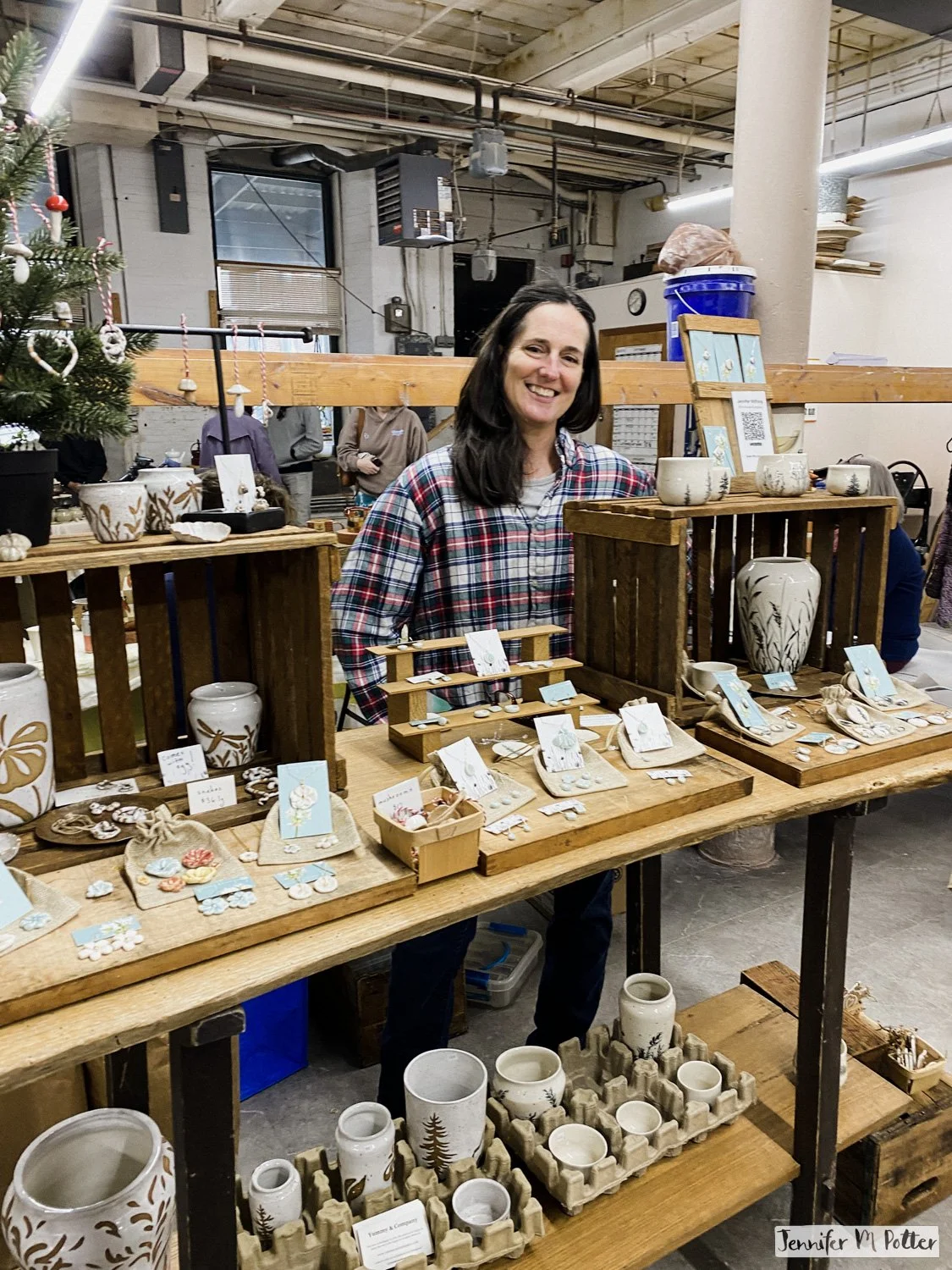
Jen Wilfong's display

Jen of Yummy & Company. The best teacher and mentor! I wrote about her here.

The next few hours were slower. There were always customers milling about but nothing like that 11am rush. My neighbor stopped by. My father-in-law. My husband. Van's husband offered to pick up lunch for us at Ekiben. I got the tofu bao. My favorite. They make the best tofu, crispy on the outside, soft on the inside. As it should be. I didn't love eating while people were shopping, but I just had to say it was Ekiben and they understood.

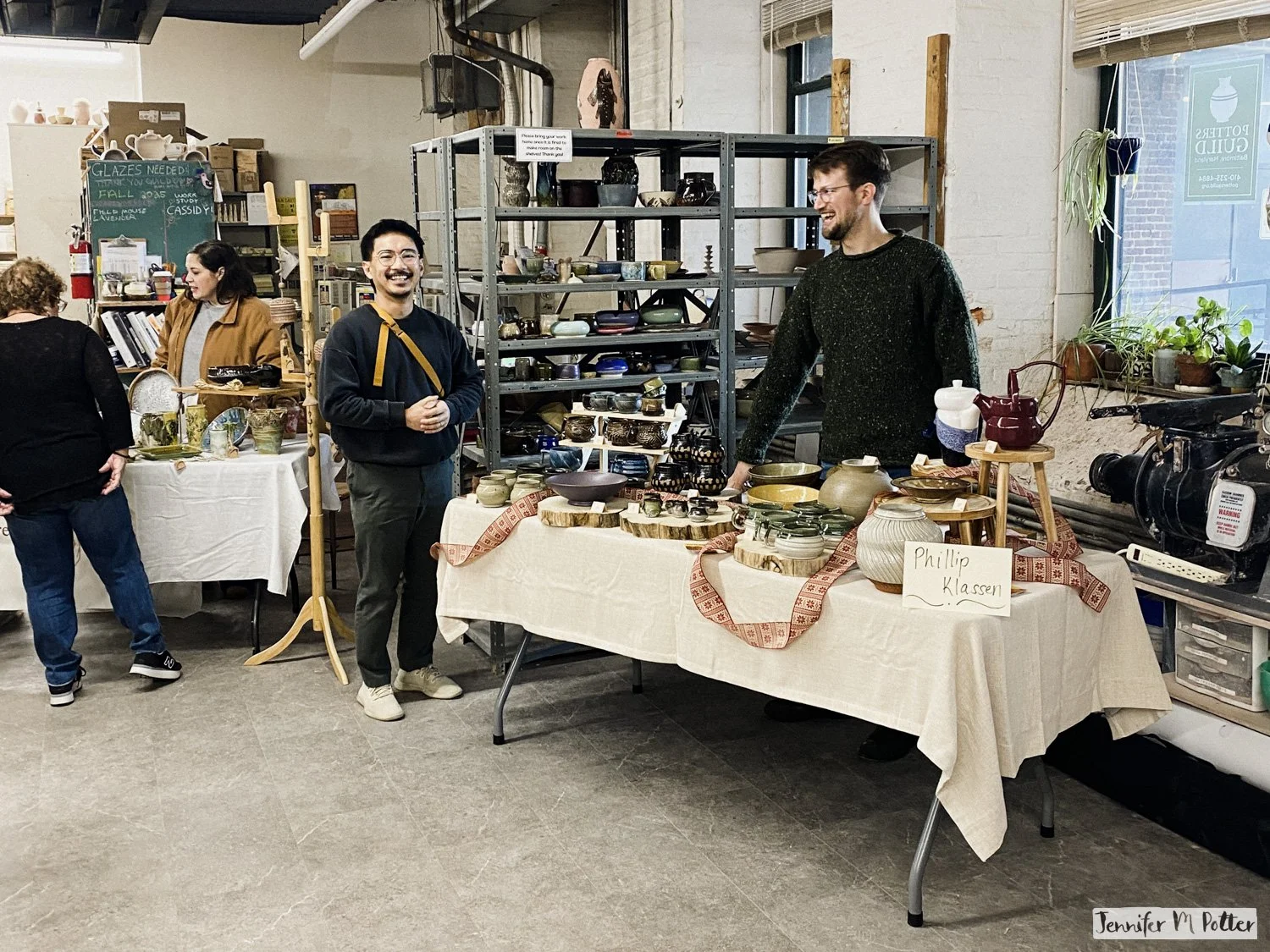
Phillip Klassen's display

Phillip Klassen (right) and his partner, Abe (center).

I made my biggest sale toward the end of the day. A $190 vase. Most of what sold was smaller—porcelain watercolor palettes at $18, trinket dishes at $68. But that one $190 sale felt pretty good. I probably could have undercut myself and sold more pieces. But I knew that if someone connected with my work, they'd want to pay what it cost. Hand made, hand illustrated. Functional, sure, but also art.

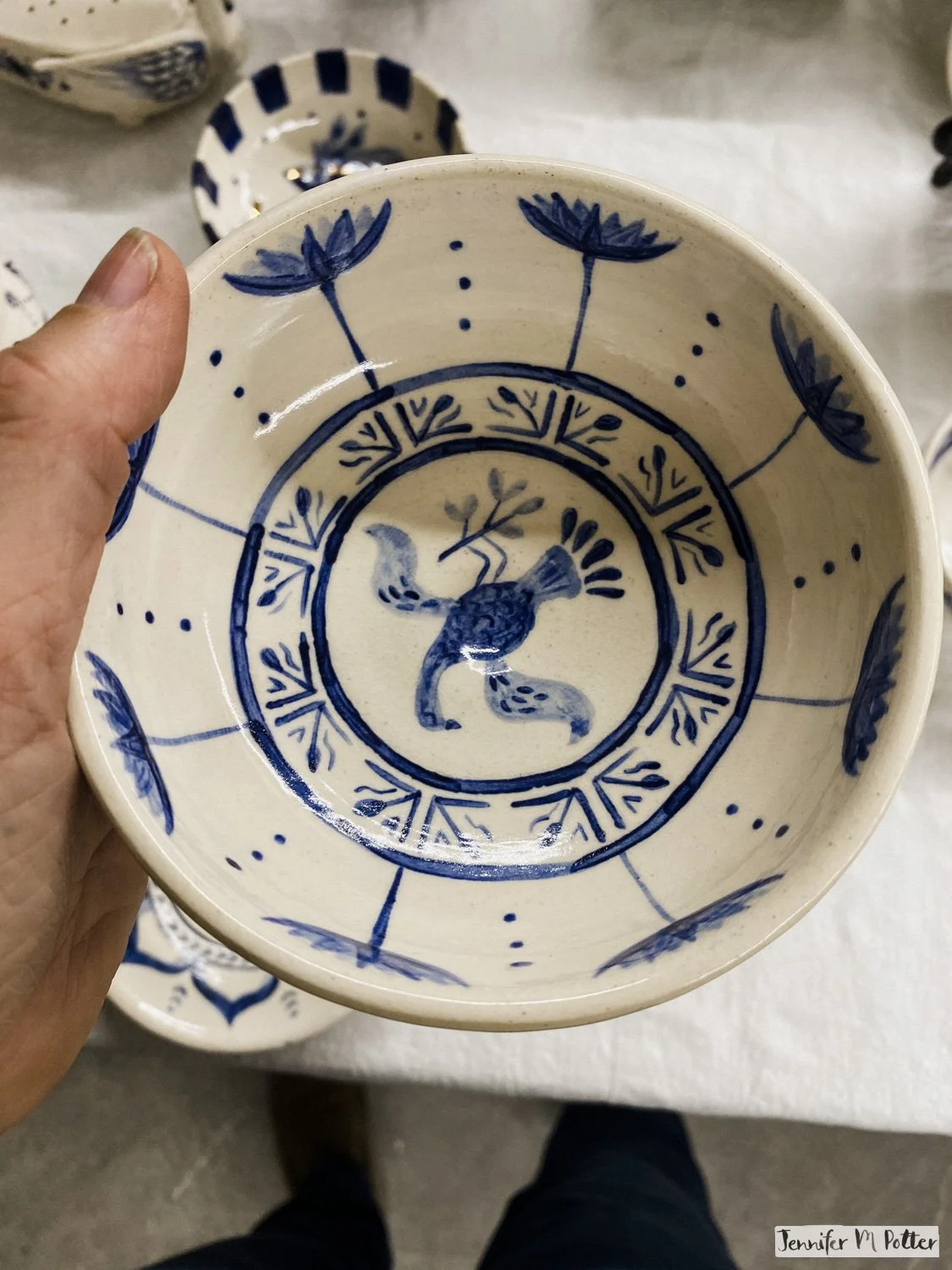
A close up of a bowl I painted with a bird and 1920s/Egyptian art-inspired designs.

I didn't hit $1,000, but I didn't lose money either. I sold some stuff and learned a ton. And I came out of it feeling pretty good. So I guess I hit one goal.

Time to research markets for 2026.

What a dish costs
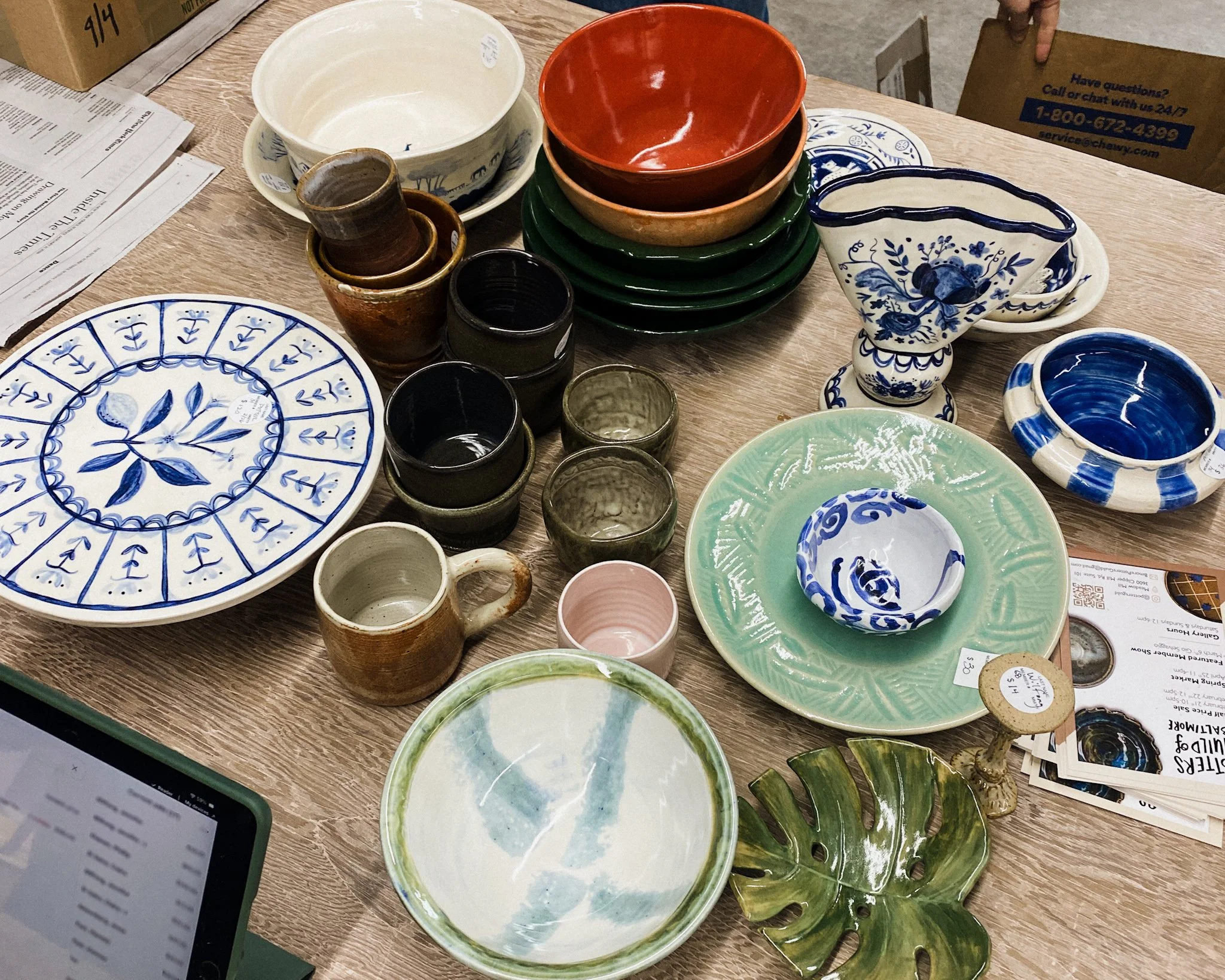
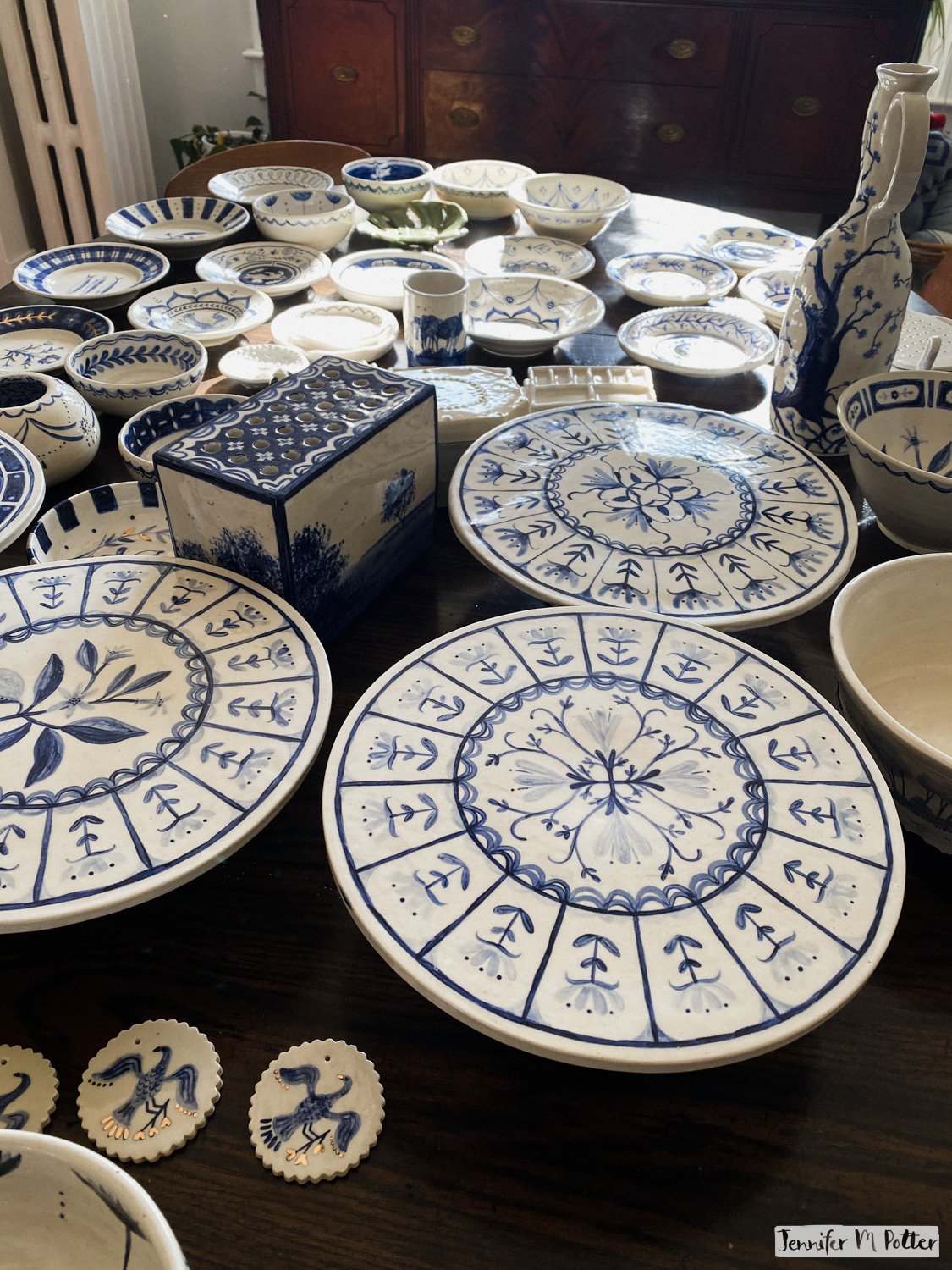
A bunch of my ceramics, mostly blue and white, all laid out on the dining table

I've been sitting at the dining table with a sheet of price stickers, trying to figure out how to price the ceramics I'm taking to the market this weekend.

It's harder than I thought it would be. I keep starting with time. How long did it take me? Three hours? Five? When I was consulting as a creative director in San Francisco, I got paid $150 an hour. Is that what my time is worth? If so that's $750 on labor alone. But I can't sell a small dish for $750. At the other end, minimum wage would put it at $75—still a lot, and that's without materials. That feels depressing. I don't want to make minimum wage. I have way more specialized knowledge now than I did then.

When someone commissions an illustration, I still think in hourly rates. It's how I know what's fair. But I'm learning that making products is different.

Because I'm two people now. I'm the labor, and I'm the business owner. Worker Jennifer can make $15 an hour. But Entrepreneur Jennifer takes the whole piece—materials and labor—and marks it up to cover overhead and profit. Overhead isn't just clay and glaze. It's market fees, hosting fees, transaction fees, broken pieces, kiln fails, experiments that don't work out, shipping materials, photography, the time spent writing numbers on pricing stickers. If the dish costs $75 in parts and labor, that's just production. Running a business costs more.

Worker Jennifer might get minimum wage right now. But Entrepreneur Jennifer needs to take home a profit on top of that, because maybe someday I'll want to hire help—hopefully for more than minimum wage—and still be able to do things like go out to eat on occasion and buy Christmas presents.

Hiring help! I haven’t done a single market yet and already I’m getting ahead of myself.

I'm a complete noob at this. My business has always been commission-focused, so I've never managed sales and inventory. Many illustrators deal with products and overhead—prints, notebooks, cards, pins. You spend ten hours on an illustration and make infinite prints from it. But you spend ten hours on a pot and you've got…one pot.

But I'm getting more comfortable with it. With the idea that pricing isn't about what I used to make or what feels fair compared to my old life. It's about what it costs to make this thing and run this business and still have something left over.

The market is Saturday. I'll let you know how it goes.

Prototypes (or Something Like That)

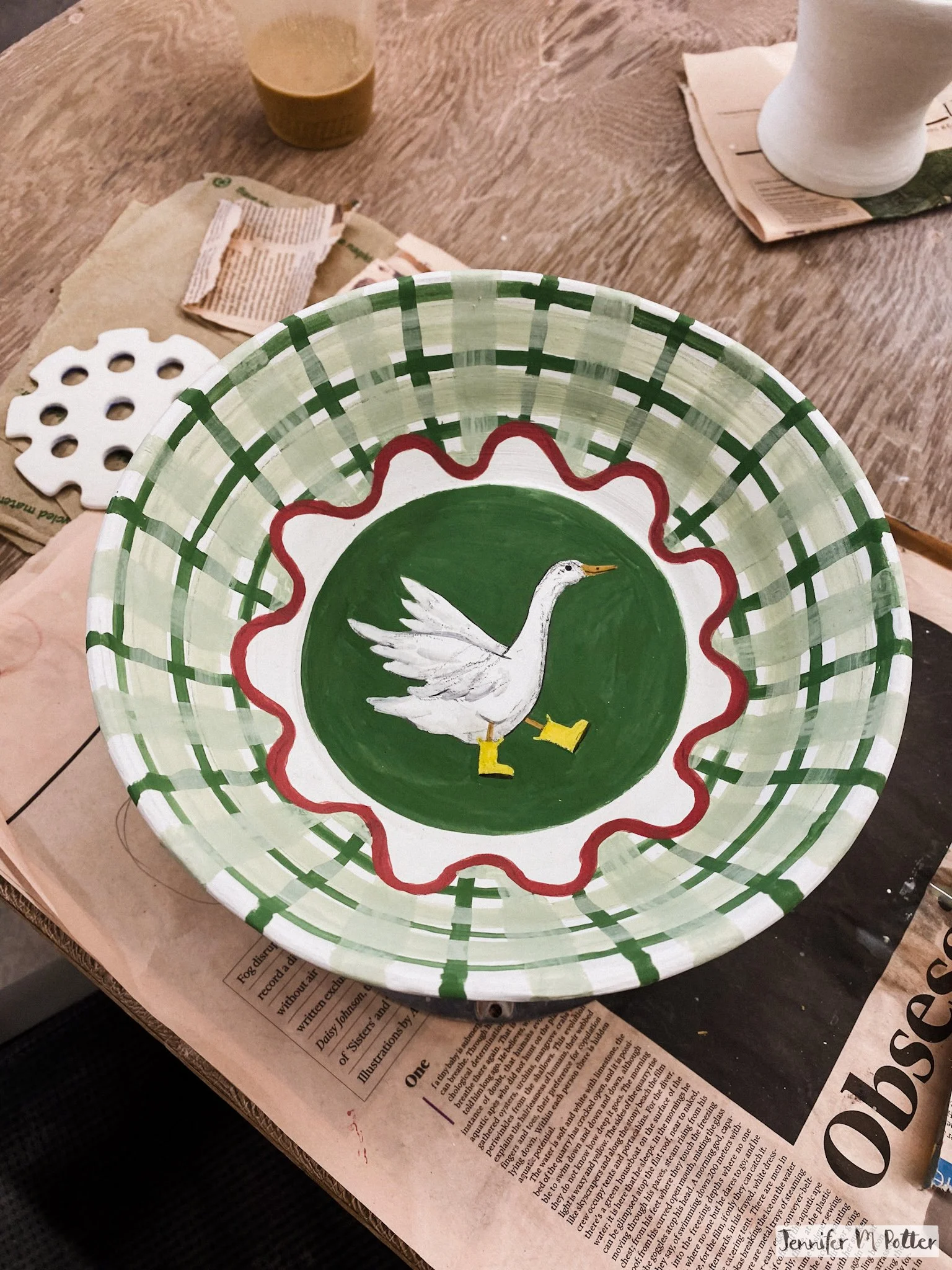
Over the summer I applied and was accepted as a member of the Potters Guild, the ceramics studio I've been taking classes at for the past few years. Their winter market is in a few weeks and as a member, I get to join in, so I'll be selling my pottery for the first time. I’ve been decorating pieces for it—last weekend I sat down with no plan for a bowl and left with a goose wearing wellies. Maybe six hours work from wheel to final glaze.

Work in progress of a goose painted on a ceramic bowl in underglaze

Before that I made a vase that took at least sixteen hours. As an illustrator I'm used to spending hours on a piece, so that doesn't sound like so much. But just to make minimum wage I'd have to price the vase at $240 and that doesn't even cover supplies and studio fees.

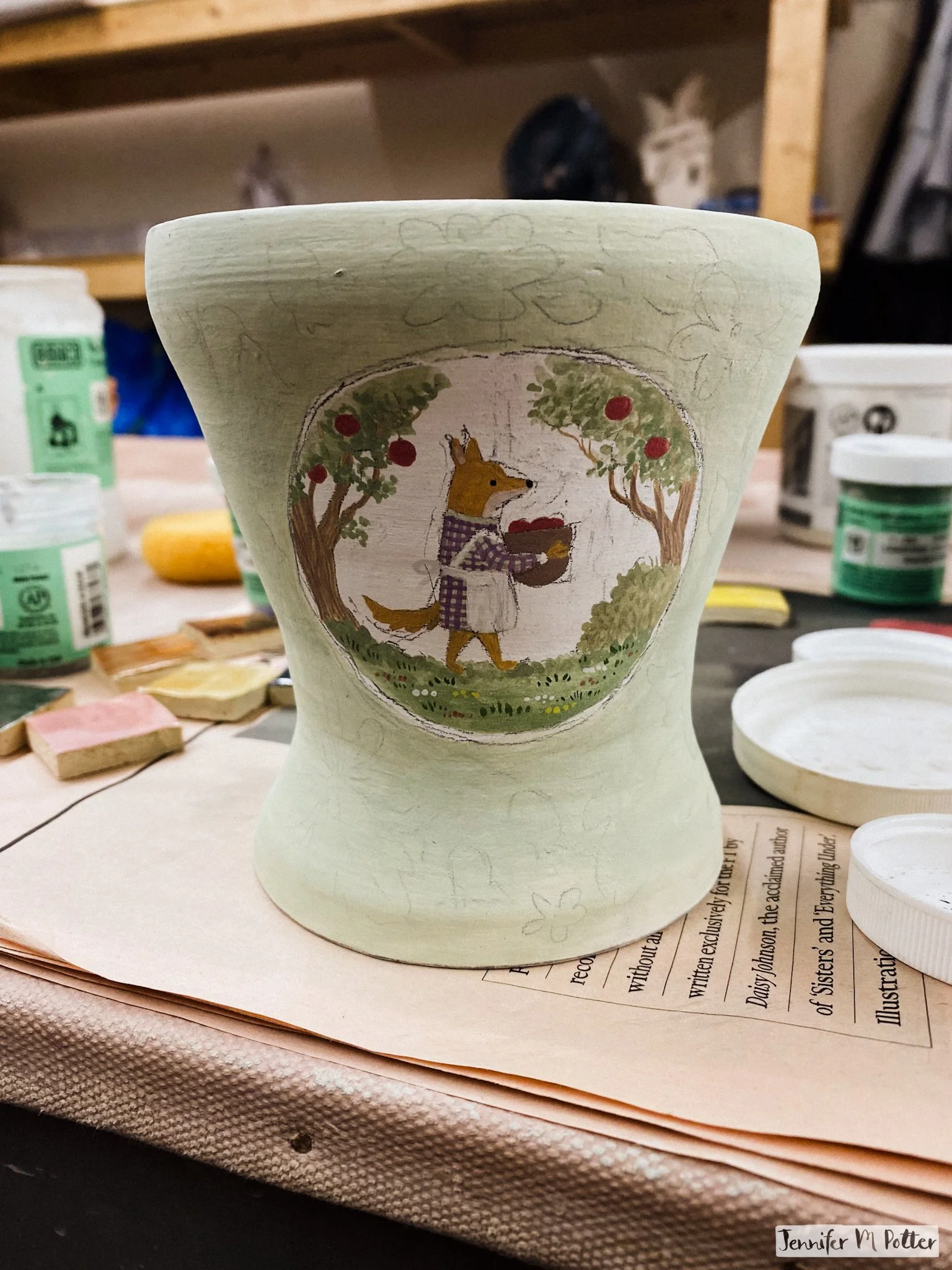
work in progress of a scene with a fox carrying a basket of apples in underglaze on a vase

I’m trying to see these time-intensive pieces as prototypes. Hand painting everything in three solid layers of underglaze is neither efficient nor cost effective. But I follow the inspiration and pay attention to what is and isn't worth the time. Some things can be streamlined with faster techniques, but some things will just need to be hand painted with all three layers to get the effect I'm after. It’s R&D.

Both the goose bowl and the fox vase are heading into the glaze kiln soon. I probably should have bisqued them again, just to set the underglaze before applying the clear gaze, but I didn’t. I was trying to save energy—but now I’m second-guessing it. Hopefully they won't bleed.

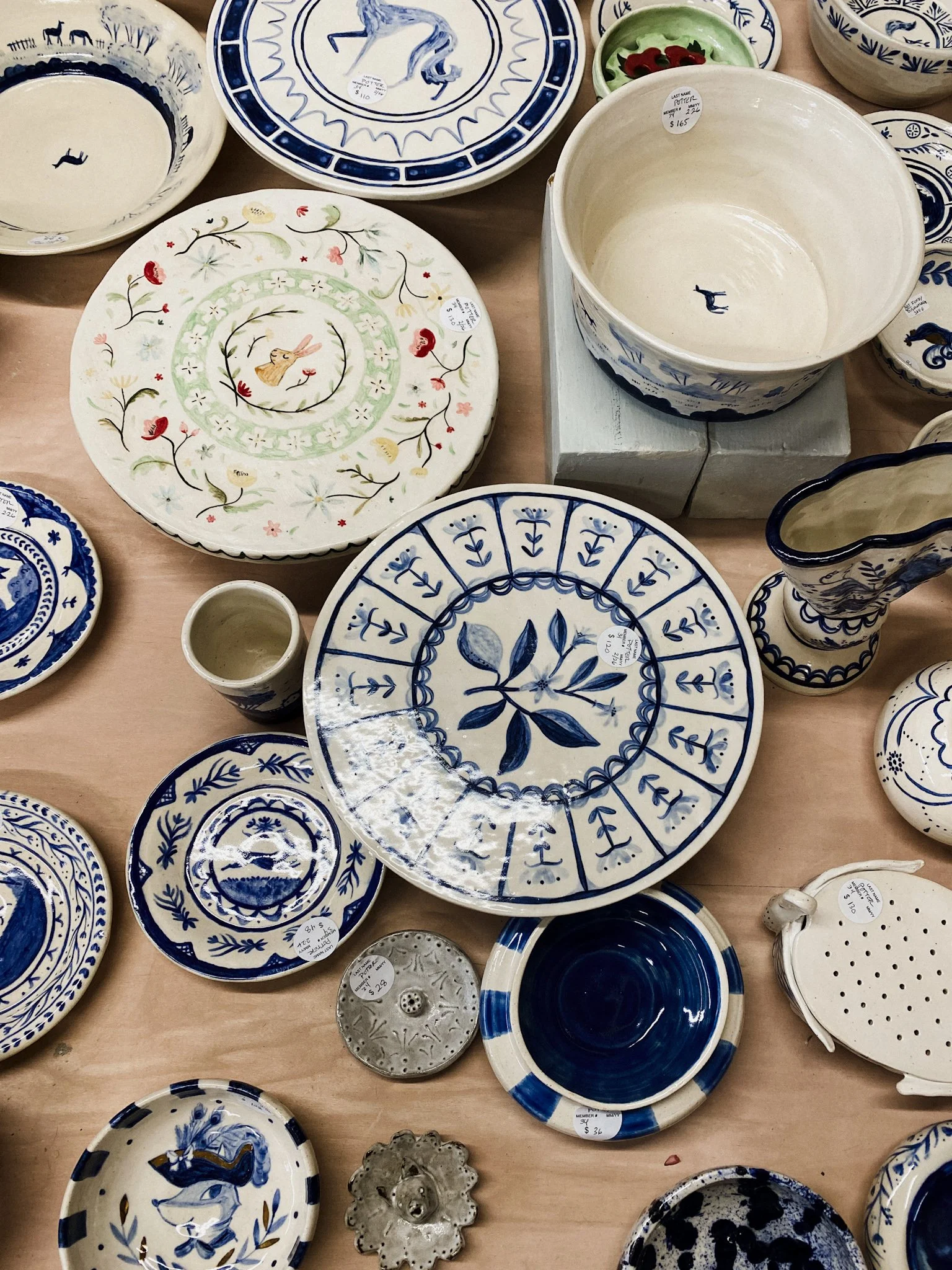
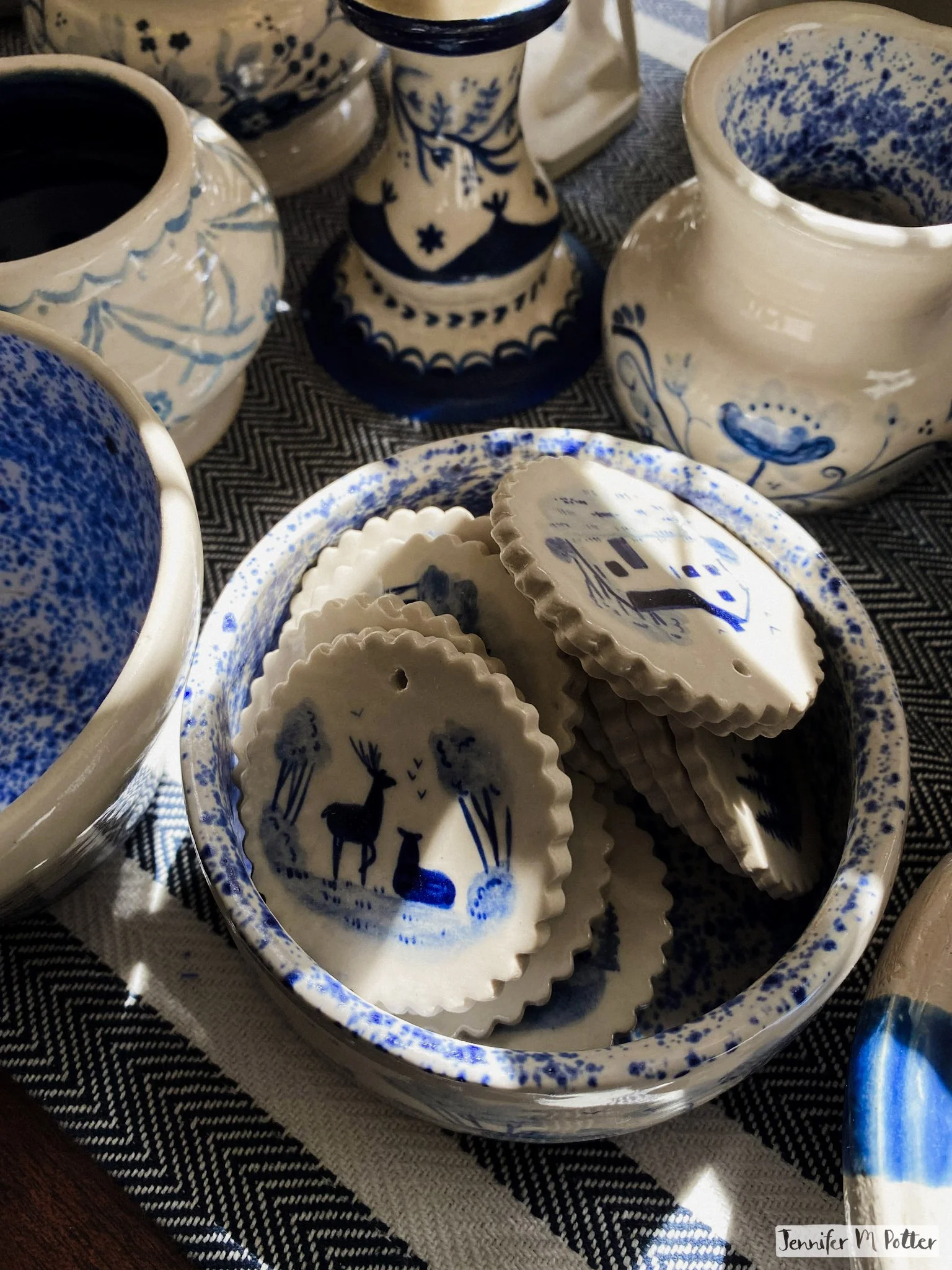
I’ve been going through my early pieces to add more things to sell. A lot of them are wonky—slightly warped, not as smooth as I’d make them now, a little too heavy. But they’re decorated with care, and that means something. Most of them are blue illustrations on white, little scenes and motifs I painted with the same attention I give my illustration work. I worry that they're not perfect, but my teacher said if you want perfect, go to Pottery Barn and that stuck with me.

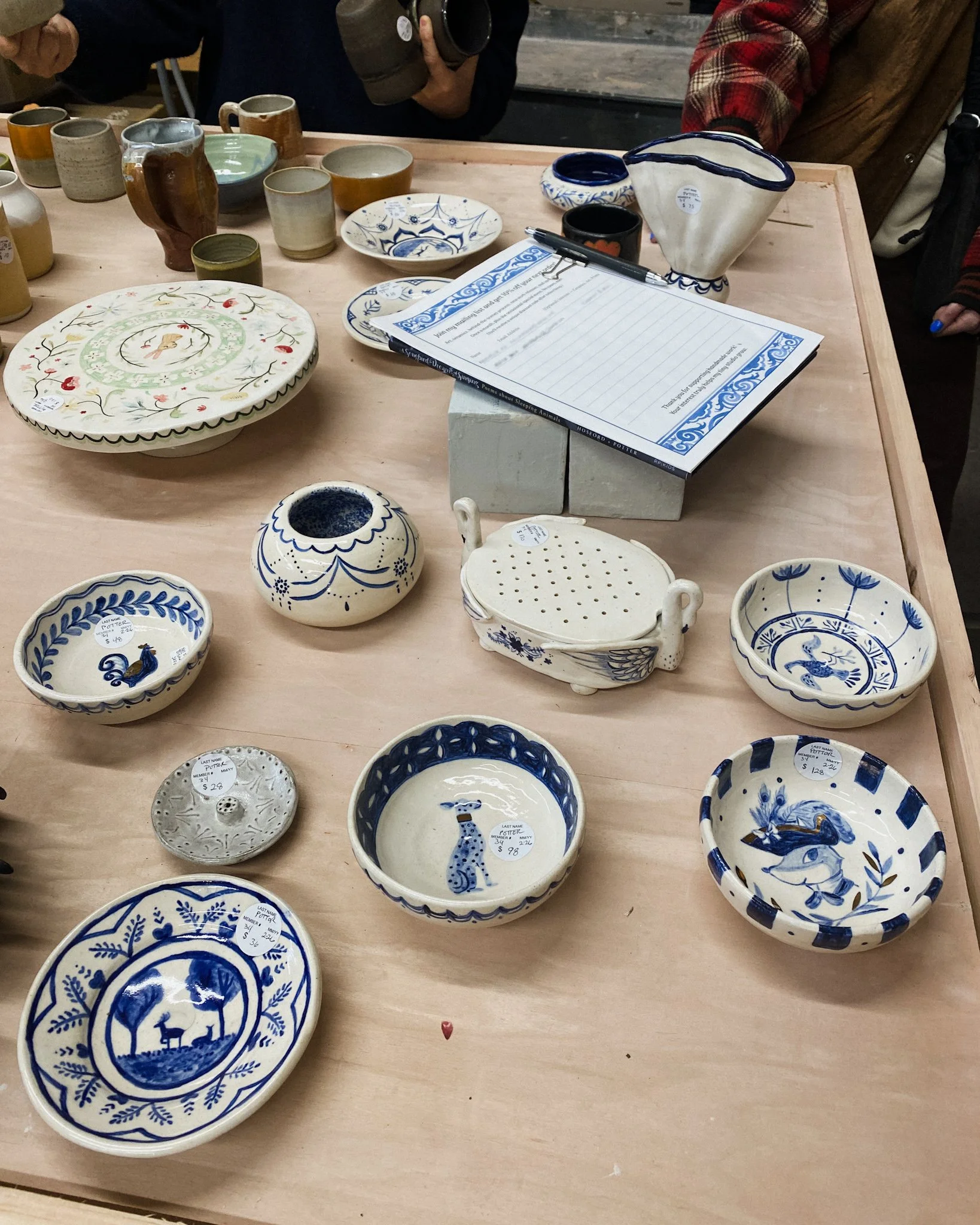
Collection of blue and white ceramics by Jennifer M Potter

All of these pieces will have to be priced. I want something that values my time but stays within reach. At the same time, I'm not confident I can price these at what they’re worth. But I’ll learn to work faster, and that will bring the prices down. Or not.

I went to the Potters Guild winter market years ago, back when I first moved to Baltimore. During the pandemic, before I was even taking classes. Outdoors, very cold, but joyful anyway. It's hard to believe I'll be participating from the other side this year. I'm nervous, but excited. I’ll be sharing a table with my friend Van. And I’ll know the other vendors, so it's sure to be a good time, and I'll probably learn a lot.

I'll probably make a lot of mistakes, too. My prices will either be too high or too low. I don't have any signage or fancy displays so it might just be dishes on a table. But that's okay. It’s just a beginning—I’ll get better.

I guess I’m treating the market as a prototype too.