The Time It Takes
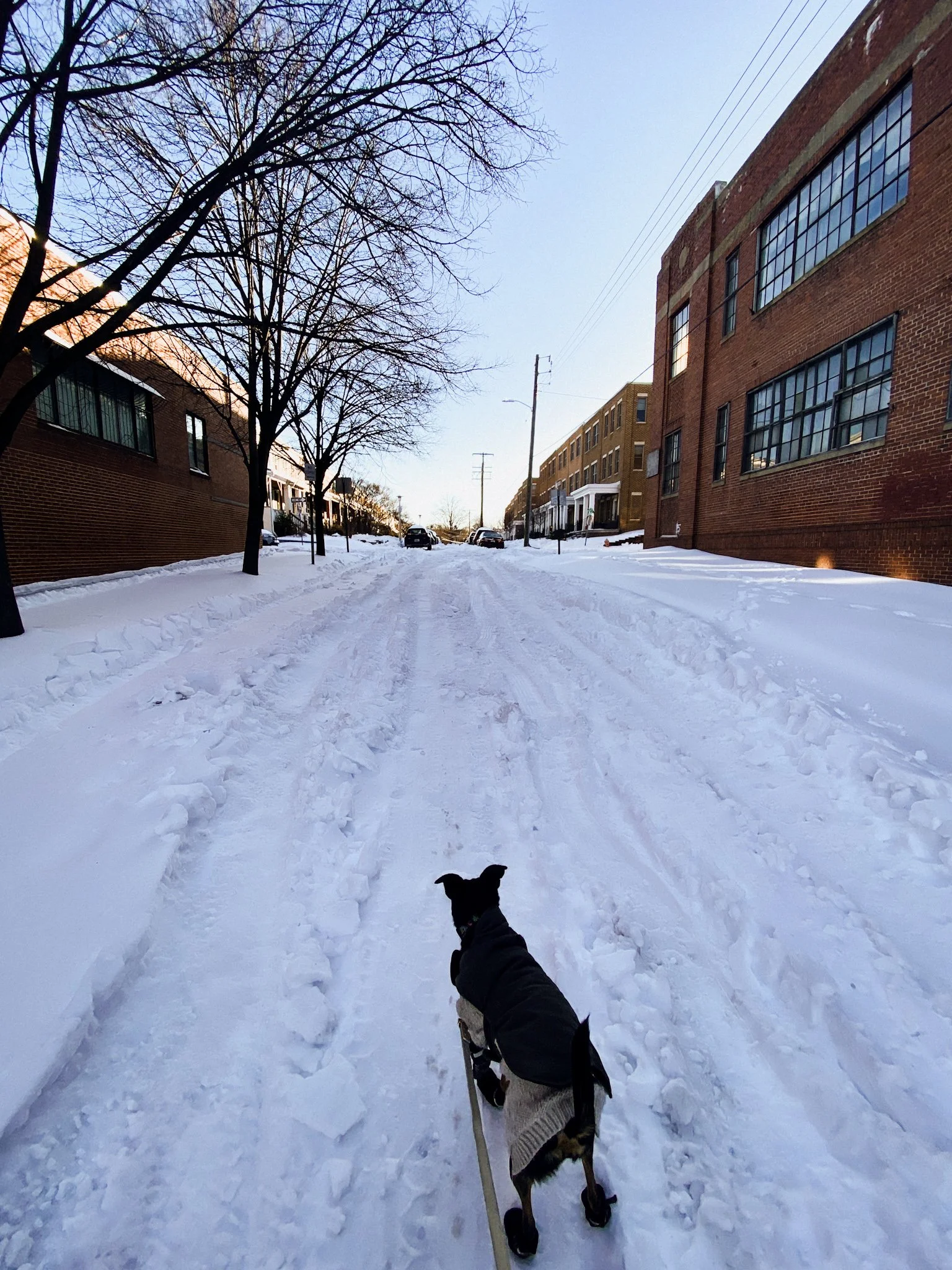
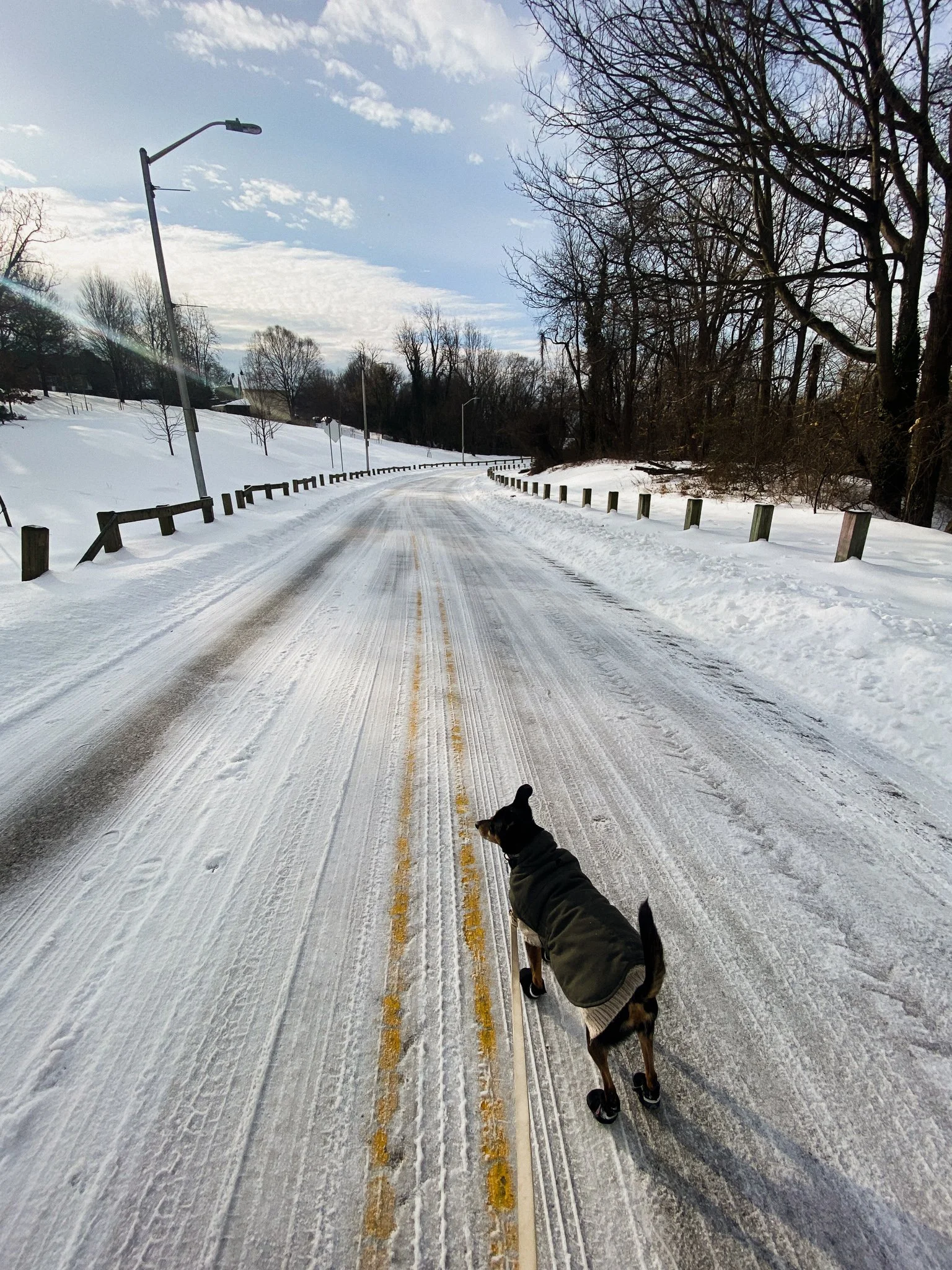
Frisket walking down the middle of an unplowed street covered in snow and ice

Baltimore got two feet of snow in January, and then the temperature dropped and stayed there. The snow turned to ice. The alley where we park became impassable, and the Potters Guild parking lot wasn't much better. I stayed home.

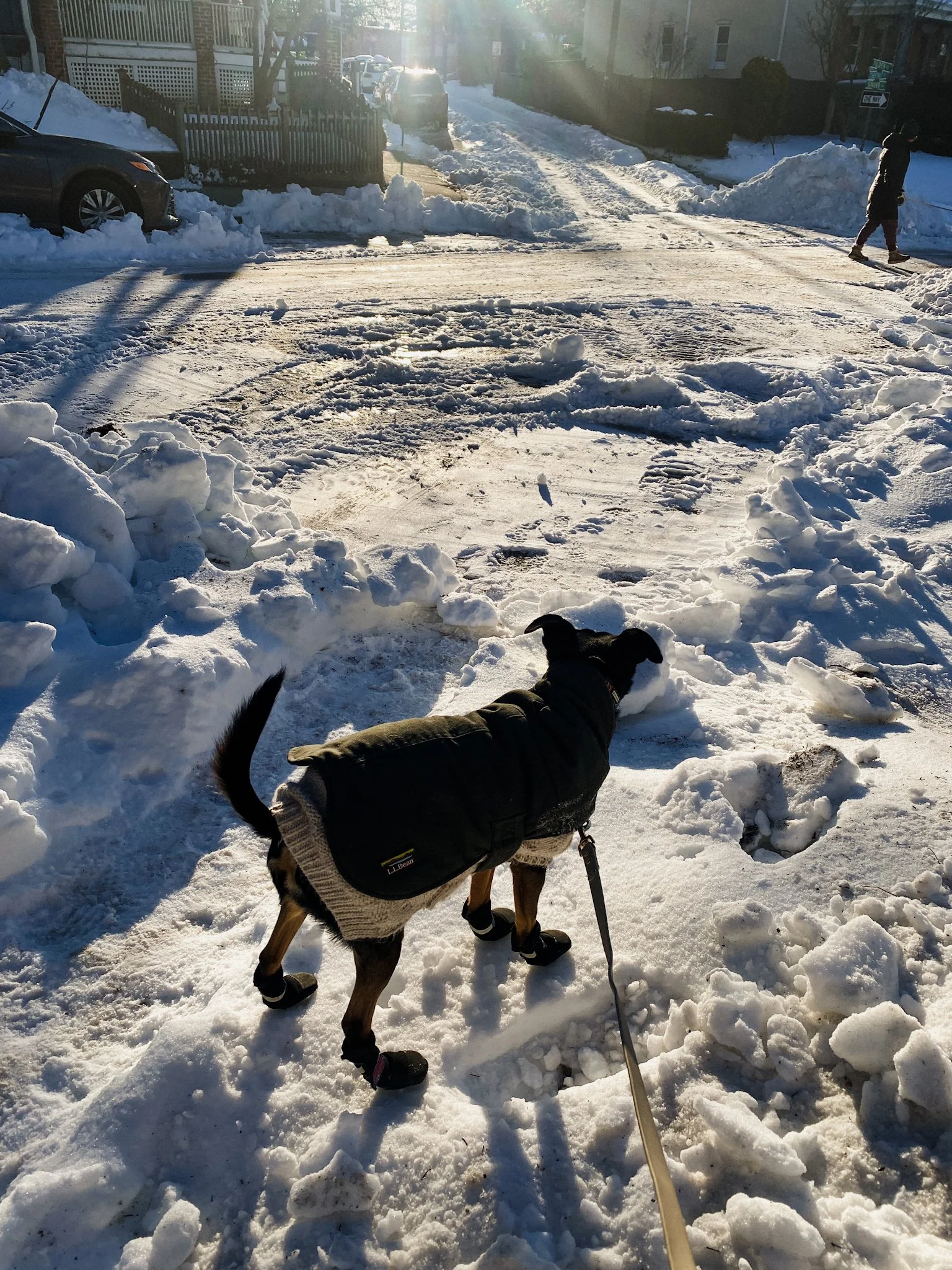
Frisket standing on a corner looking at crossroad of plowed and unplowed streets. Snow is piled all around.

The next week, things warmed up just enough for the ice to start melting—seeping across the slanted sidewalk, refreezing overnight into something you couldn't see. I was walking Frisket when I turned a corner and went down, twisting my knee and pulling a tendon. Another week home.

I finally made it in for open studio, but spent most of it learning to pug reclaim—running old clay through the pugger until it comes out the other side as something uniform, workable again. It’s a good thing to know, but not what I'd planned.

The next week I got client revisions, so I stayed home to work on an approaching deadline. Same for this week. It's been nearly a month.

I've been thinking about time a lot lately, for obvious reasons. Making art is a balance between indulgence and efficiency. When you make art for yourself, you can take as long as you want. But once money comes in, you start weighing the time you want to take, the time the piece needs, against what you can ask for it.

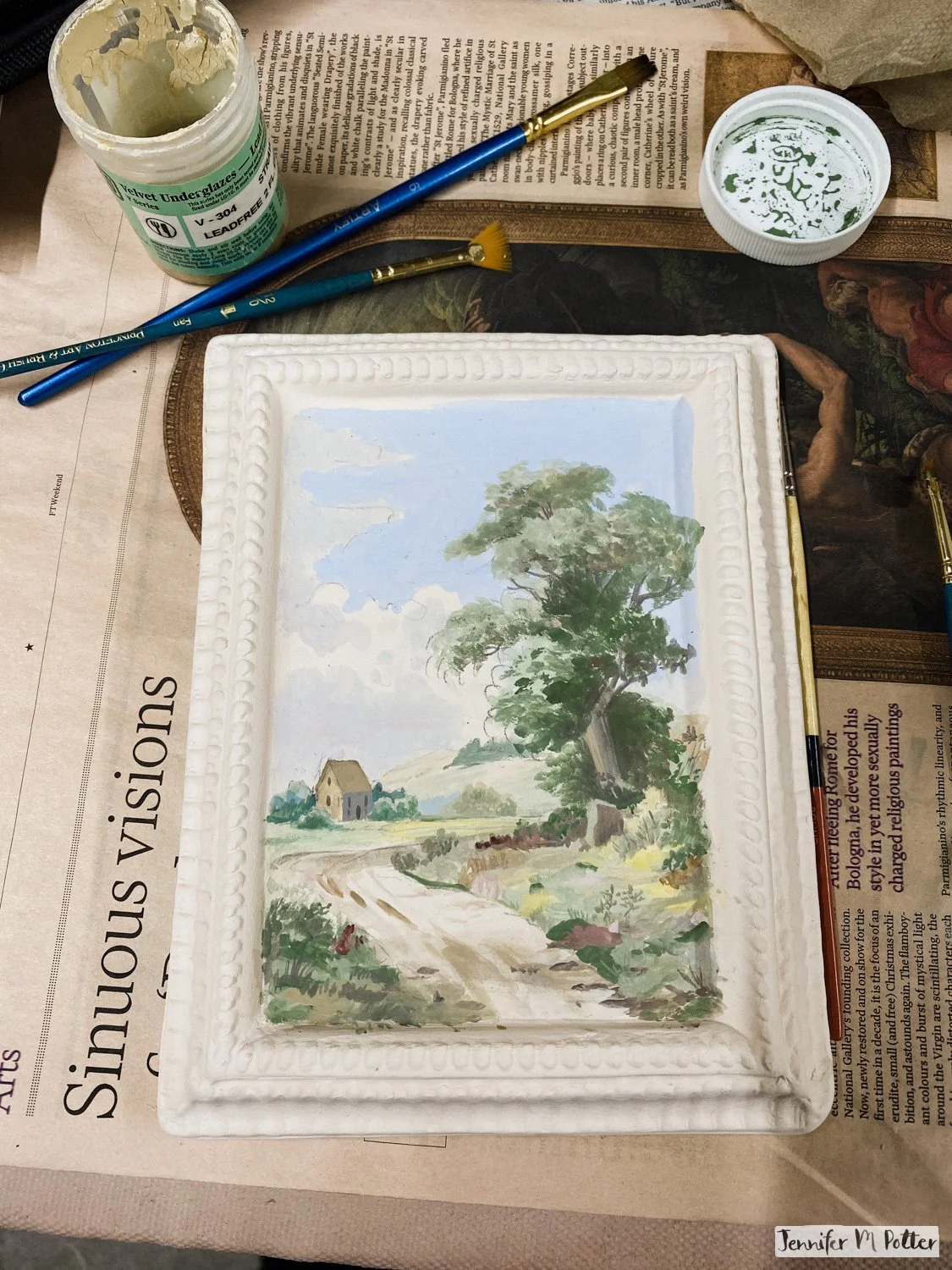
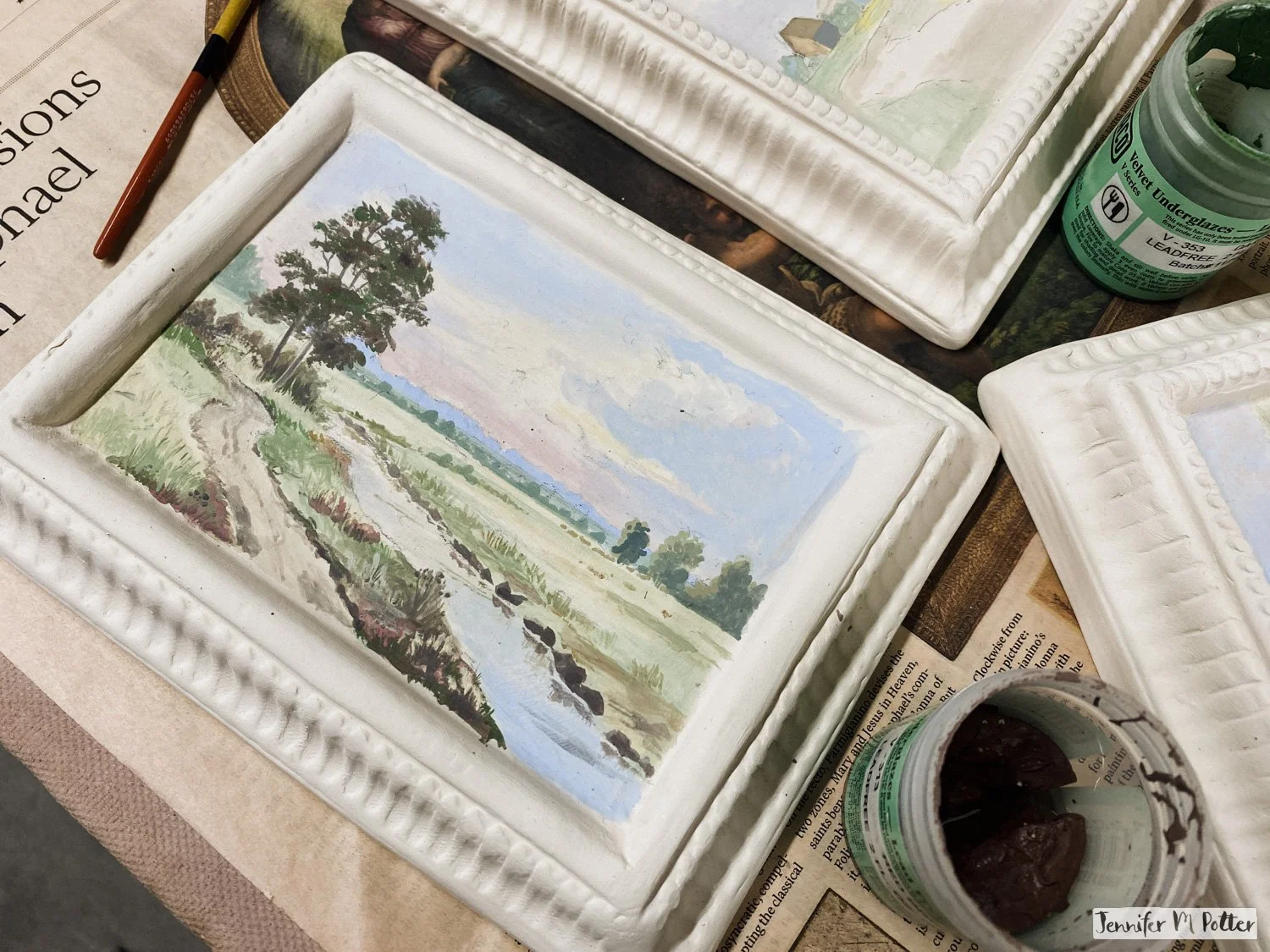
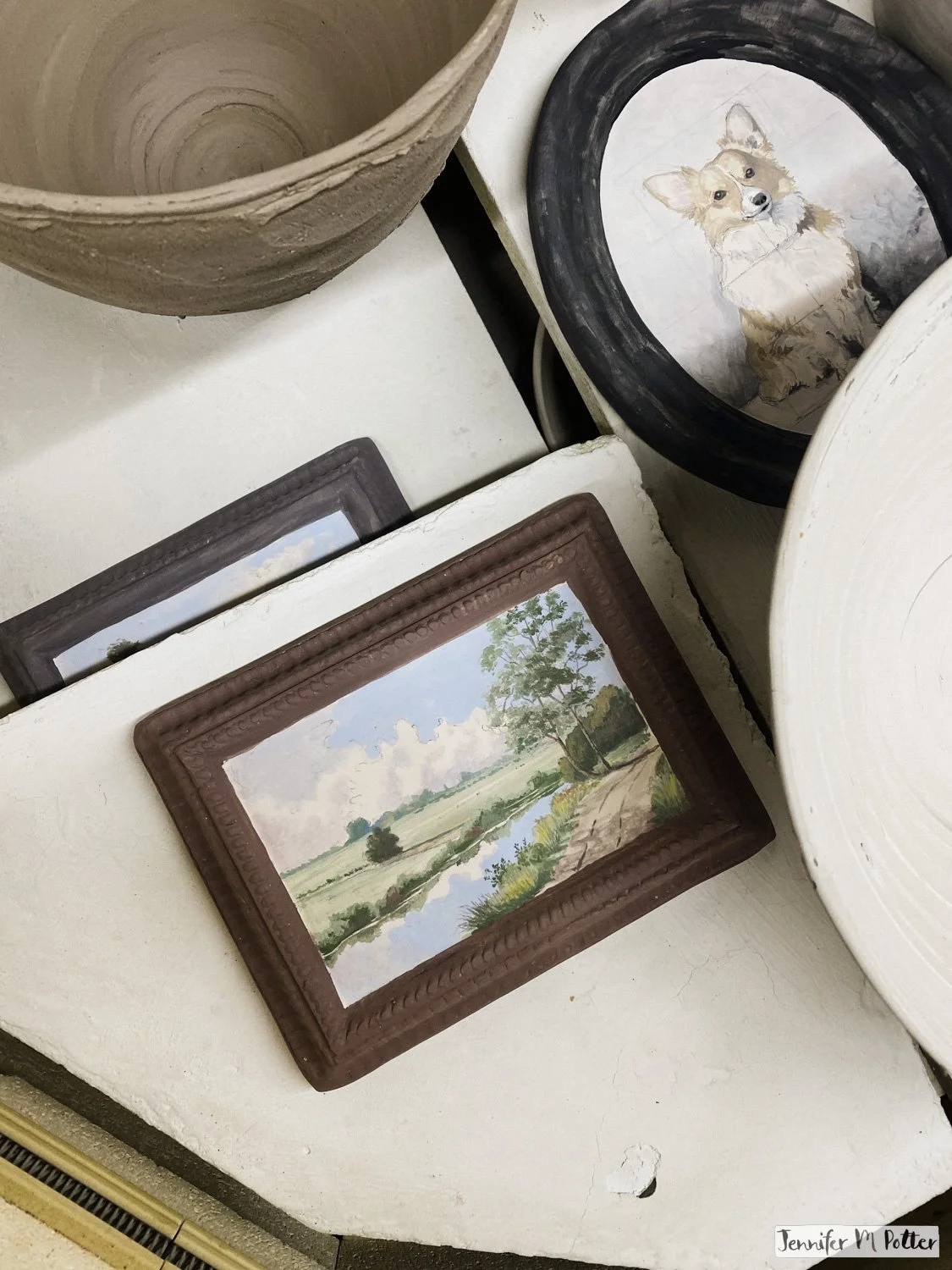
A detailed ceramic painting of a pastoral scene with a winding dirt path winding around a tree and passing an old stone house

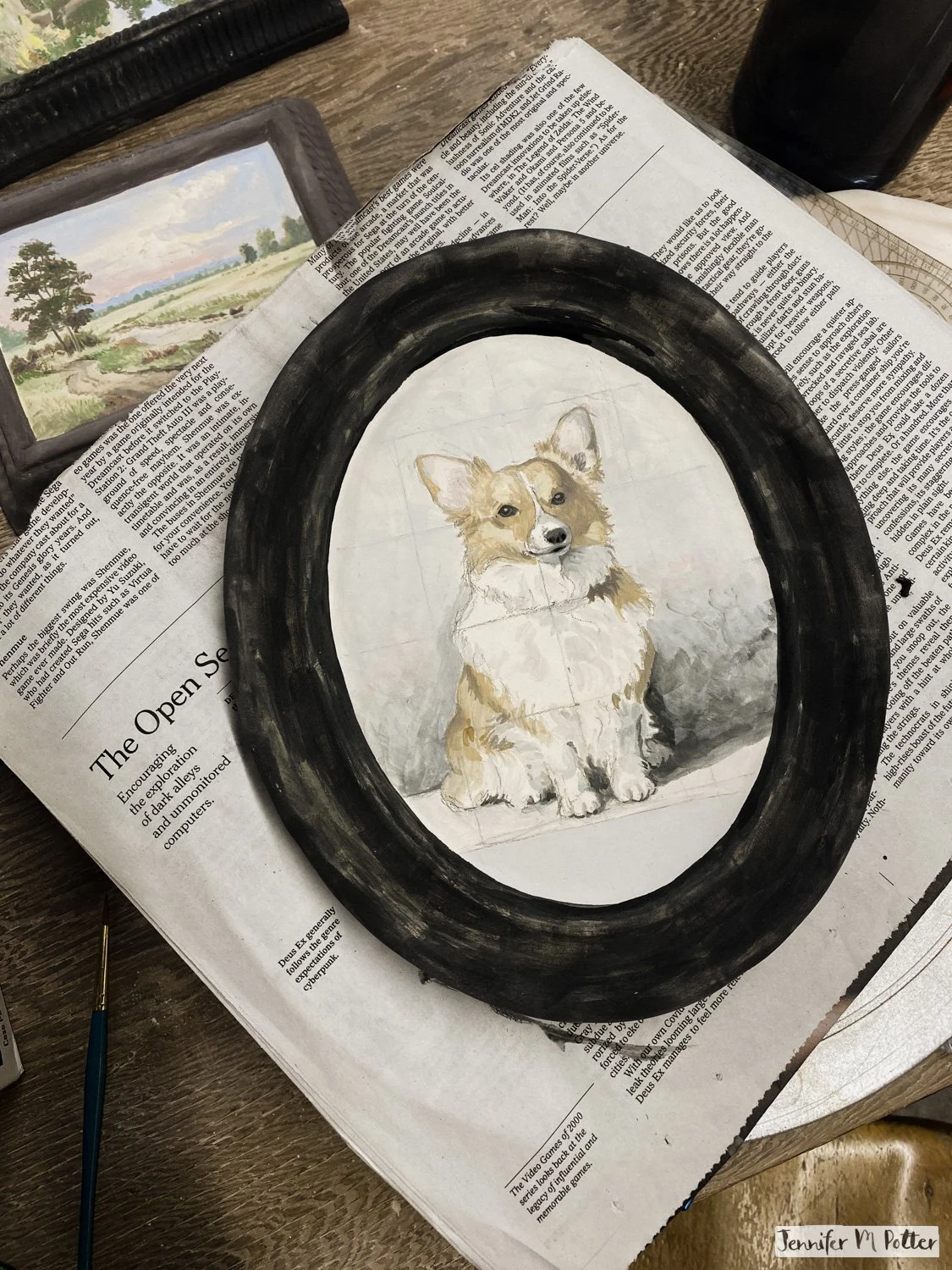
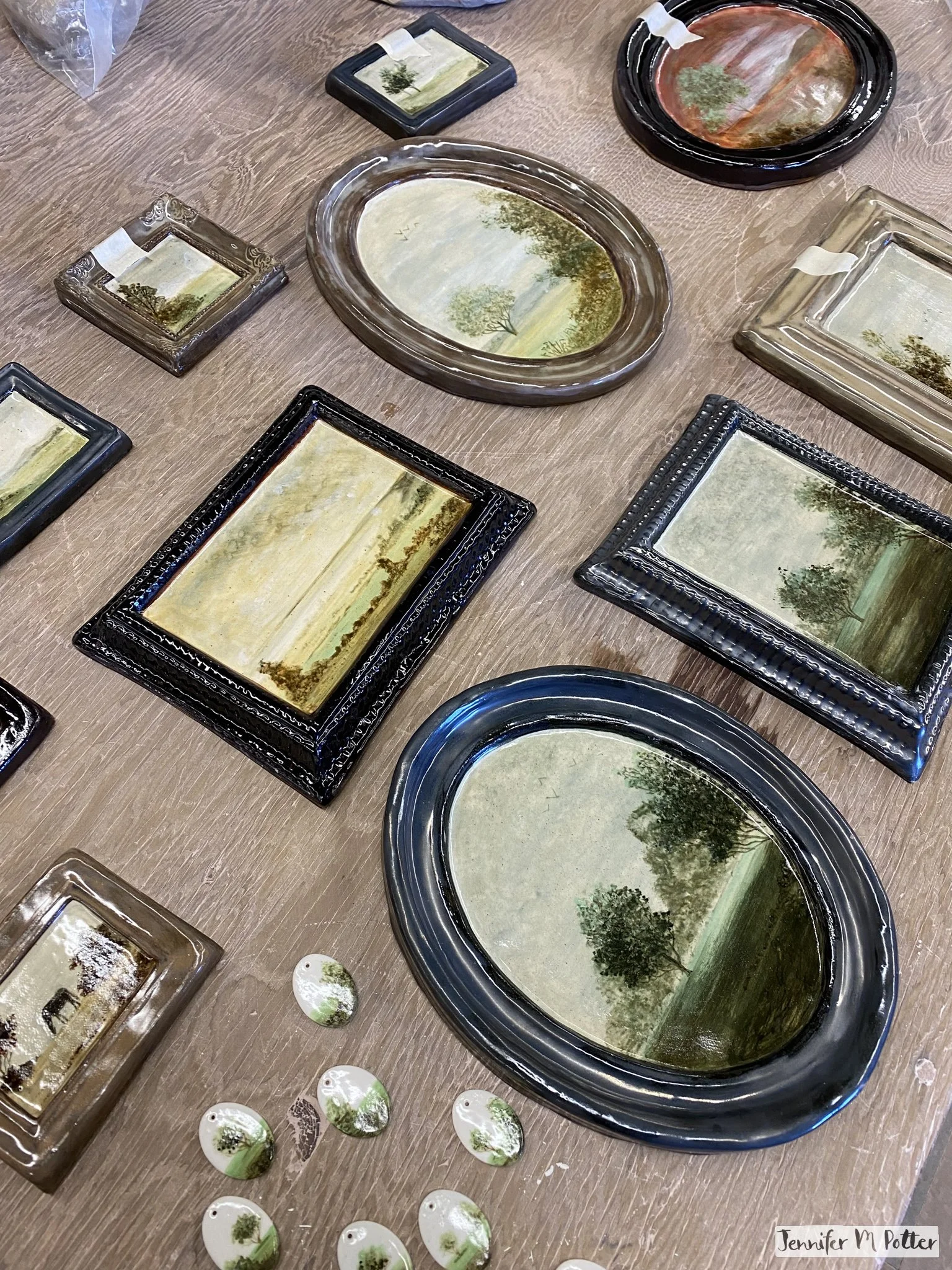
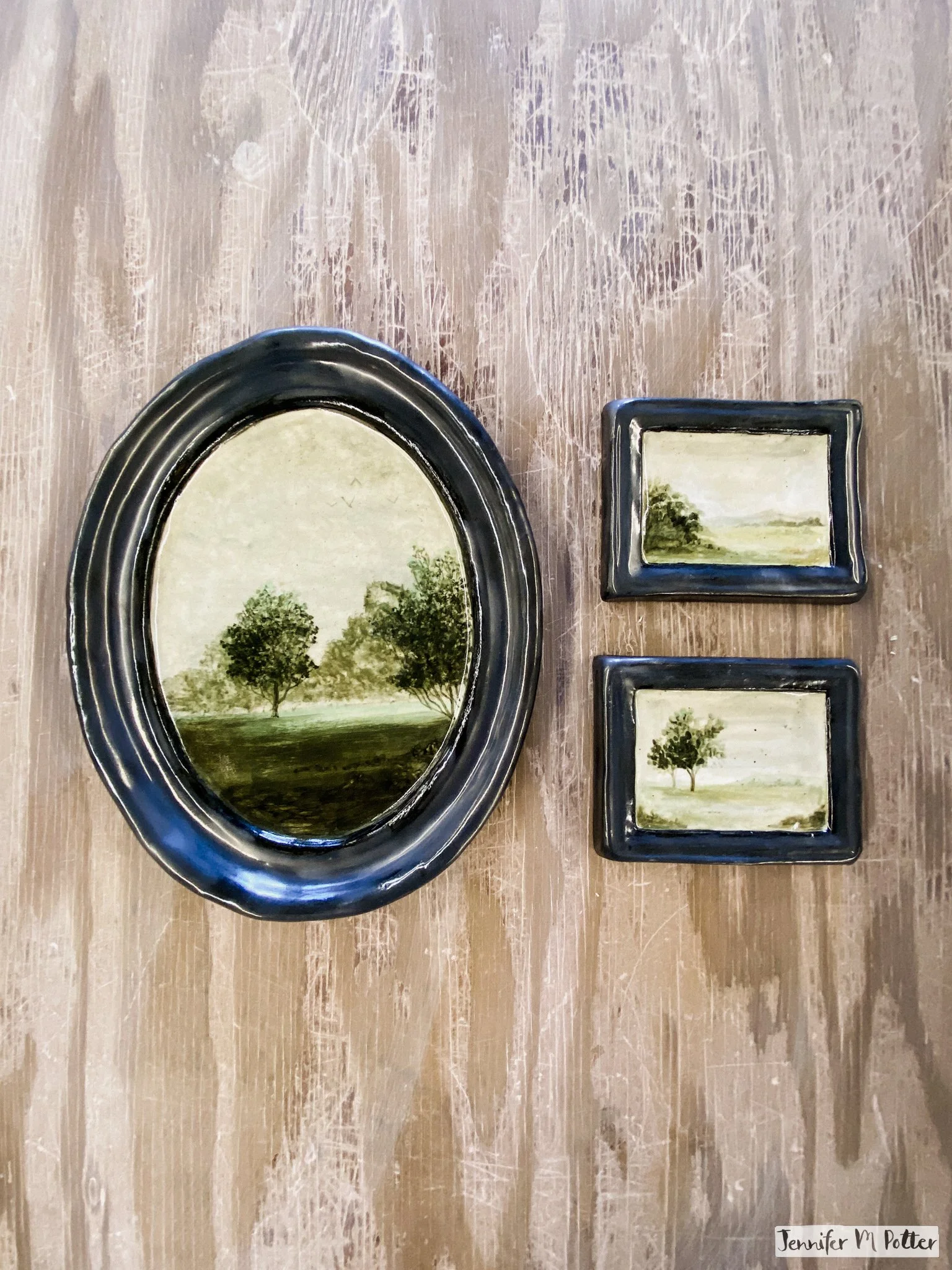
I think about this with the ceramic paintings especially. Some are indulgent—more colors mixed, more careful layering, tiny brushstrokes that hopefully won’t disappear entirely in the kiln. They're a risk every time, and the price has to reflect that. But I also want to make things that are simpler. Still beautiful, but cleaner. Fewer colors, more restraint. A more accessible price point.

The thing is, efficiency in ceramics only goes so far. It's not like illustration, where you slide out a sheet of paper, apply paint, and call it done. Each ceramic painting gets molded and sculpted, then must dry completely before the first fire. Then it's painted—sometimes over multiple sessions. Fired again. Then two different glazes, several layers of each, all painted on because the shape doesn't allow for anything faster—no quick dip and done, no two seconds in a bucket. Fired a third time. No matter how efficient I get with a brush, the forming, the firing, the glazing—it all takes the time it takes.

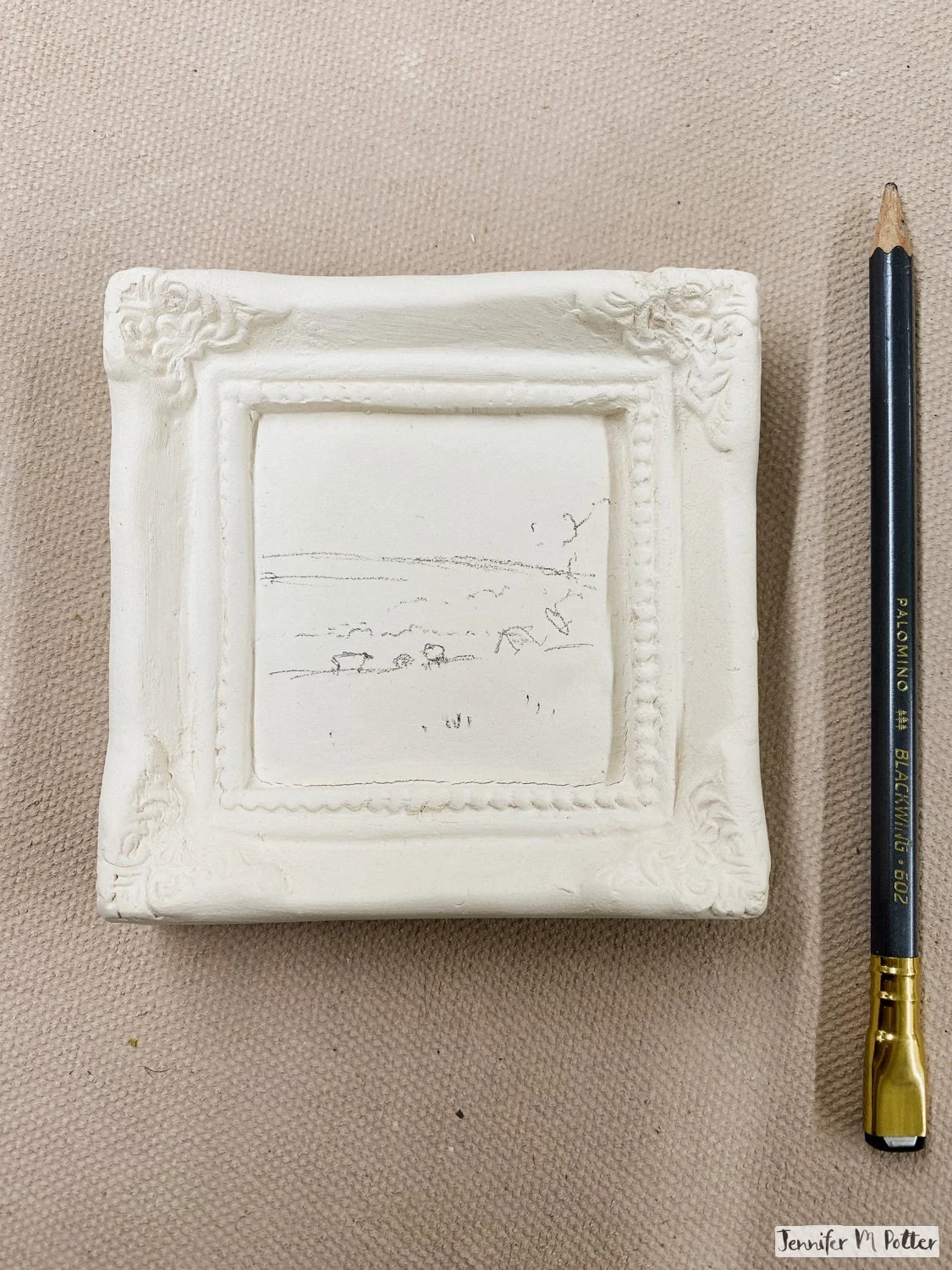
A simple sketch on a small white bisqueware frame.
A painting of a hillside with sheep in progress on a small bisqueware frame

I meant to have these frames finished and fired weeks ago. Then the snow came, and then my injured knee, and then the revisions.

The ceramic frames I expected to have finished and fired by now are still waiting.

Turns out "the time it takes" includes a lot of things you can’t always account for.

Two Puzzles

Remember those boxes that arrived in December? The ones that had to sit unopened while we dealt with basement flooding and I worked on line art for the next project? I can finally show you what was inside.

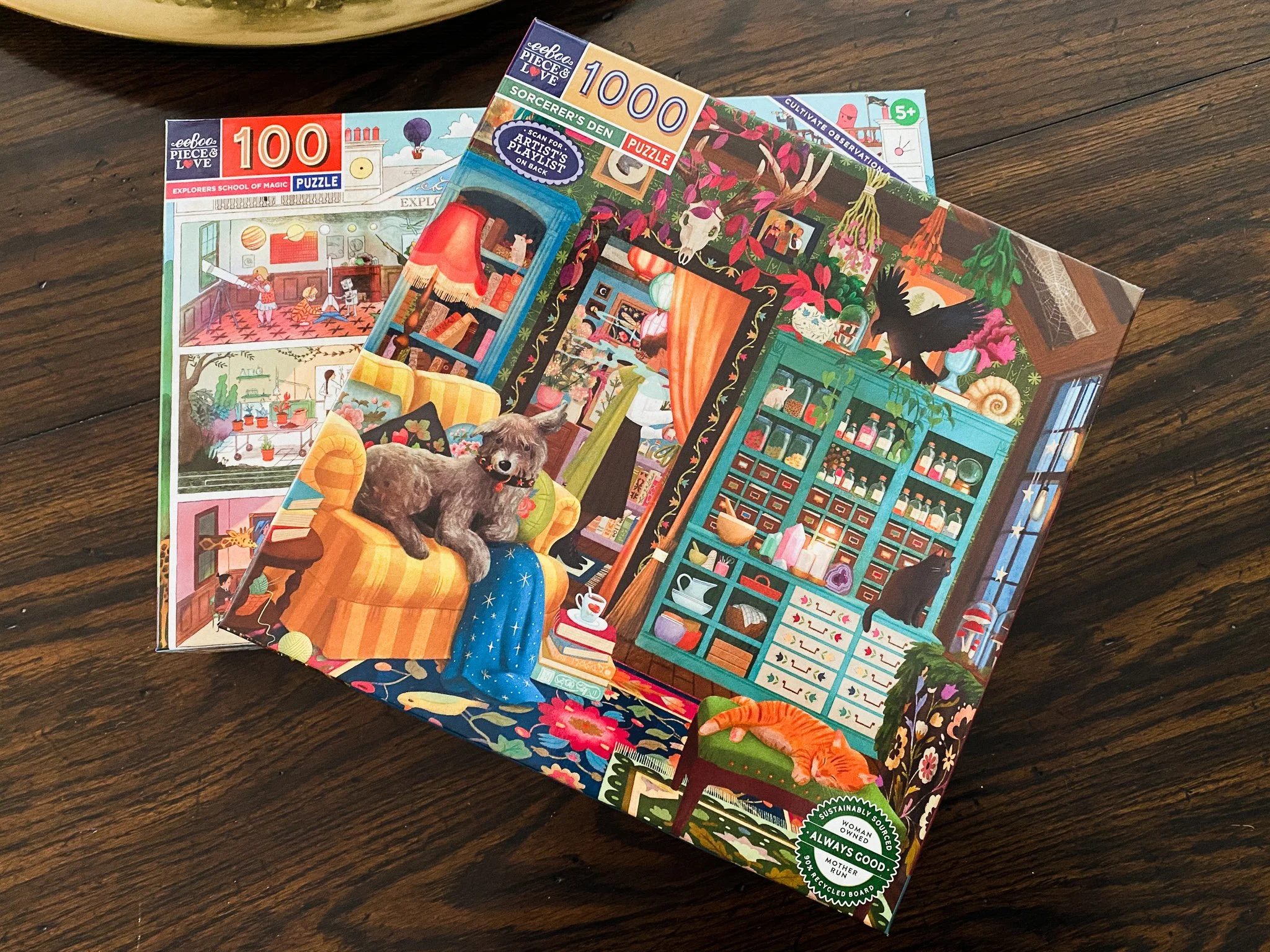
Photo of two puzzles illustrated by me and published by eeBoo.

Two puzzles I illustrated for eeBoo. The Sorcerer's Den box first—a 1000-piece puzzle, the first in a new series. As I held it in my hand, my initial reaction was critique. Are the colors too dark? Are the shapes too stiff? But then I noticed the pattern in the rug and thought how much I like all the patterns. Then my eye caught another one, and before I knew it I could sense my eye moving around the whole image. This is what I want. With illustration you're often trying to deliver a clear message, a precise focal point. But sometimes you're just inviting the viewer in. Giving them something to enjoy, to pore over. Lots and lots of eye candy. This is that.

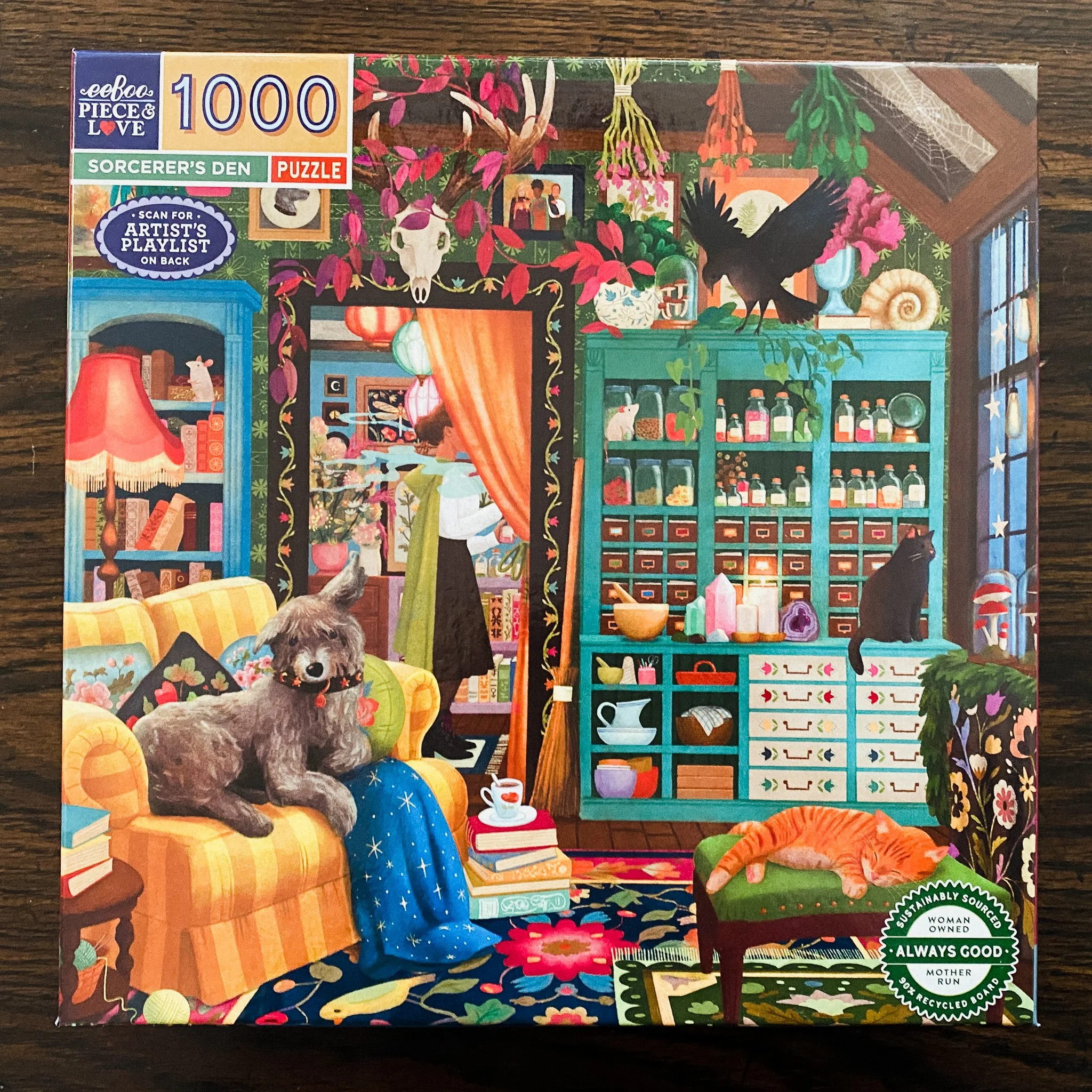
Sorcerer's Den 1000-piece puzzle box by eeBoo, illustrated by Jennifer M Potter, featuring cozy magical den with Irish Wolfhound on yellow striped loveseat, orange cat on green cushion, turquoise apothecary cabinet, hanging dried flowers, and raven

The puzzle features a cozy, colorful den. An Irish Wolfhound is curled up on an overstuffed loveseat. There are cats, mice, a raven, crystals, stacks of books, and trailing plants everywhere. A library of herbs and ingredients. Nautilus shells and mushrooms under bell jars. The sorcerer herself is in the background at her workbench, mixing potions. If you like puzzles and a witchy forestcore aesthetic, this one's for you.

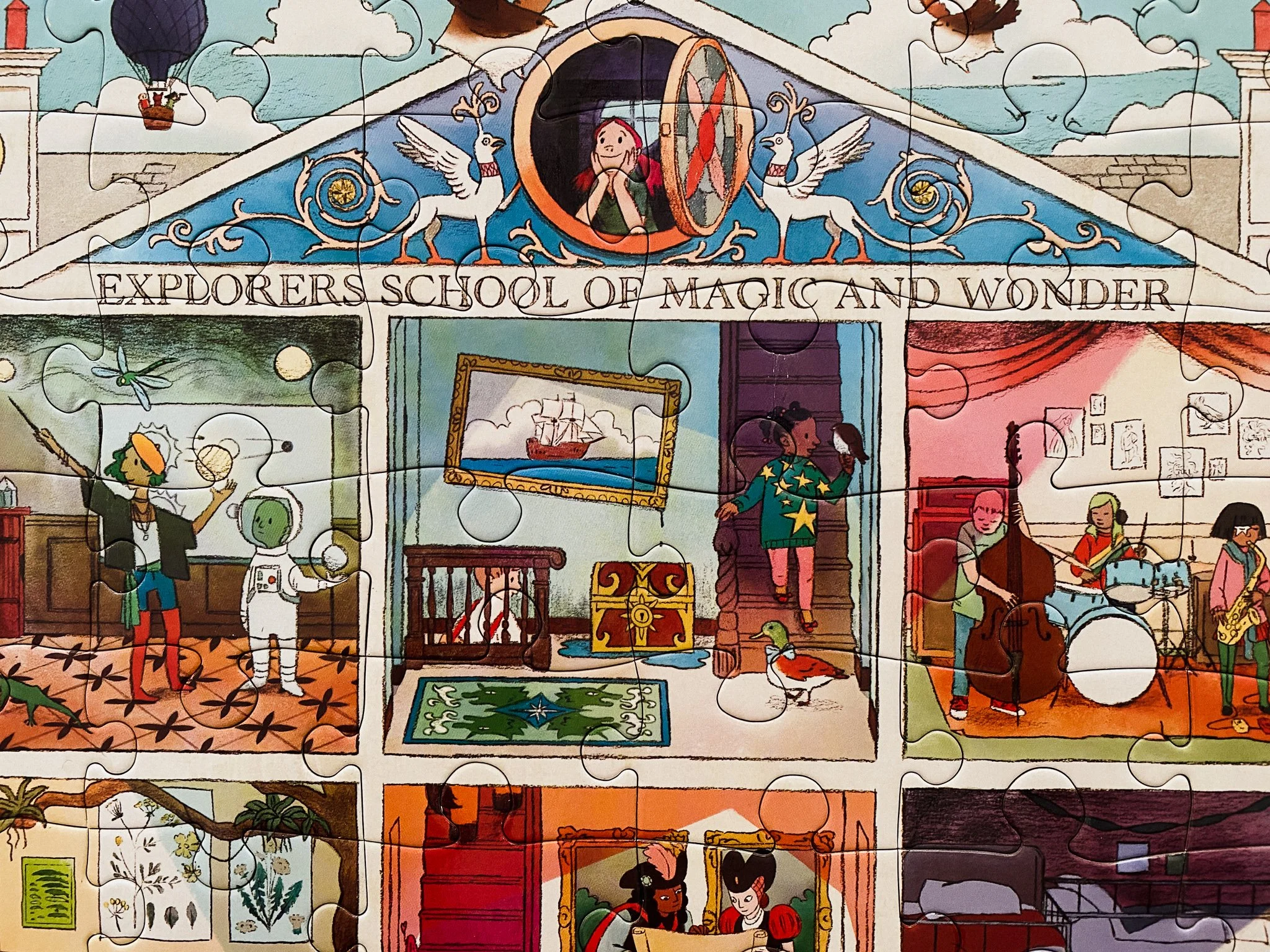
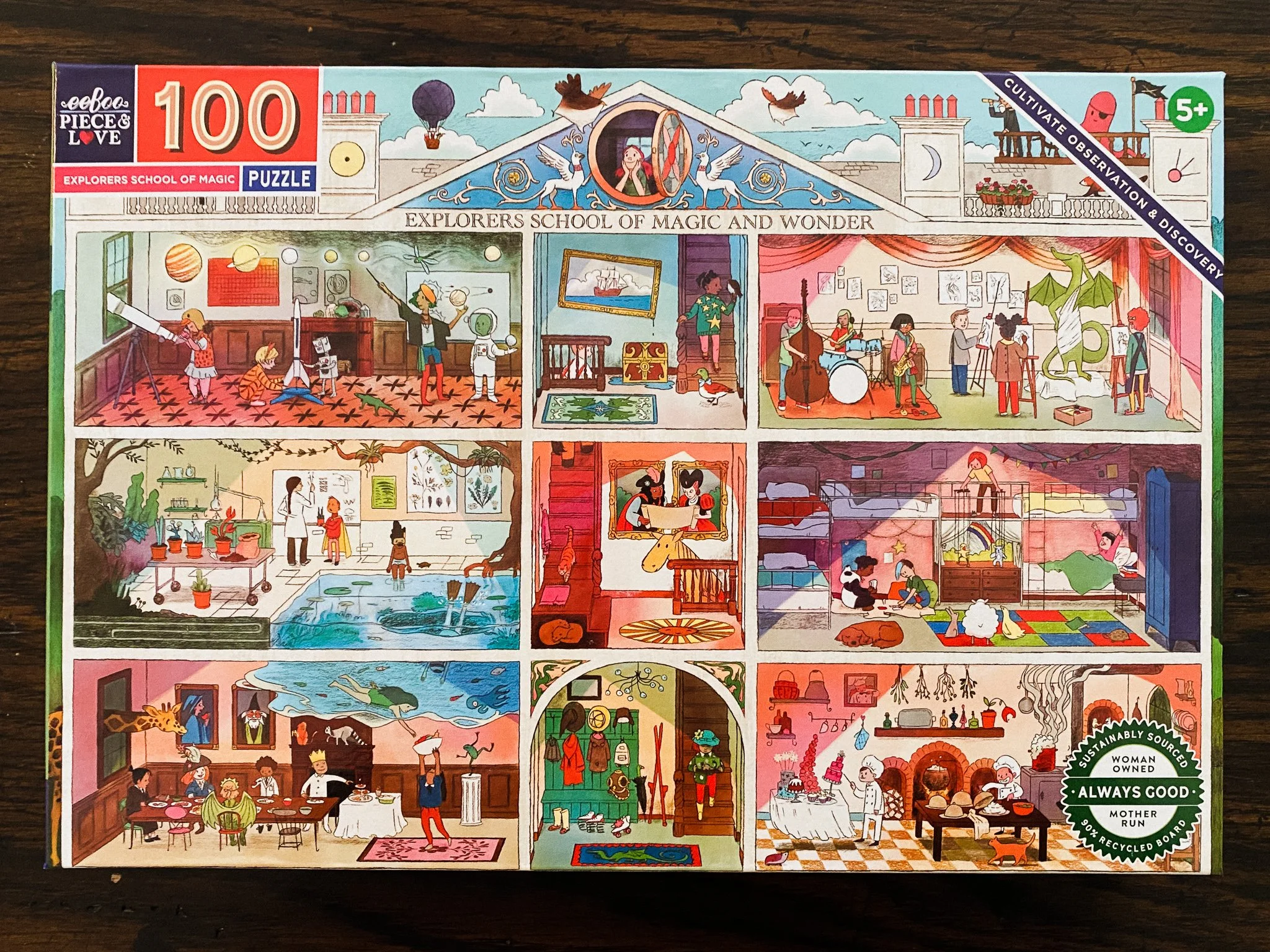
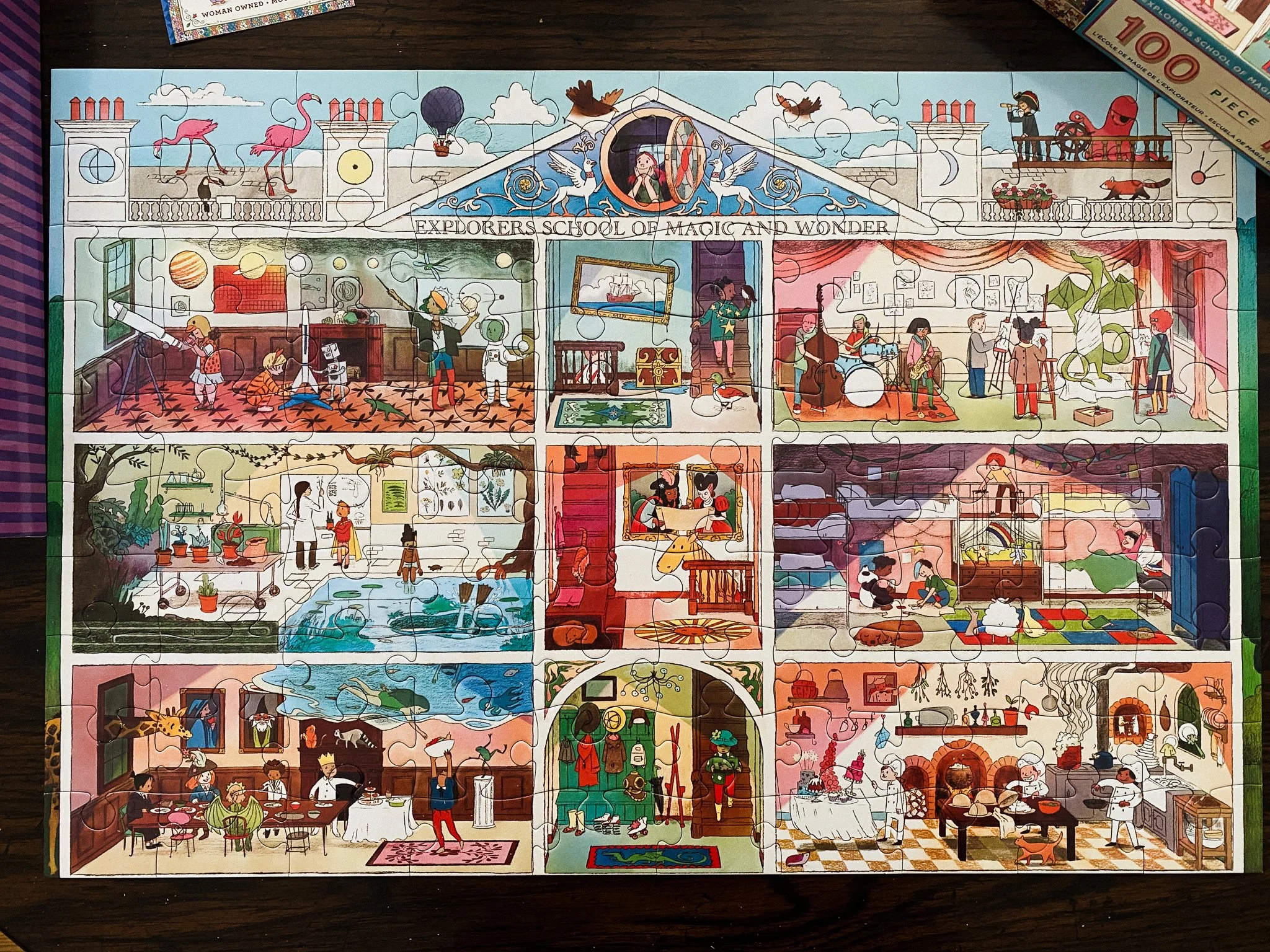
The second puzzle is the Explorers School of Magic, 100 pieces for kids. My eye moved around this one too, but differently—not object to object, but room to room. Each space telling its own story. Life drawing class with a dragon model, a puppet show in the bedroom, swimming in the greenhouse, planet gazing in the science room. Baking elaborate cakes in the kitchen and sending them out to the dining hall on floating carts. Creatures everywhere.

I made both of these during one of the most difficult times of my life. Coloring in the hospital room, distracting myself from how sick my dad was. They kept my hands busy when I needed it most. My dad pulled through, and having them here means something. It could have gone so differently, but there's nothing but joy here.

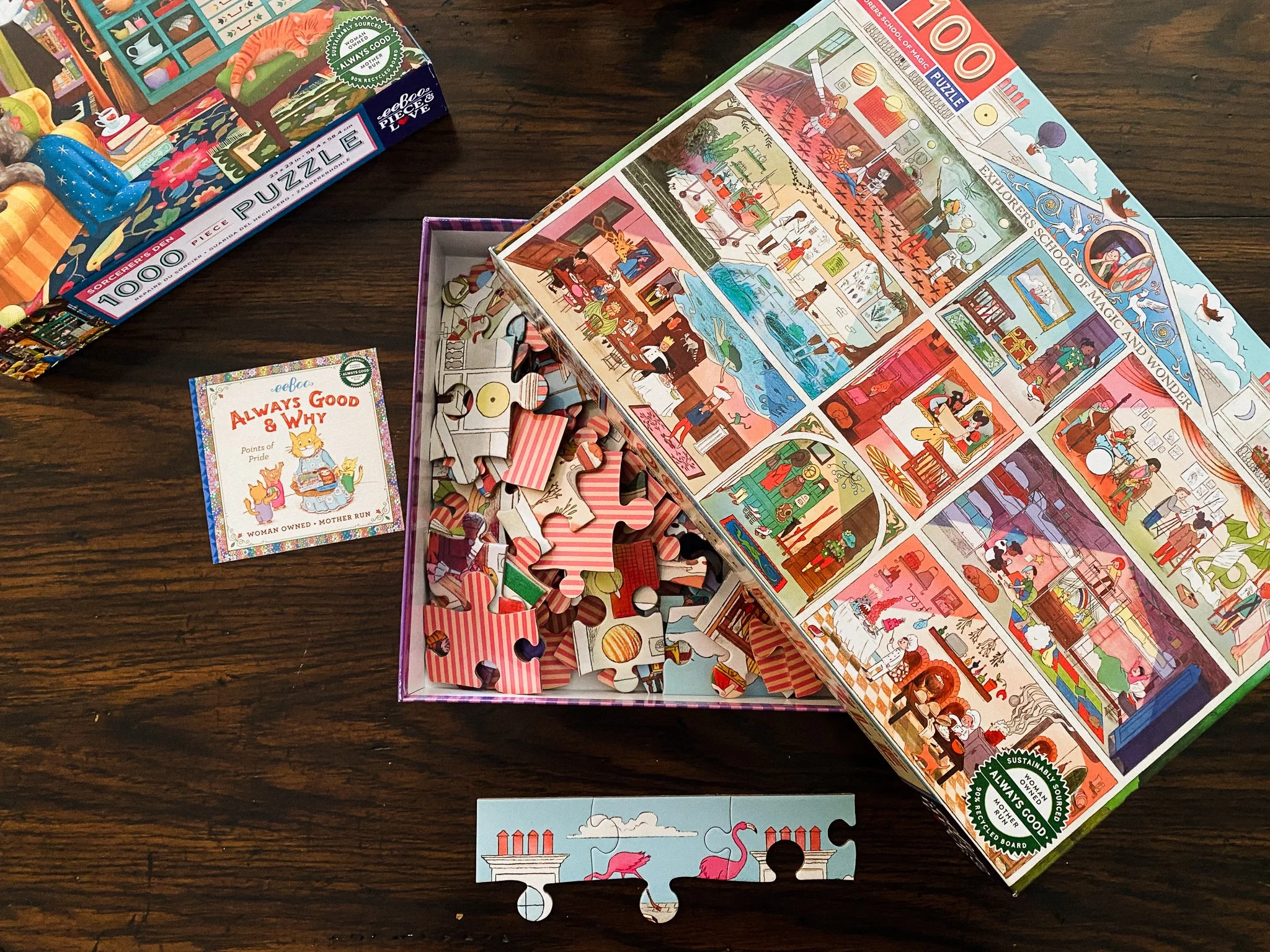
Open box of the Explorers School puzzle showing the pink striped tile backs

I put the Explorers School together recently. First thing I noticed—eeBoo added pink and red stripes to the backs of the pieces. Just decorative, but it makes each tile look special. Like a little treasure. A little confection.

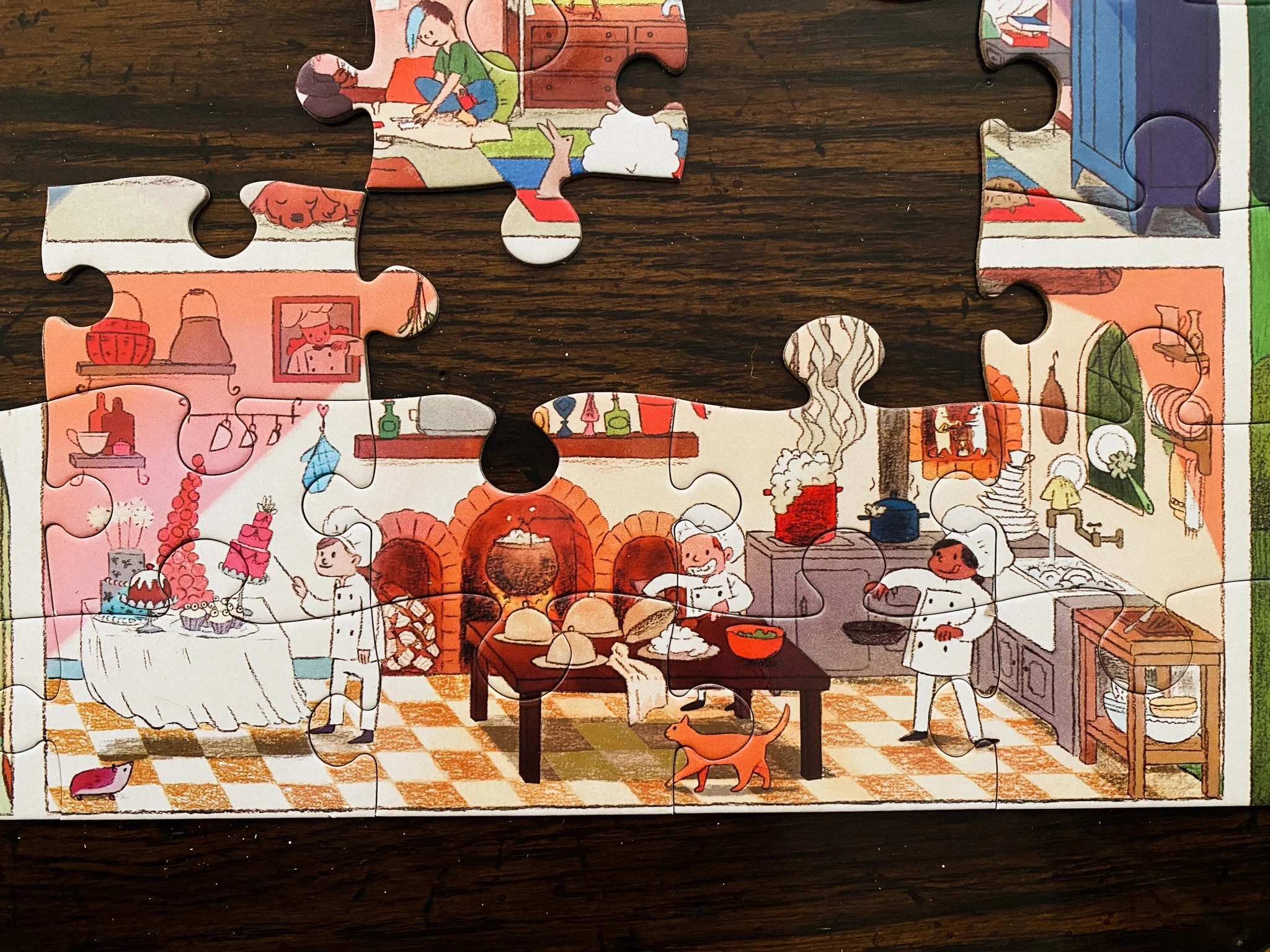
Close up detail of the kitchen scene. Elaborate cakes, the brick oven with cauldron bubbling, kid chefs in white hats, a cat on the checkered floor, dishes washing themselves

I started with the edges, then sorted pieces by room—the color variations made it easy to collect them into little piles. Kitchen pieces here, bedroom there, science room over here. I think that'll be fun for kids, building it room by room. Each one its own little world.

It's been several months since I finished this illustration, so I got to revisit it with fresh eyes. Sometimes I'm too close to my work, too critical. But this came out cute. The Sorcerer's Den is still in its box. A 1000-piece puzzle is a commitment I haven't had time for yet.

Completed  Explorers School of Magic puzzle  showing all nine magical  rooms

Both puzzles are available now—you can find them on eeBoo's website or at shops that carry their puzzles. If you see one in the wild, let me know.

A Pile of Imperialists

My husband and I were talking about fascism over dinner—like you do—and he said fascism is imperialism turned inward. Directed at a nation's own people. I hadn’t heard it put that way before.

He also mentioned Foucault's boomerang. I've only read Madness and Civilization, and this hadn't crossed my path. (Thank you, art school.) But the idea stuck: the things we do to other nations, we eventually do at home. Other countries become the testing ground. Foucault and others were talking about how Europe ignored colonial atrocities until they came home as fascism.

America has its own long history of atrocities, which includes destabilizing governments and overthrowing regimes. All in the interest of democracy, of course. Depending on who you ask. And what's been redacted.

I'd been thinking about imperialism anyway—setting sights on Venezuela and Greenland, selling arms to warring nations (while hosting peace talks, naturally), creating an enemy in immigrants. It's all more of the same, isn't it?

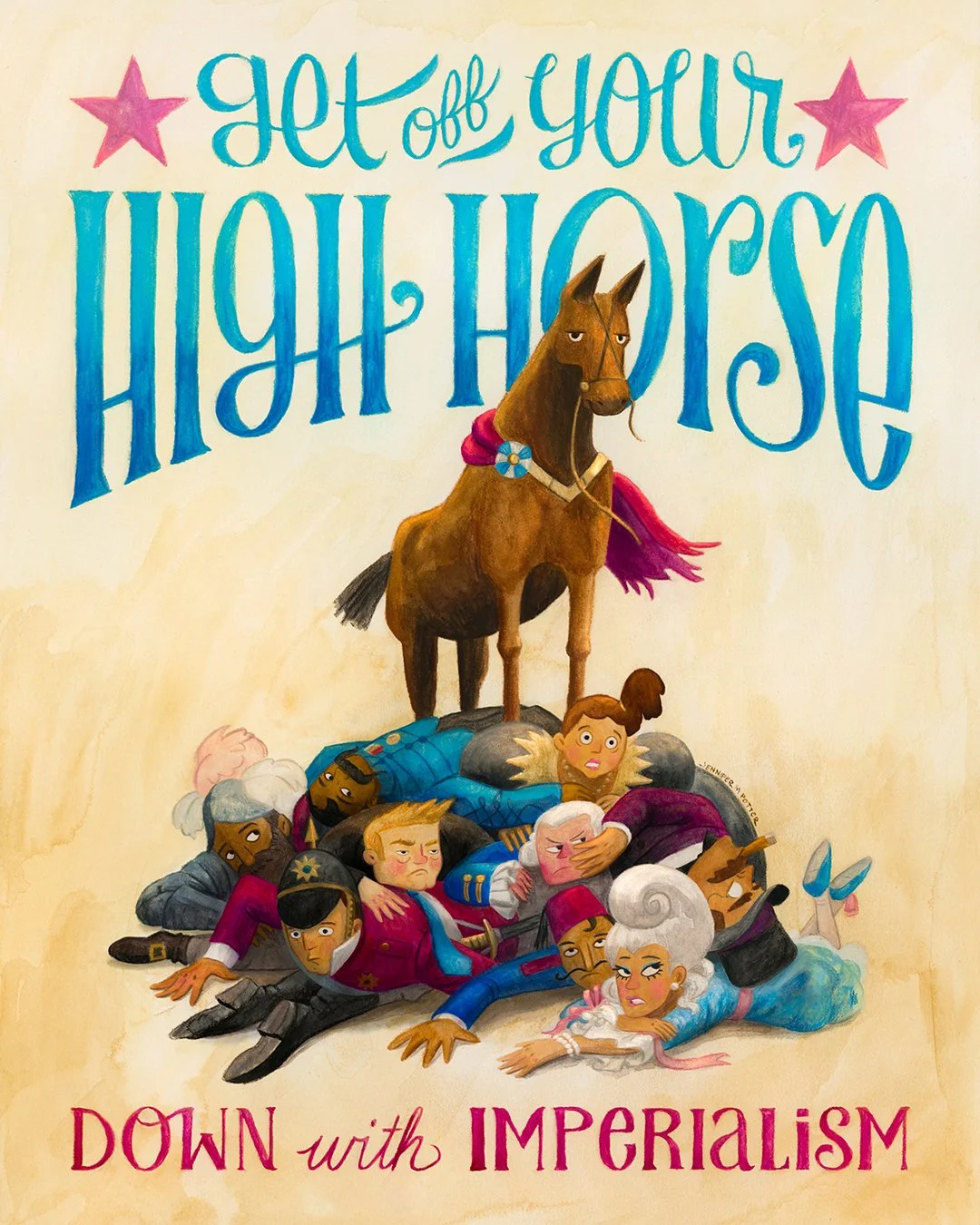
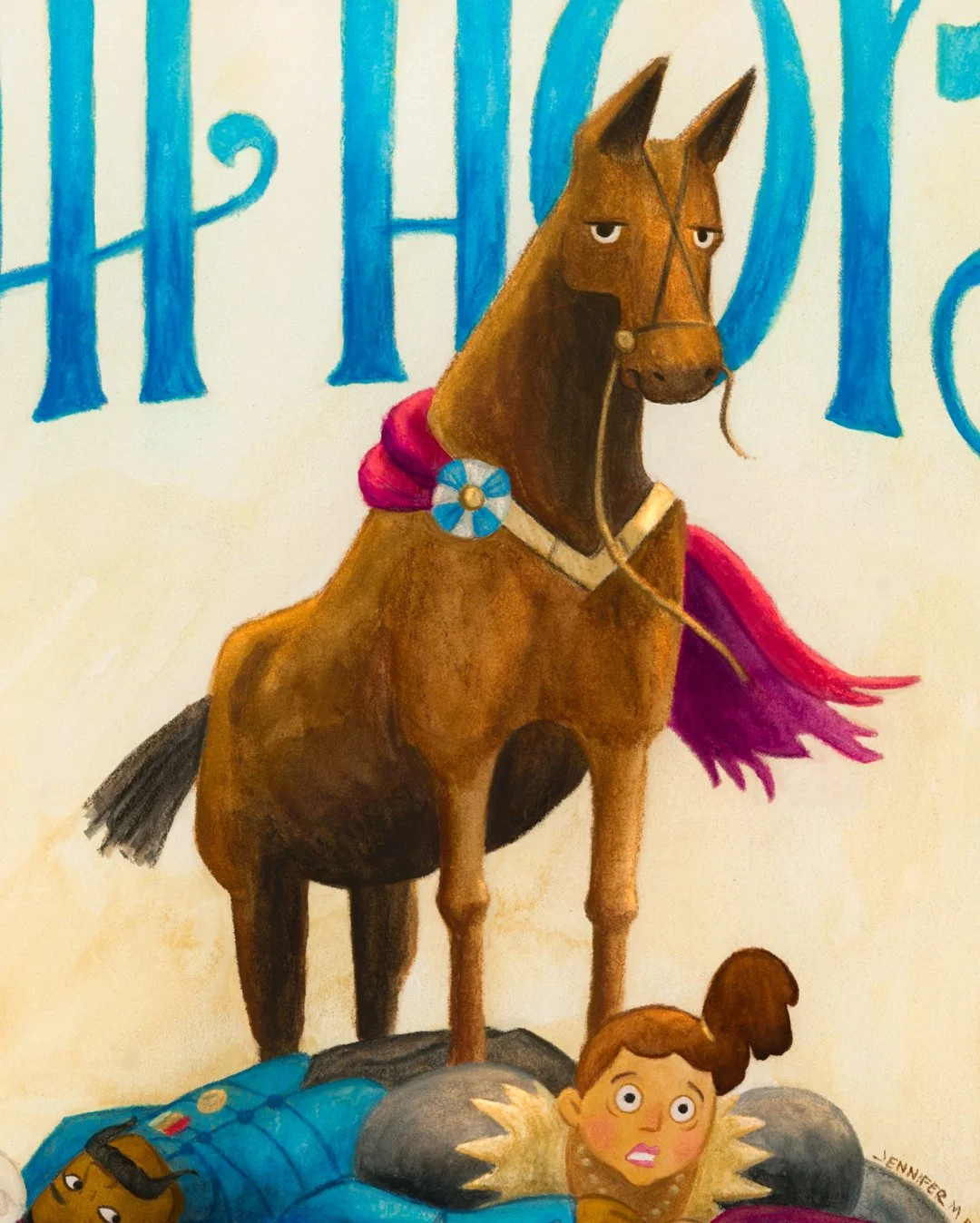
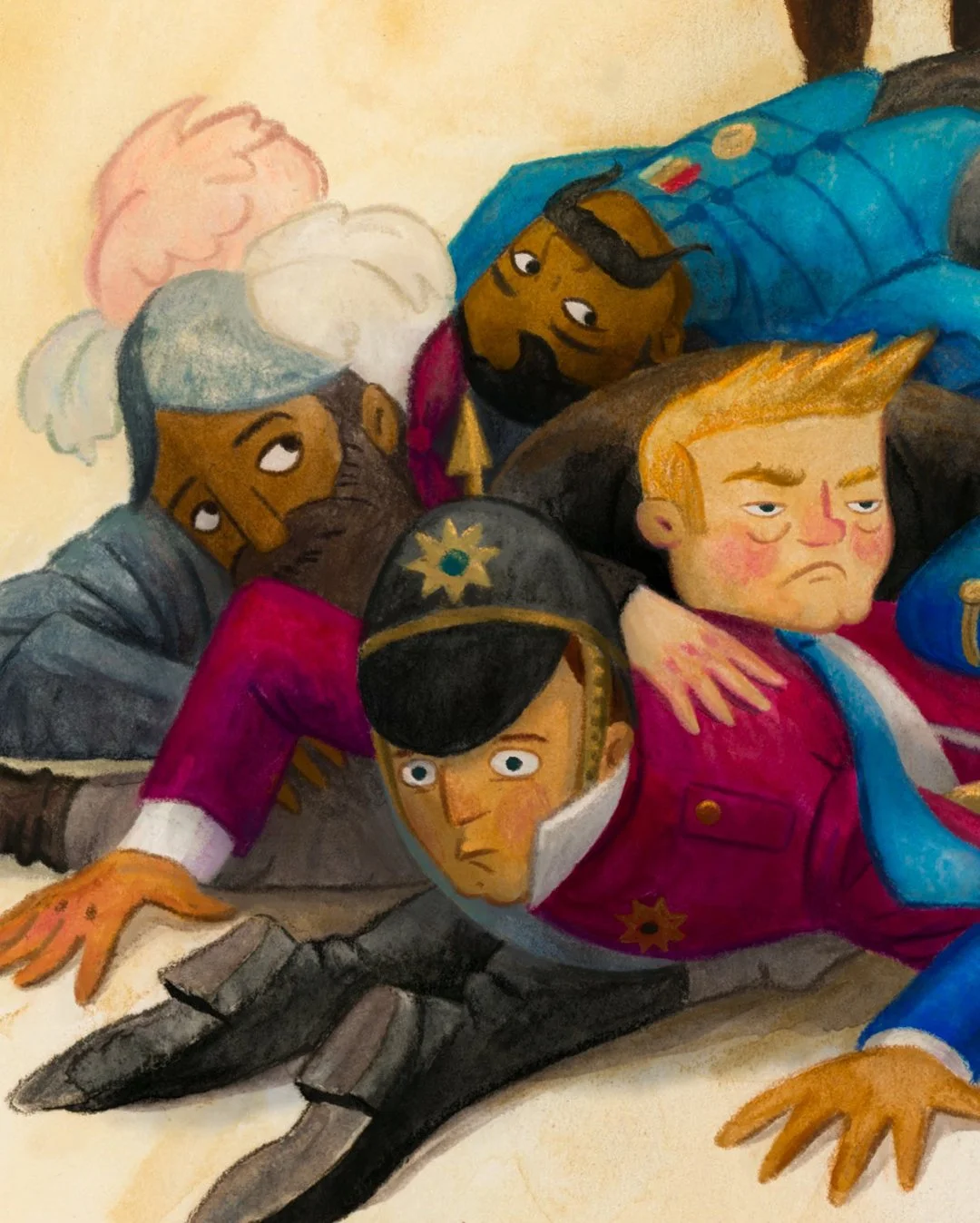
So I made this piece.

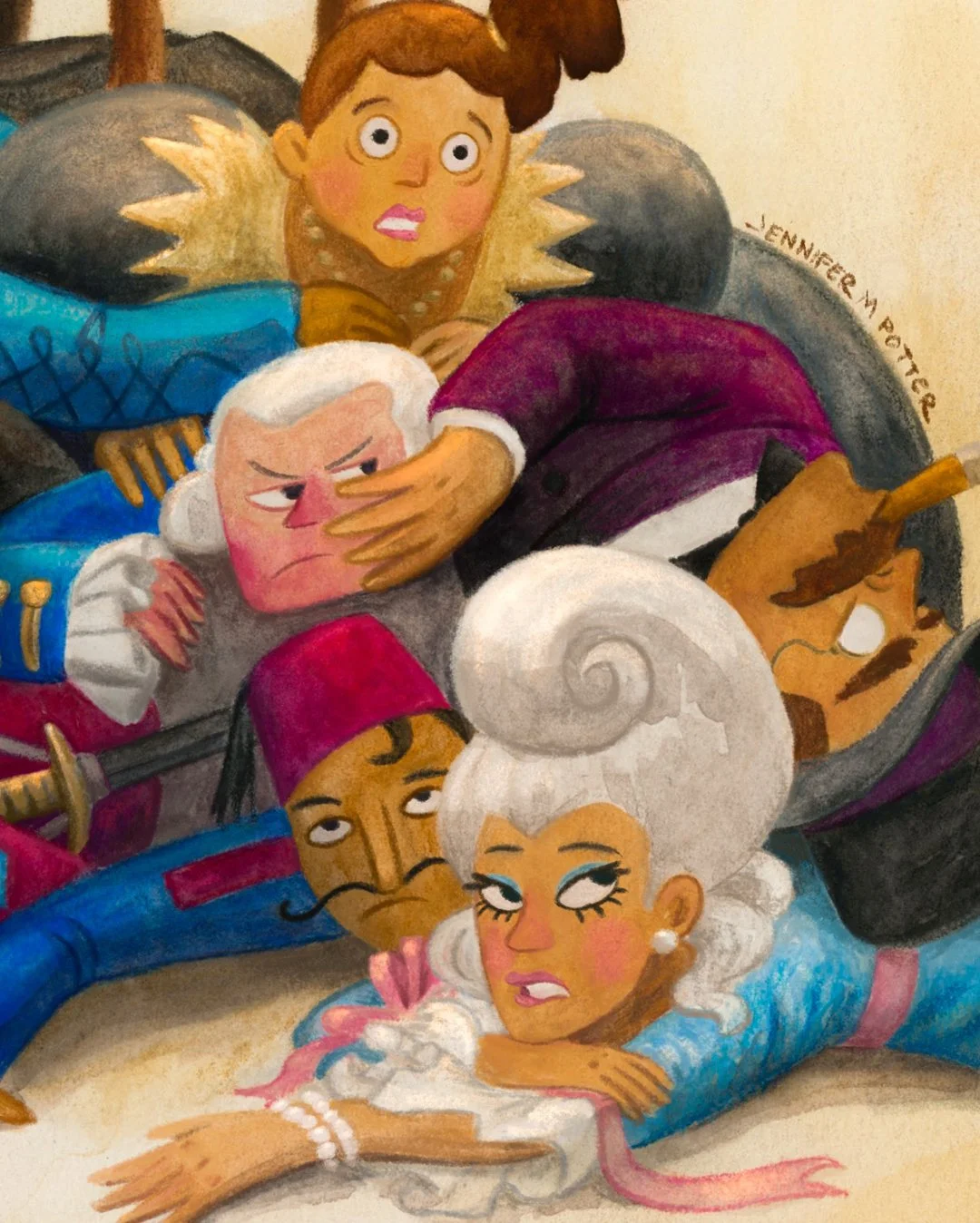
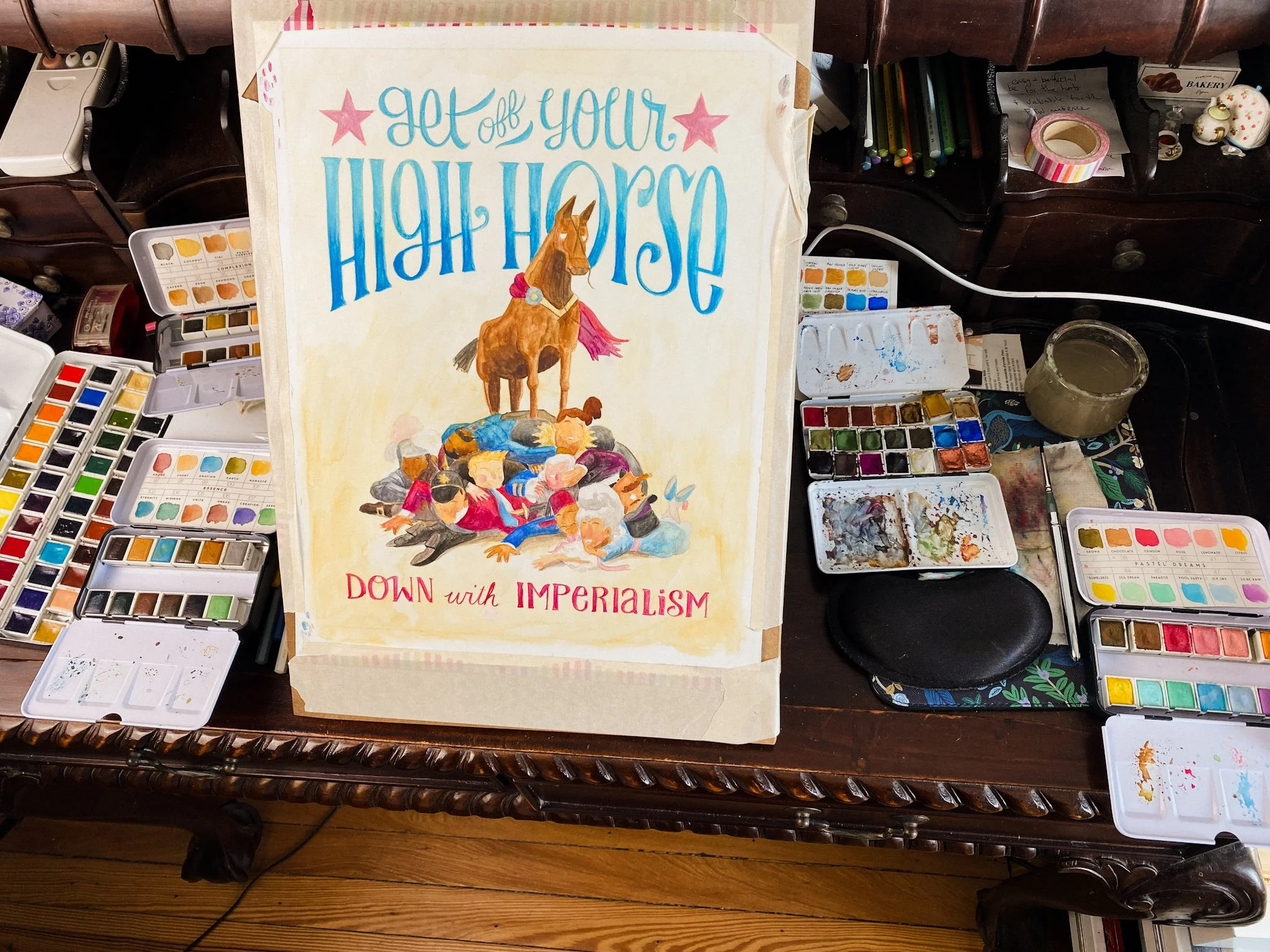
Illustration of a horse standing atop a pile of imperial figures in historical dress, text reads Get Off Your High Horse and Down With Imperialism

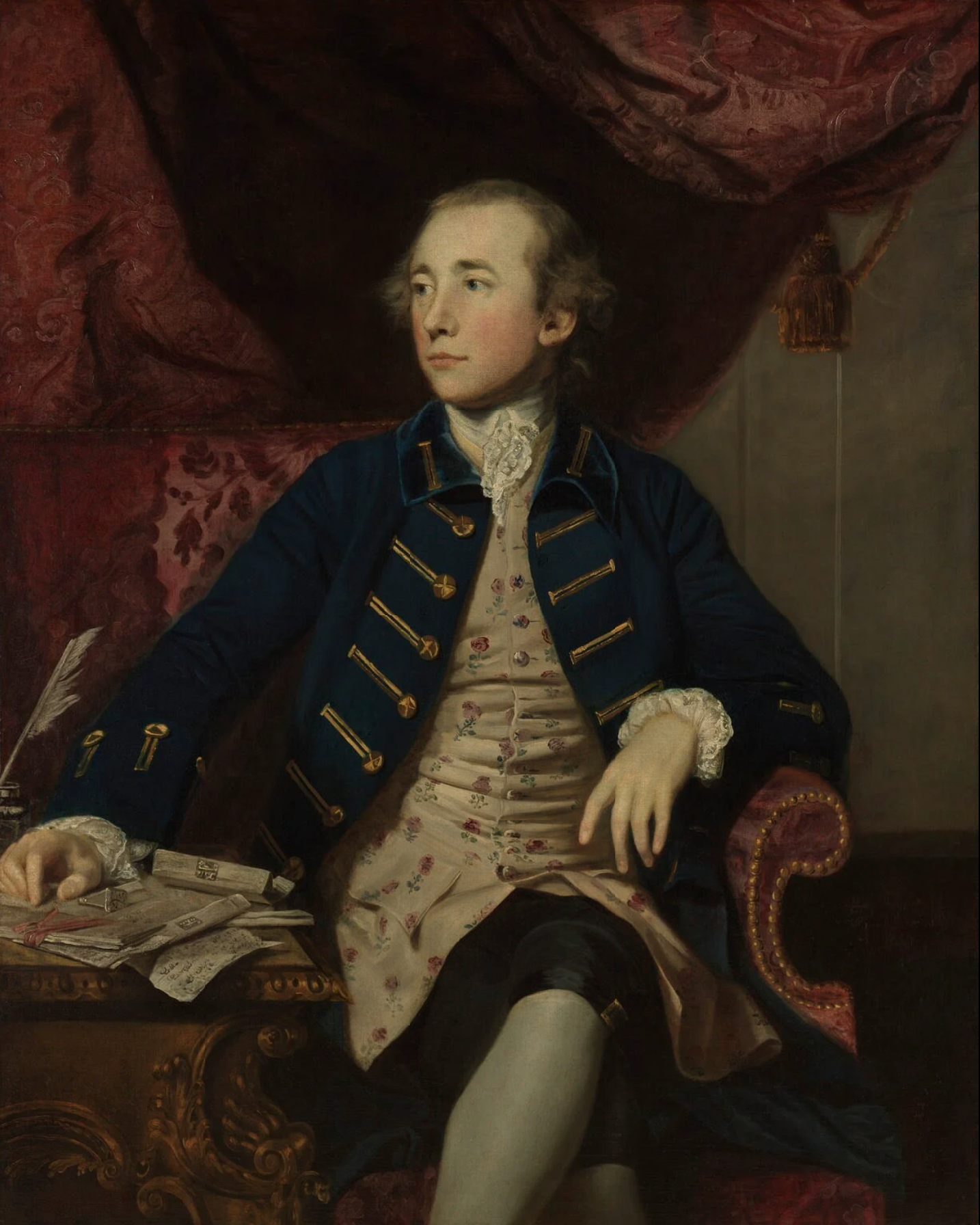
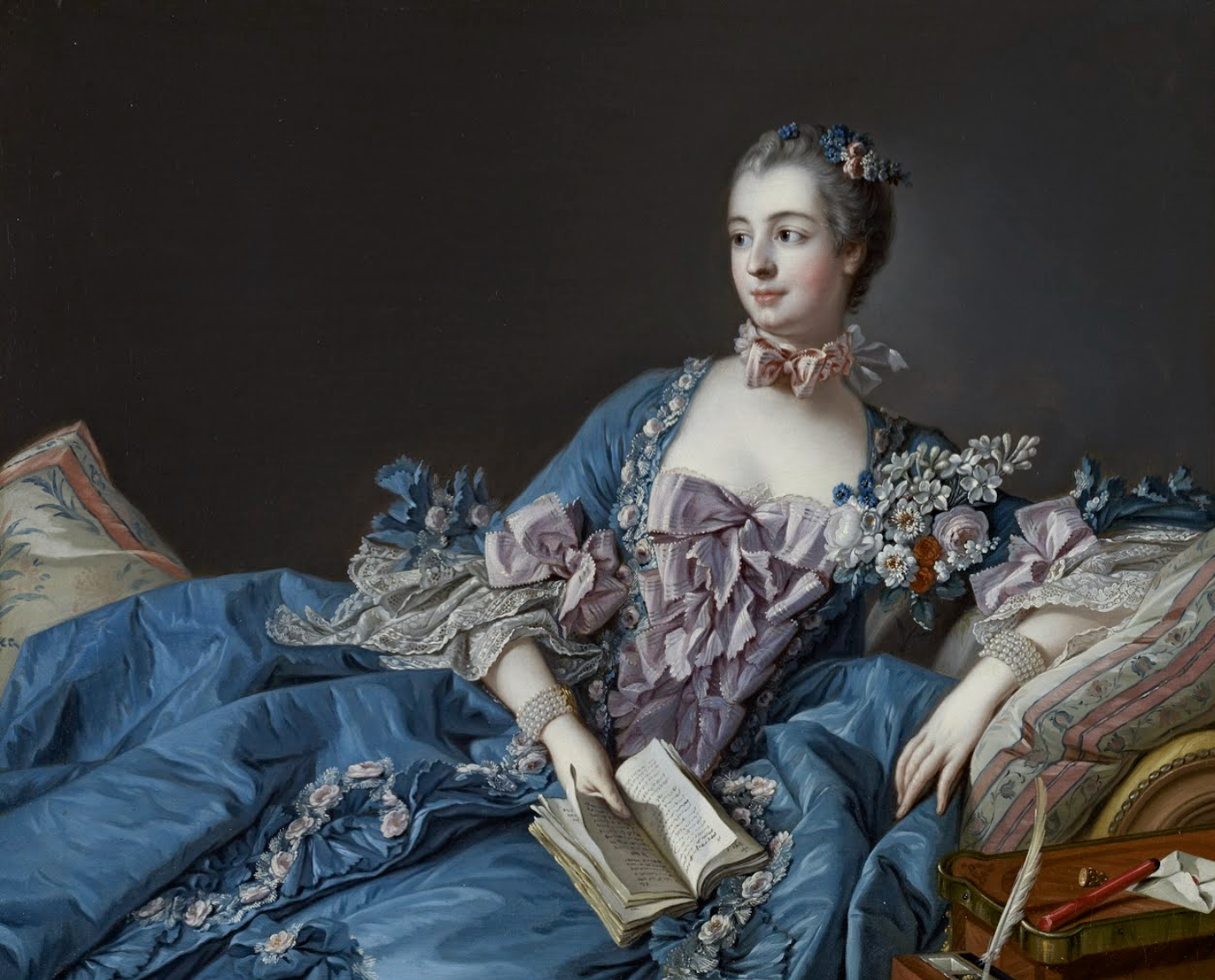
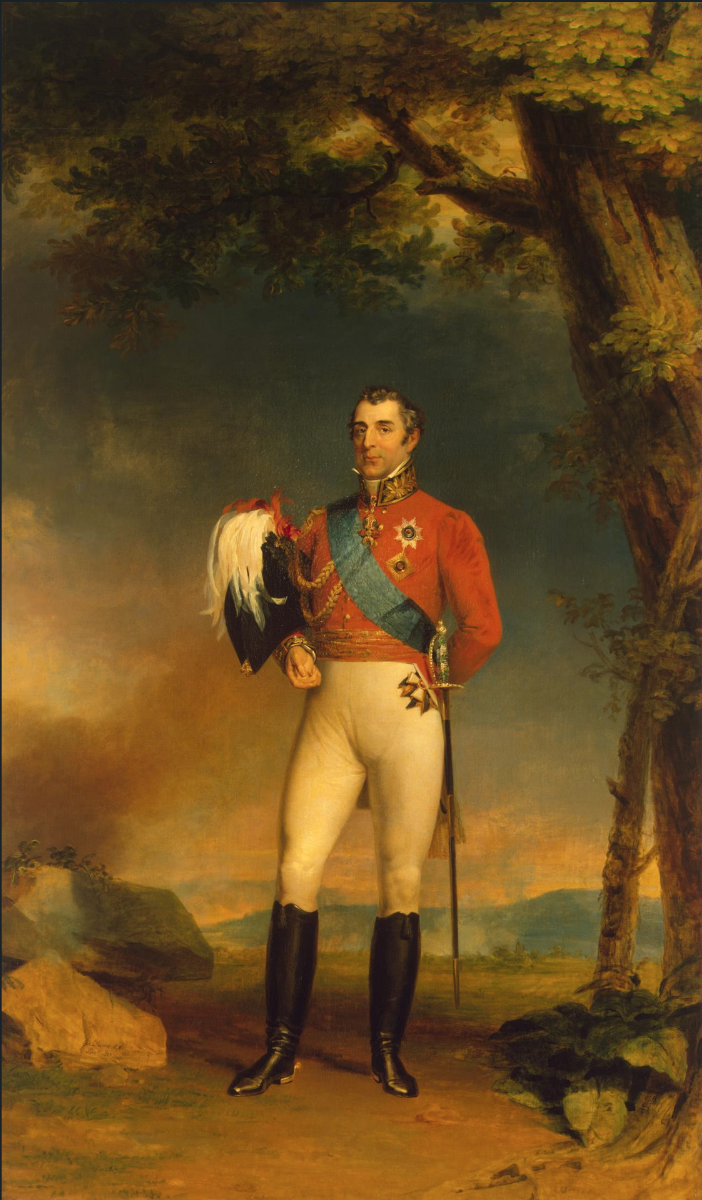
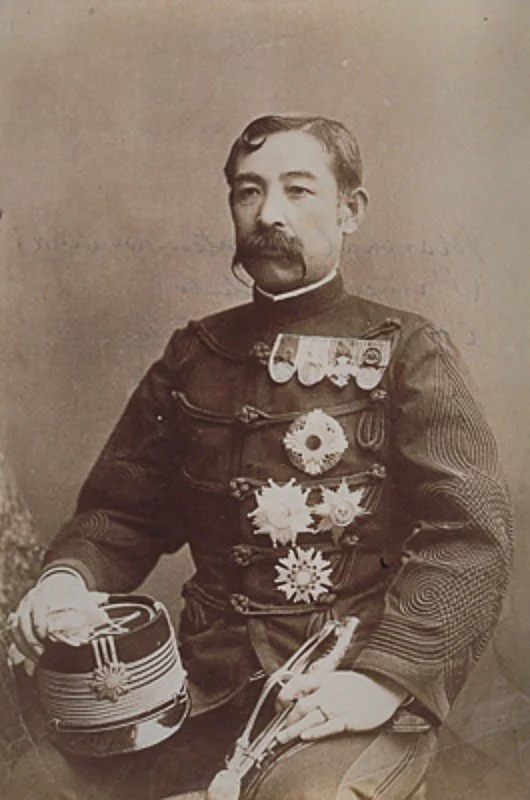
Making it meant diving into images I love. Gilded Age portraits in black silk and lace, rococo oils with ribbons and flourishes everywhere. Ottoman infantrymen in red fezzes, Japanese princes in military regalia, soldiers covered in medals. All that gorgeous fabric and elaborate costume, the wealth and power on display. I admire the aesthetics. And I get that they exist because of imperialism. The wealth that funded them, the systems that made that wealth possible—it's all tangled together

A lot of dark and beautiful things came out of this history. I can love these paintings, study this clothing, use it in my work. And I can still say no more.

I want to live in a world where imperialism is behind us. I don't think that happens unless we work toward it.

The piece itself is watercolor and watercolor pencil. I had several palettes open, looking for the exact right pigments to complement my pencils. A mix of drawing and painting. Layer after layer—watercolor, pencil, blend, repeat. Always scribbling and blending, drawing out the texture.

Work in progress of the illustration on a desk surrounded by multiple watercolor palettes
Snowdrift

The snow started Saturday evening and continued all day Sunday. We spent most of the day shoveling—our pathway first, then the sidewalk in front of our house, then a few of our neighbors' sidewalks too. Our houses are close together. There's not much ground to cover. I texted my elderly neighbor and asked if she wanted me to take care of the path and stairs leading to her porch. She said yes, thank you. When I went to do it, I found another neighbor had already cleared it.

As I shoveled, I thought about our differences in this country. The stories we tell. There are people in the surrounding counties who are afraid to come into the city. I have family who are afraid to come here. I wonder if they know there are good neighbors here, too.

In the afternoon a young man with a snowblower came through and cleared the sidewalks for the entire block.

Dog walking on a quiet, freshly ploughed street

This morning I walked Frisket, both of us bundled against the cold. The sun was finally out. Few cars were on the road, mostly just snow plows. The few people out were walking dogs like me, or shoveling their cars out of a foot of snow. Or carrying sleds to the big hill by the ballpark.

We walked in the street rather than trudging through the sidewalks. I looked down. Frisket had lost a boot. I went back to find it—a small black speck in the snow. A man with his son got there first and tossed it to me so I didn't have to climb over the snowdrift.

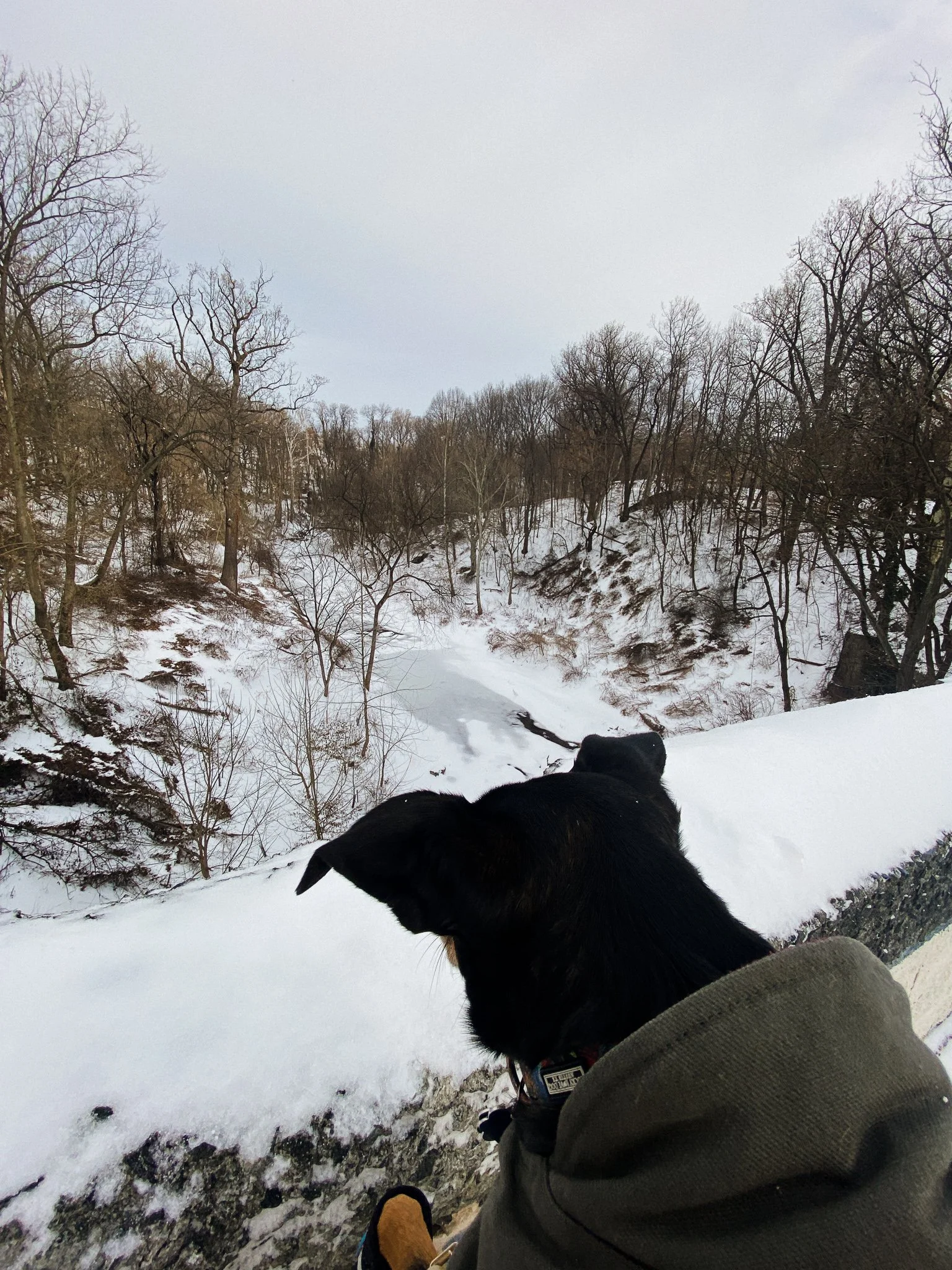
Dog overlooking an icy creek surrounded by trees and a blanket of snow

We walked to the bridge overlooking the creek. Frisket doesn't like bridges but she always wants me to lift her up so she can see over the wall. She likes the view as much as I do. We looked out over the creek, icy and white. Blue sky above. I stood there a moment thinking about how beautiful the world is. Fierce, and terrible, and beautiful.

On the way home we stopped and watched some dads sledding with their kids.

I spent my lunch break calling my senators and going through my closet. I pulled coats and sweaters for our neighborhood ice watch group. Donations for people who can't go shopping for fear of being abducted by men with masks.

I think about how some people spend an awful lot of money to make us believe that the poorest and most disenfranchised among us are the reason everything is broken right now.

This afternoon I need to work on my shop. Go through photos of the things I made, upload them, write product descriptions. It feels unfair to engage in capitalism when all of this is happening.

Snow-covered residential street in Baltimore with parked cars and row houses

I don't know if I'll make art about any of this. I feel a call to, but it also feels like my voice isn't necessary—there are already so many people saying what I'm feeling, better than I can say it.

And then I wonder if that's the wrong way to look at it. Maybe my voice matters anyway. In the way that protests are about showing up. Another body to add to the numbers. I prefer taking concrete action. I like helping people where I can, doing something instead of just posting about it. I don't want to make anyone feel worse. We already feel terrible.

I don't have an answer. Just this: I shoveled snow. I called my senators. I'm donating what I can. I'm working on my business. I'm trying to hold all of it at once.

Underglaze vs. Watercolor

I usually only fire my work twice. A first bisque fire to bake the clay enough to glaze, then a final fire to melt the glaze into solid, shiny glass. But when a piece involves detailed painting, I fire it three times.

I rarely do this. An extra bisque uses extra electricity. Sometimes I even paint straight on greenware—unfired clay. But these pieces took so long—a second bisque sets the underglaze so I can apply glaze without risk of smudging. I’ve done this before. A finger brushed against underglaze that was once dry but was dampened by wet glaze. So frustrating!

A second fire also gives me a chance to correct mistakes. Like if the burgundy comes out too streaky, the way it did in my test tile, I can touch it up before sealing it forever under glaze.

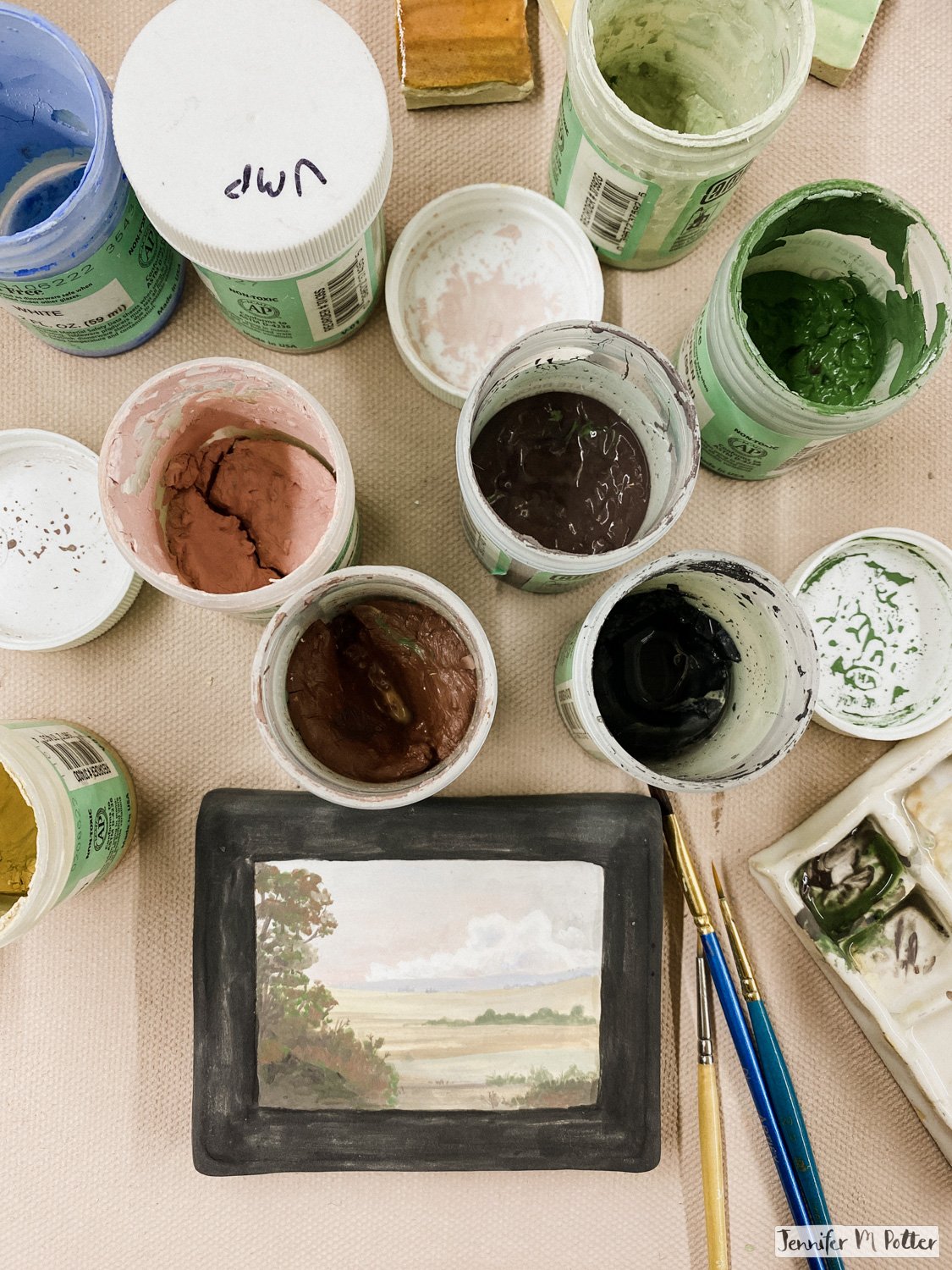
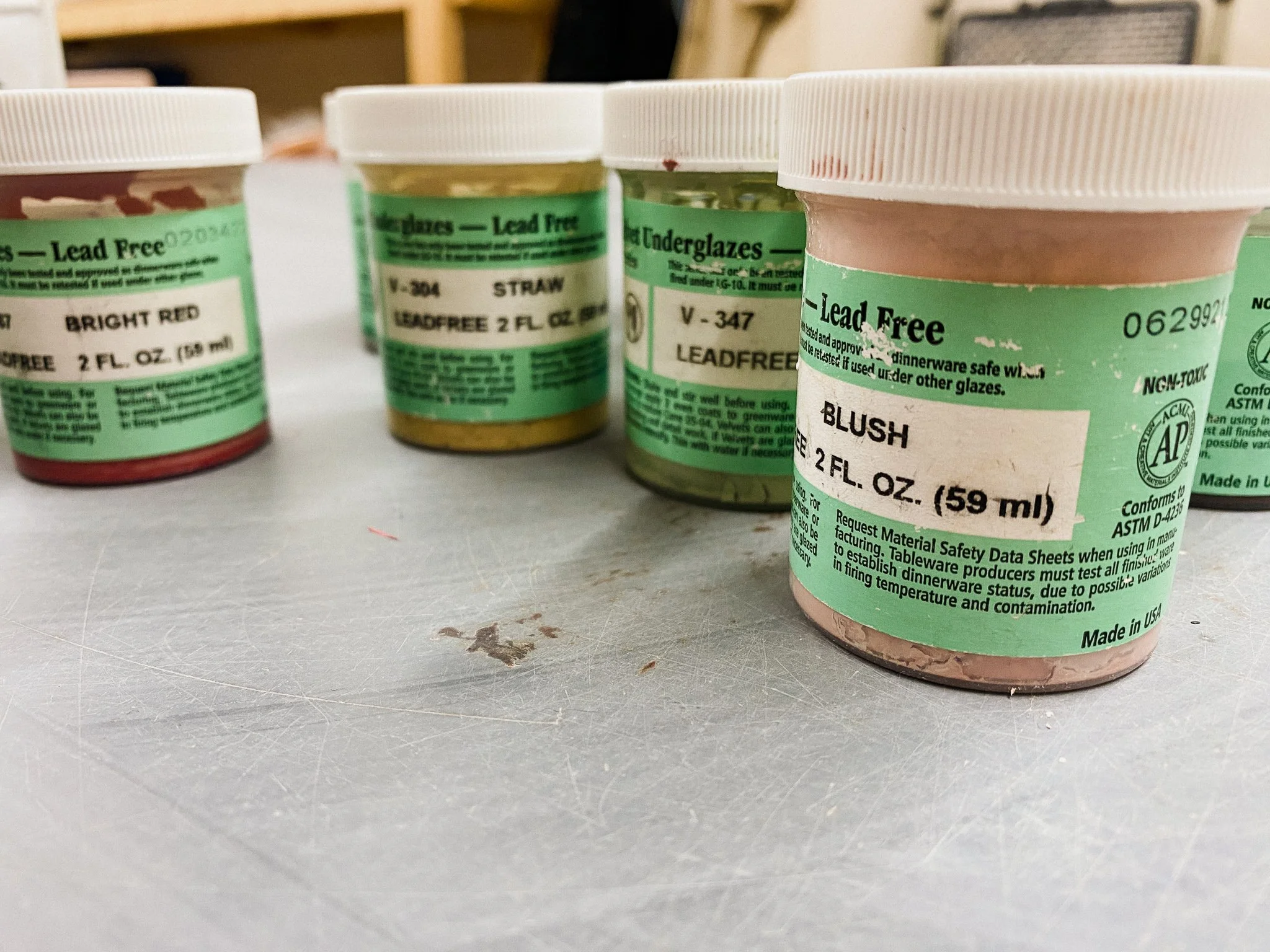
Small jars of Amaco Velvet Underglaze

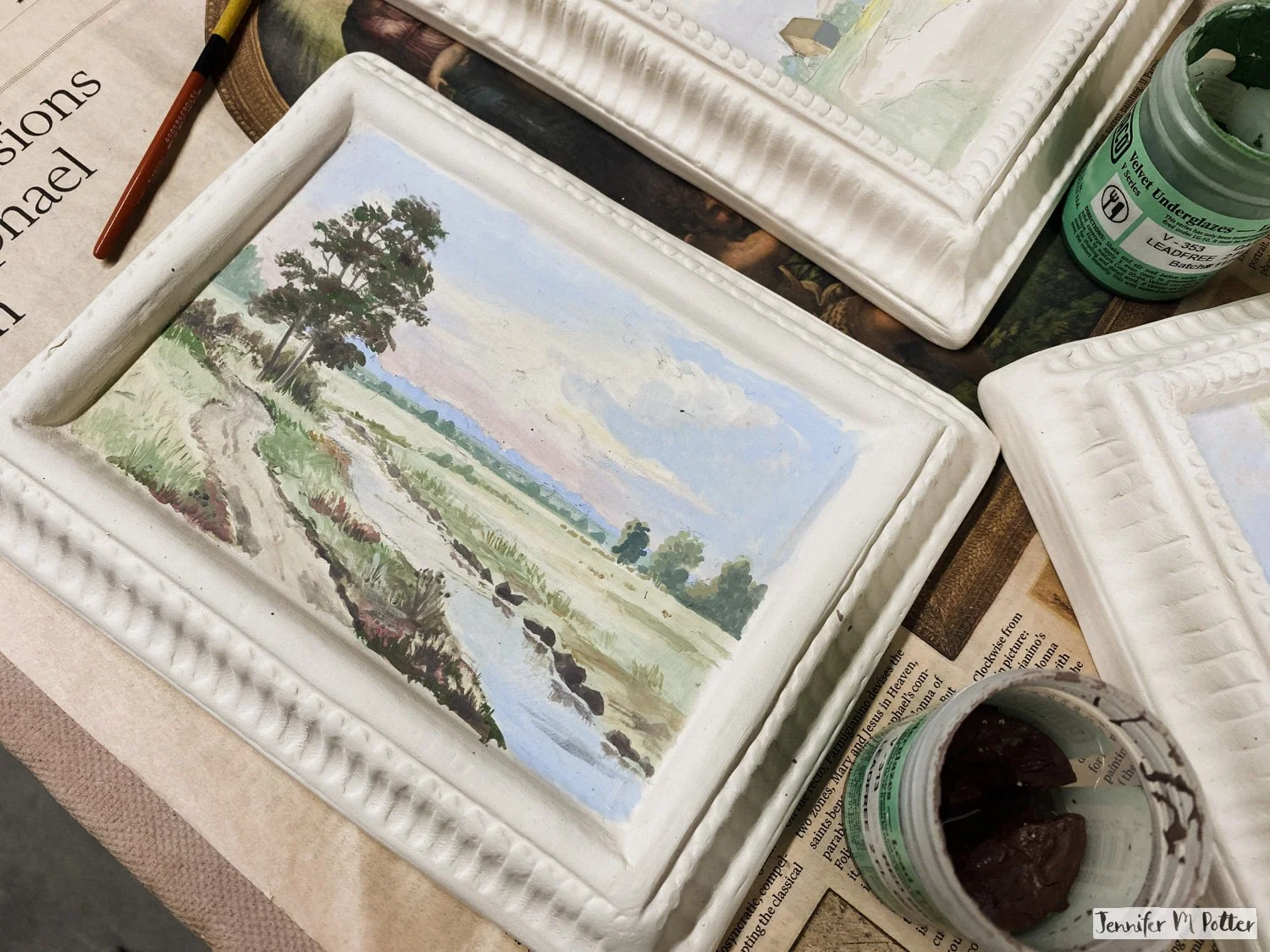
Underglaze is strange. It's like watercolor but also not at all like watercolor. They share the same binder—gum arabic—so you can thin them and mix them the same way. You have to work quickly. Bisqueware absorbs water even faster than cotton rag, each brushstroke disappearing into the clay almost immediately. Wet on wet is next to impossible. And you layer colors the same way, light to dark. You can overpaint light on dark, but when it fires, the dark underpainting bleeds through no matter how many layers you put down. Because the particles move and bleed into the glaze during heating. Because science.

I boldly did a red imprimatura on one of my first ceramic frames, thinking it might show through a little. Oh no. It was a red mess with translucent scenery floating over it. You can see it in the photo below. I eventually put a gold luster rabbit on it and gave it to a friend. Lesson learned.

Glazed and fired ceramic paintings laid out on a work table. One painting is messier and very red compared to the others.

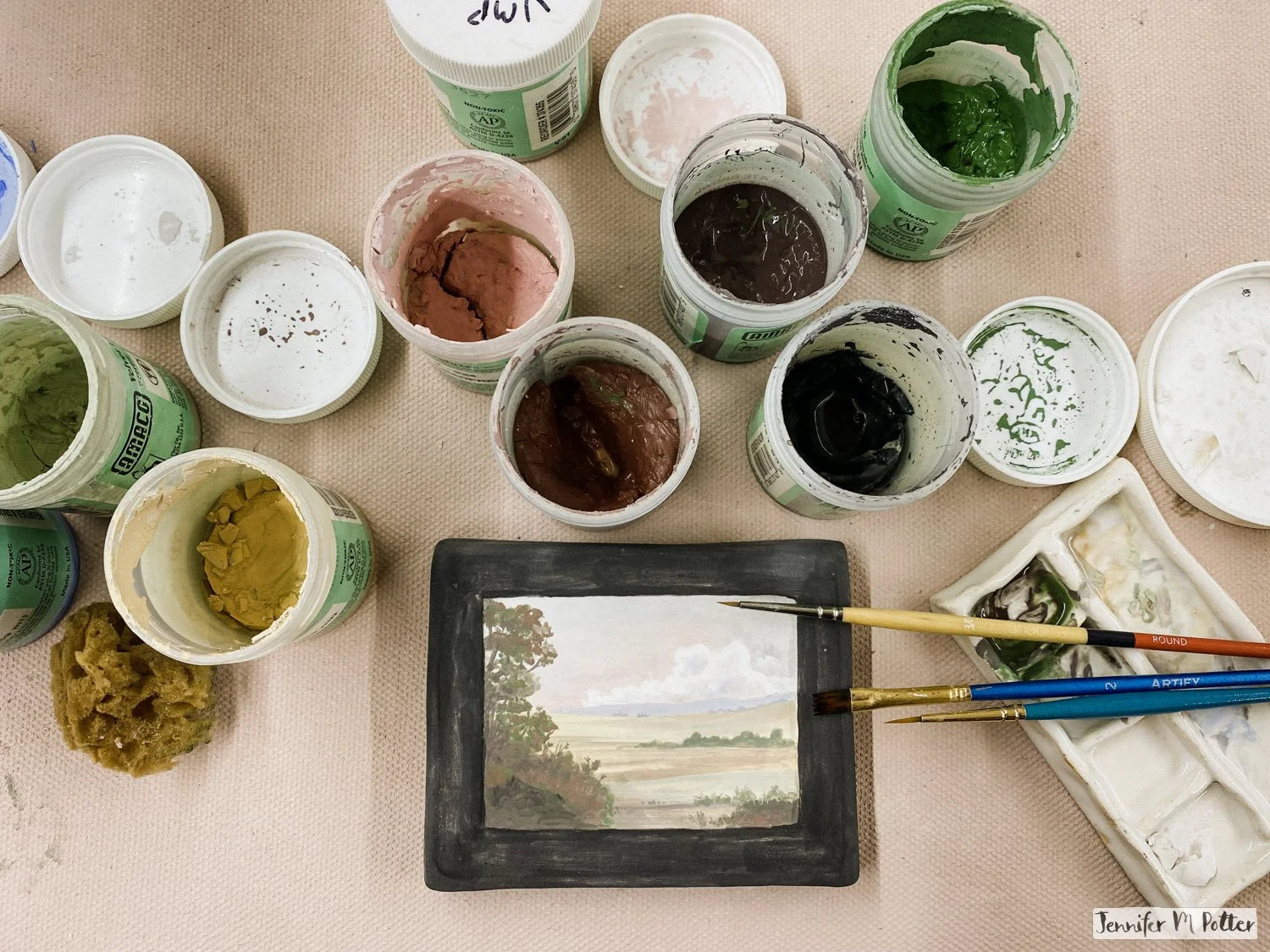
I use high-quality brushes for watercolor—brushes that hold water for long fluid strokes, brushes that keep a fine point. For underglaze I aim for the same, but the clay absorbs water so quickly there's no such thing as a long fluid stroke. And high-quality brushes are useless since the clay particles in the underglaze get trapped in the bristles and sabotage the fine point pretty quickly. I reach for smaller and smaller brushes so that even when they're splayed from clay, they're not too wide.
A small unfired landscape painting in underglaze on a bisque framed canvas. It is surrounded by small jars of underglaze, paintbrushes and a small hand-build watercolor palette.
The biggest difference is how colors change during firing. With watercolor, what you see is what you get. With underglaze, the end result will be much darker. Or sometimes lighter. Sometimes it barely shows up at all. Your carefully planned color theory can fly out the window as soon as the kiln shuts. Science again.
Several landscape paintings on unfired bisqueware.
A few simple glazed and fired ceramic landscape paintings.

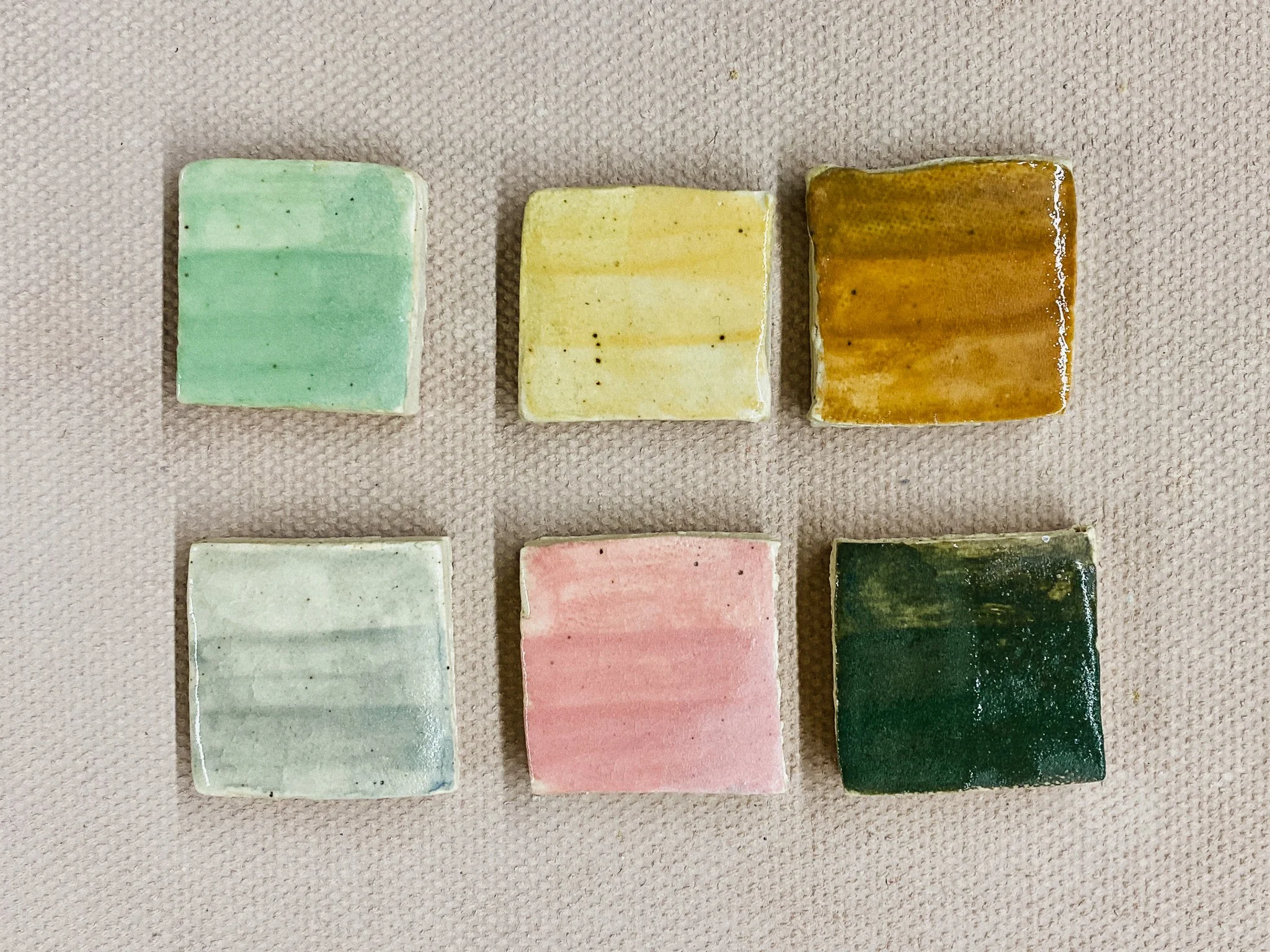
I made test tiles. Little pieces of Standard 182 clay with one, two, and three coats of each color. I keep them on my table when I paint, a tiny taste of before and after. It gives me an idea of what to expect, which colors will be reasonably accurate and which will need more care.

Six colorful test tiles in pistachio, straw, light brown, pearl gray, blush, and dark green

We'll see.

Ceramic Paintings

I got into ceramics because I wanted to draw on three-dimensional forms, to make hopefully-beautiful sculptural things for my home. So much of what I do is for other people—commissions for books, cards, gifts, the occasional magazine. These are for me.

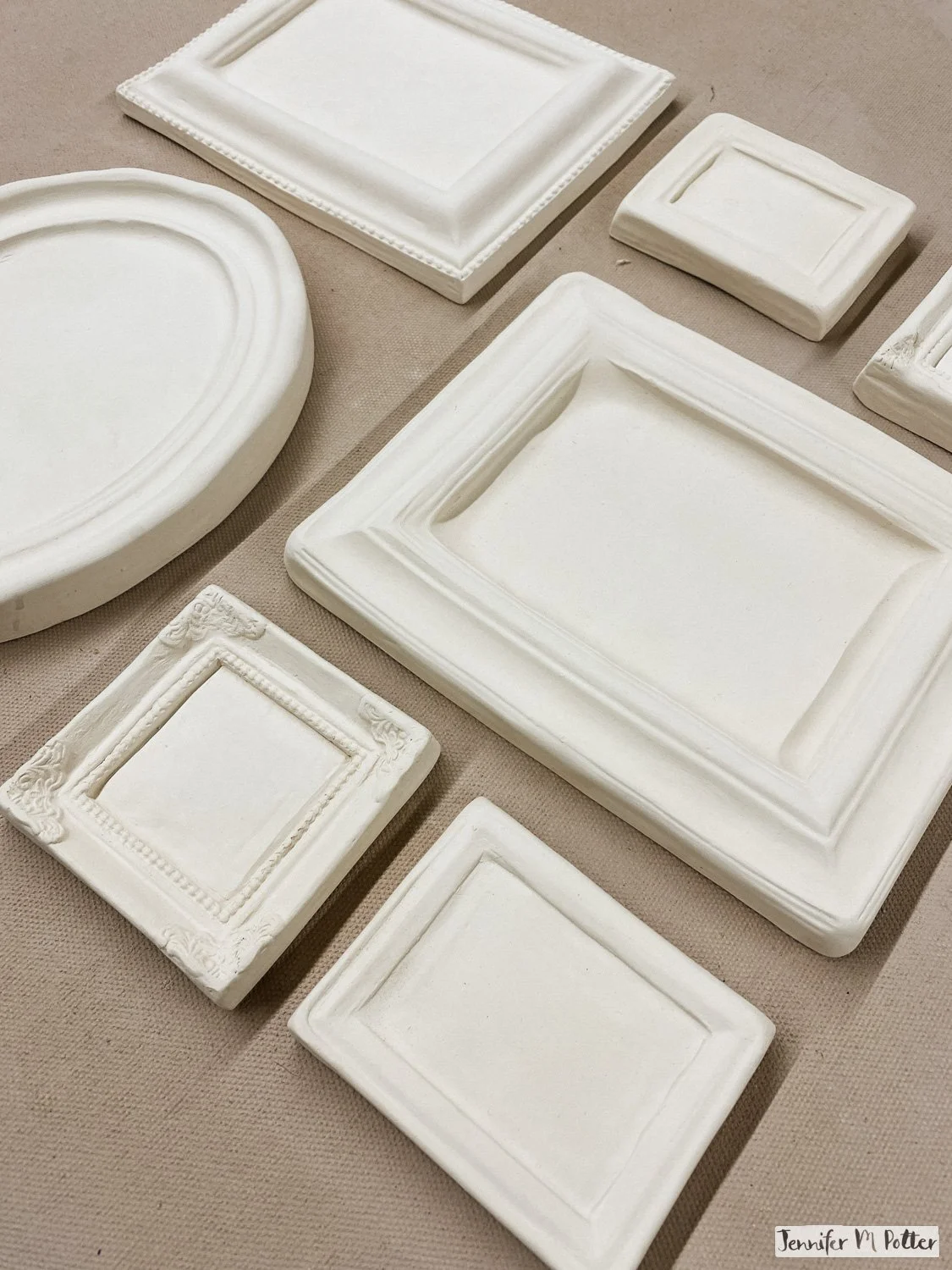
Blank white ceramic framed painting that have been bisque-fired and are ready for paint.

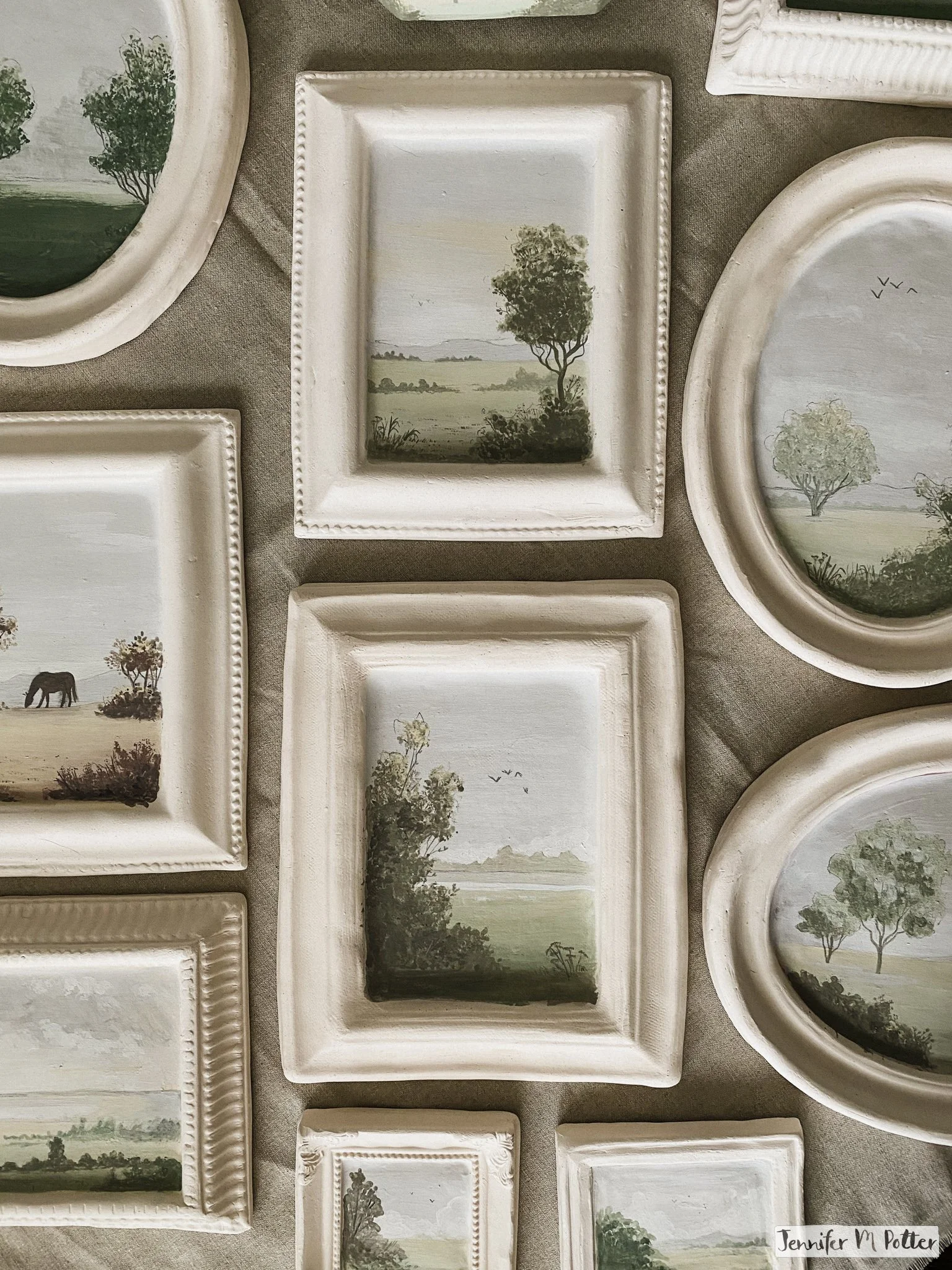
Which makes it strange that the project I'm most drawn to is a series of ceramic framed paintings. I take the time to mold three-dimensional canvases just so I can paint on them in two dimensions anyway. But also not strange at all. Few things move me more than an old framed canvas.

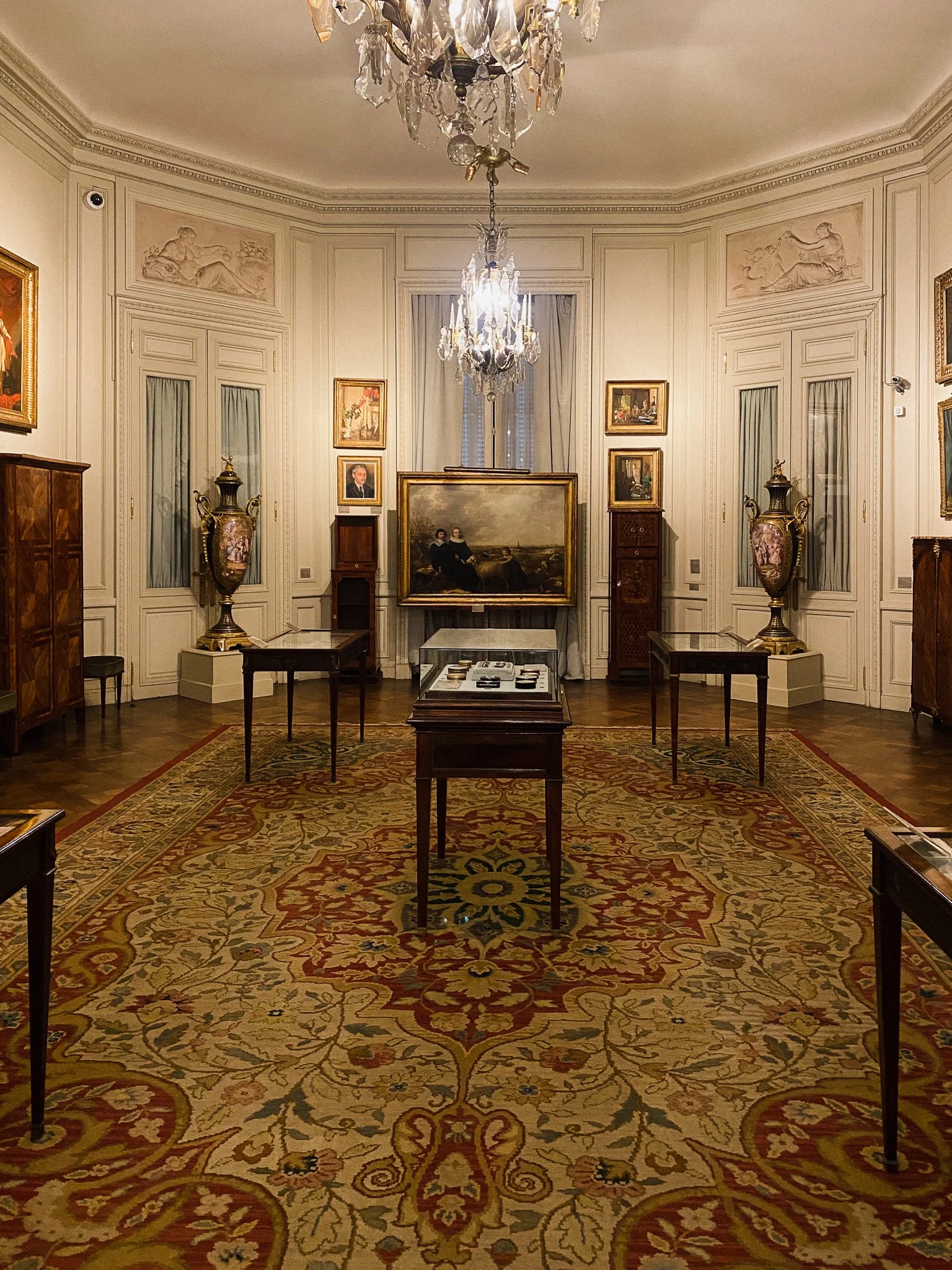
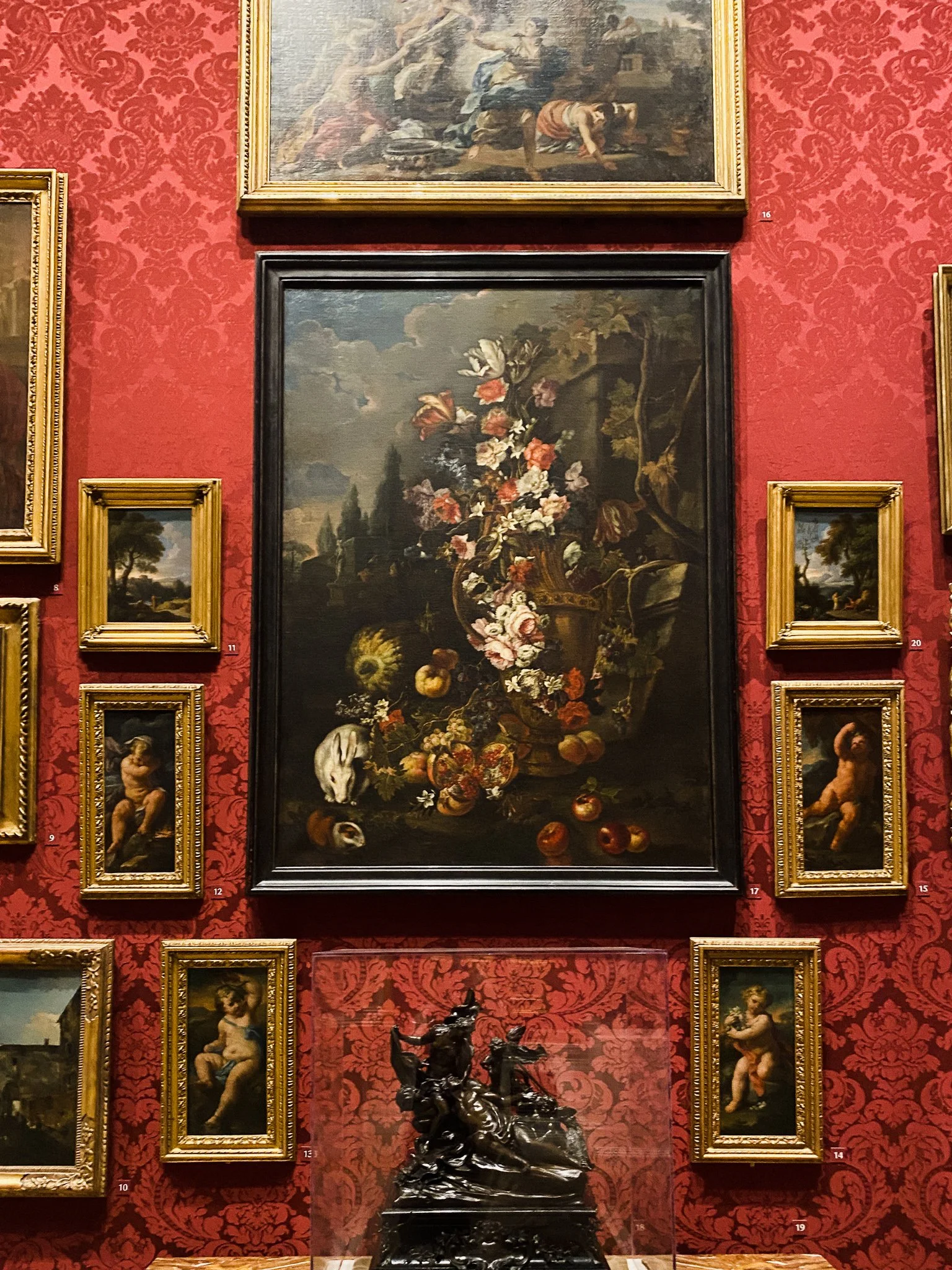
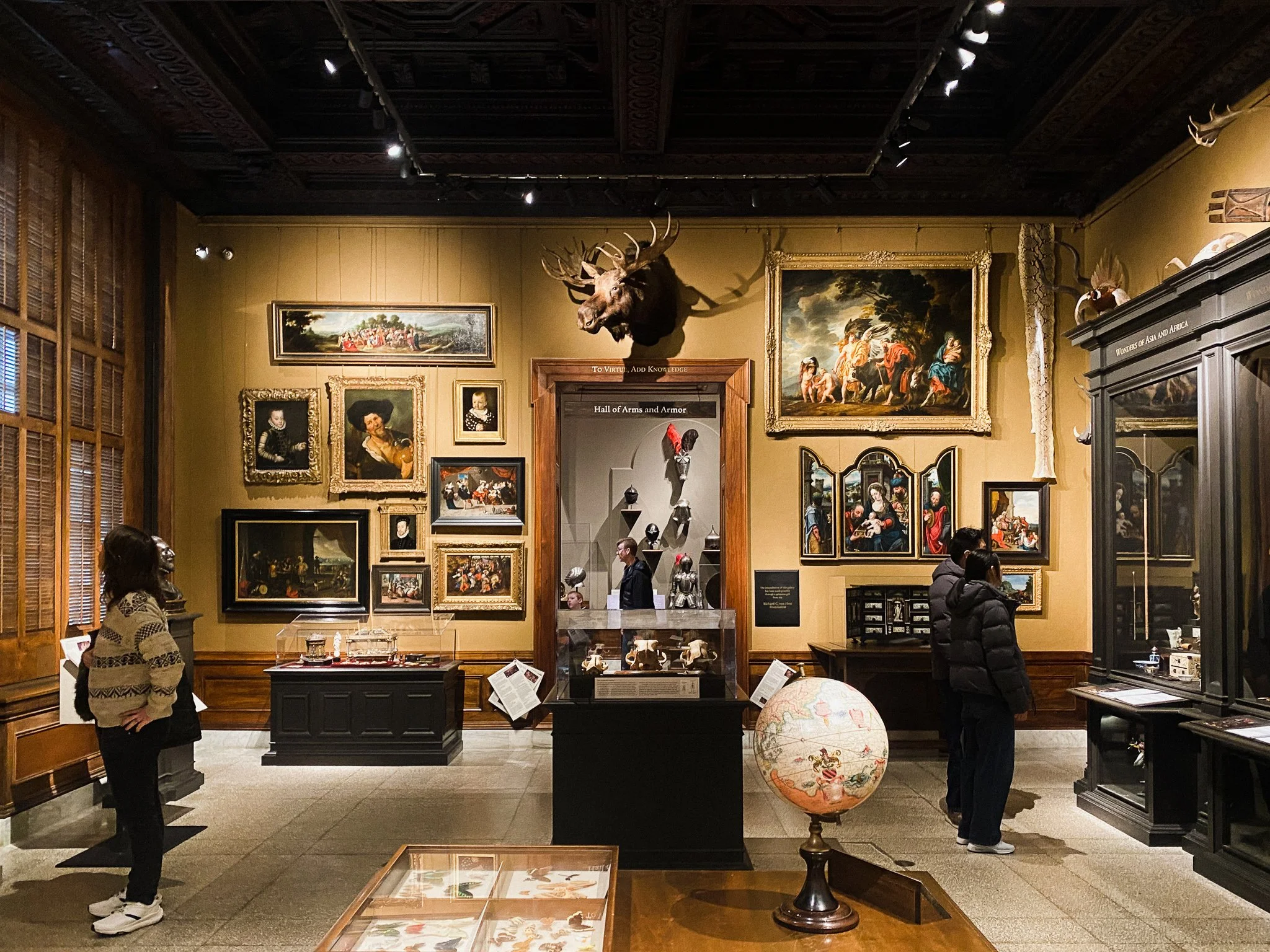
A gallery room filled with paintings and objects from the natural world at the Walters Museum in Baltimore.

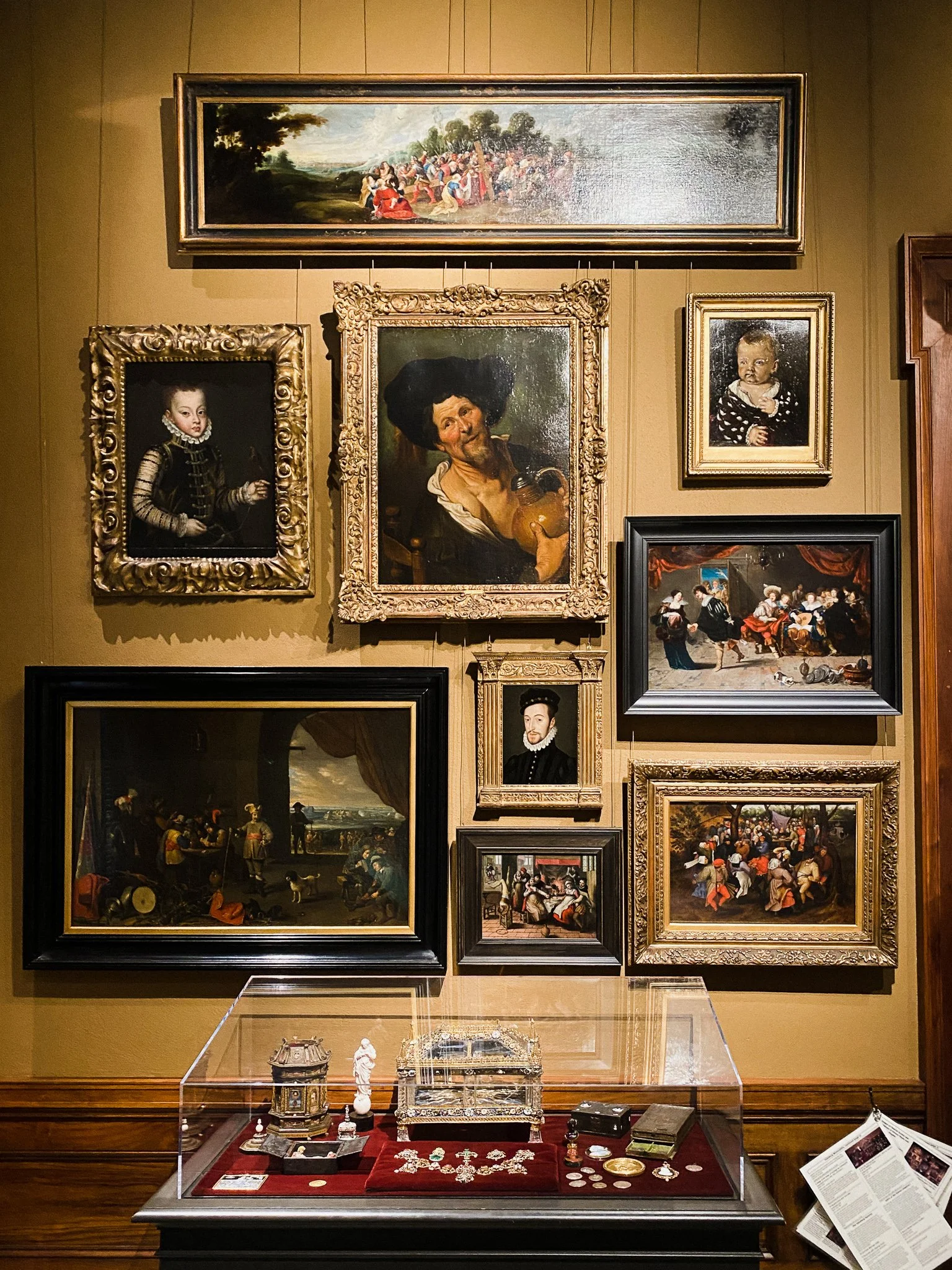
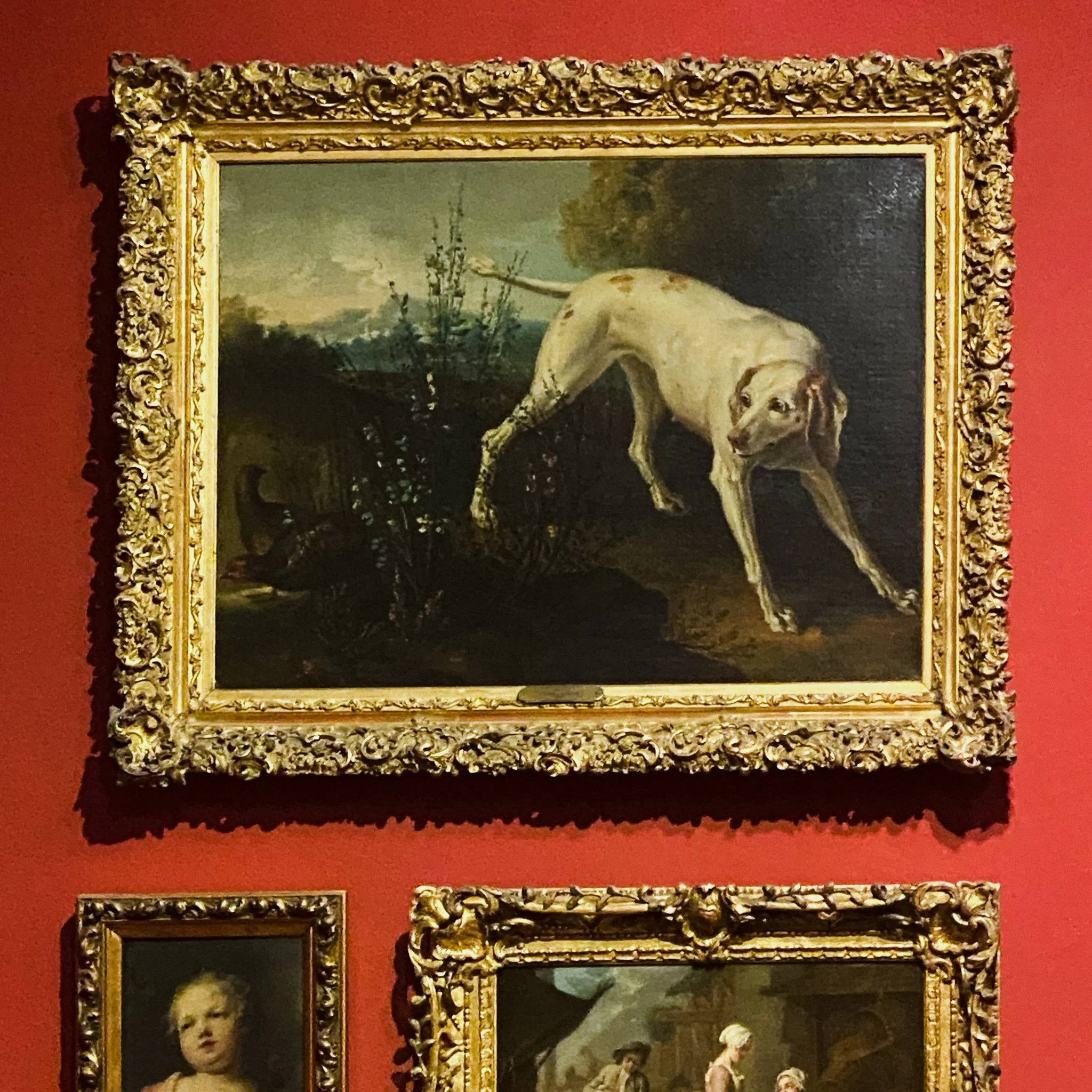
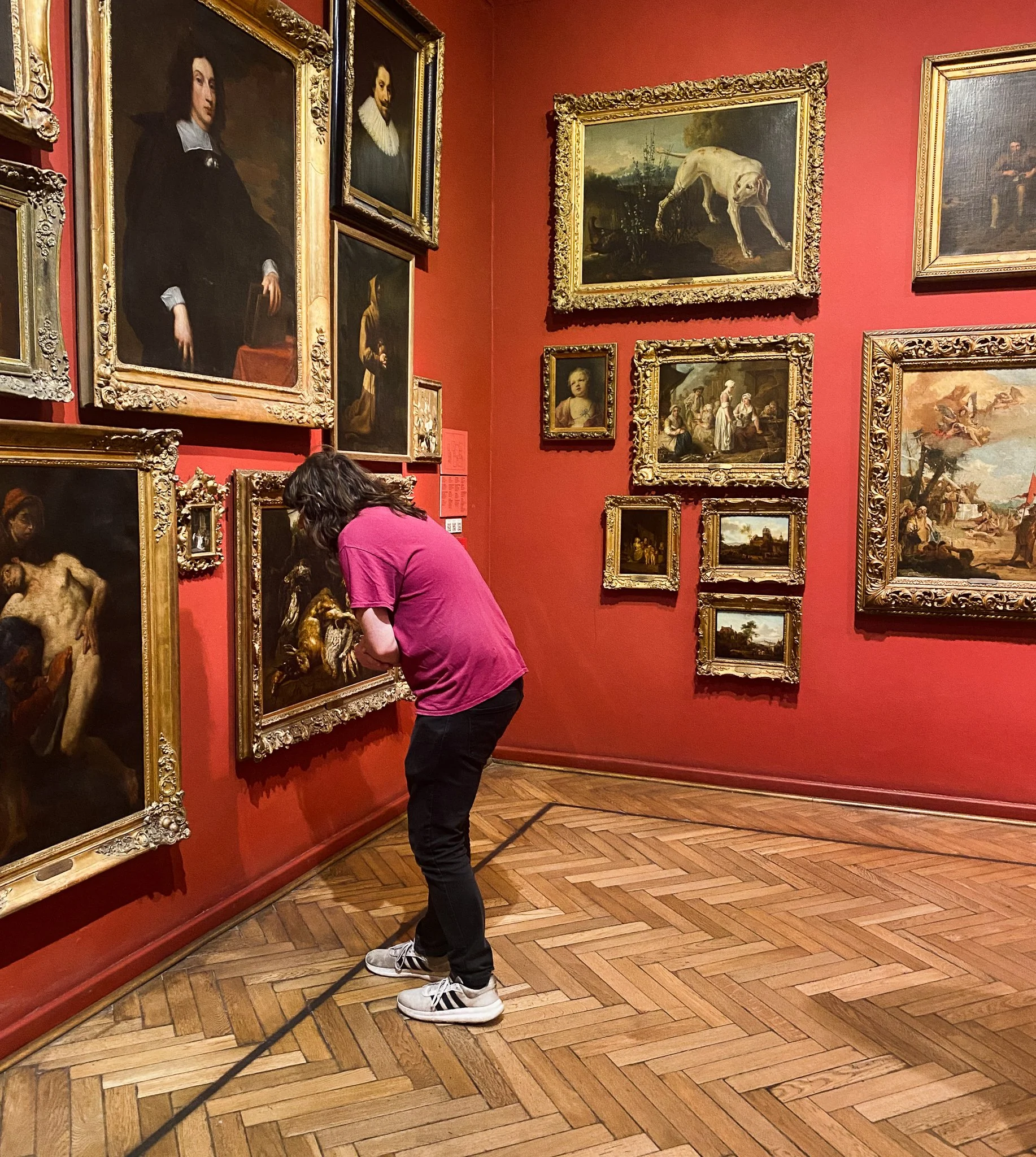
I love old paintings. The feeling of standing in a museum, surrounded by exquisite art hung salon-style on jewel-toned walls. The Walters in Baltimore does this—grand rooms where paintings and curios are displayed the way they might have been in their time. Light peeking in from tall, shuttered windows. The cabinetry. The quiet. The sense of stepping into a world gone by.

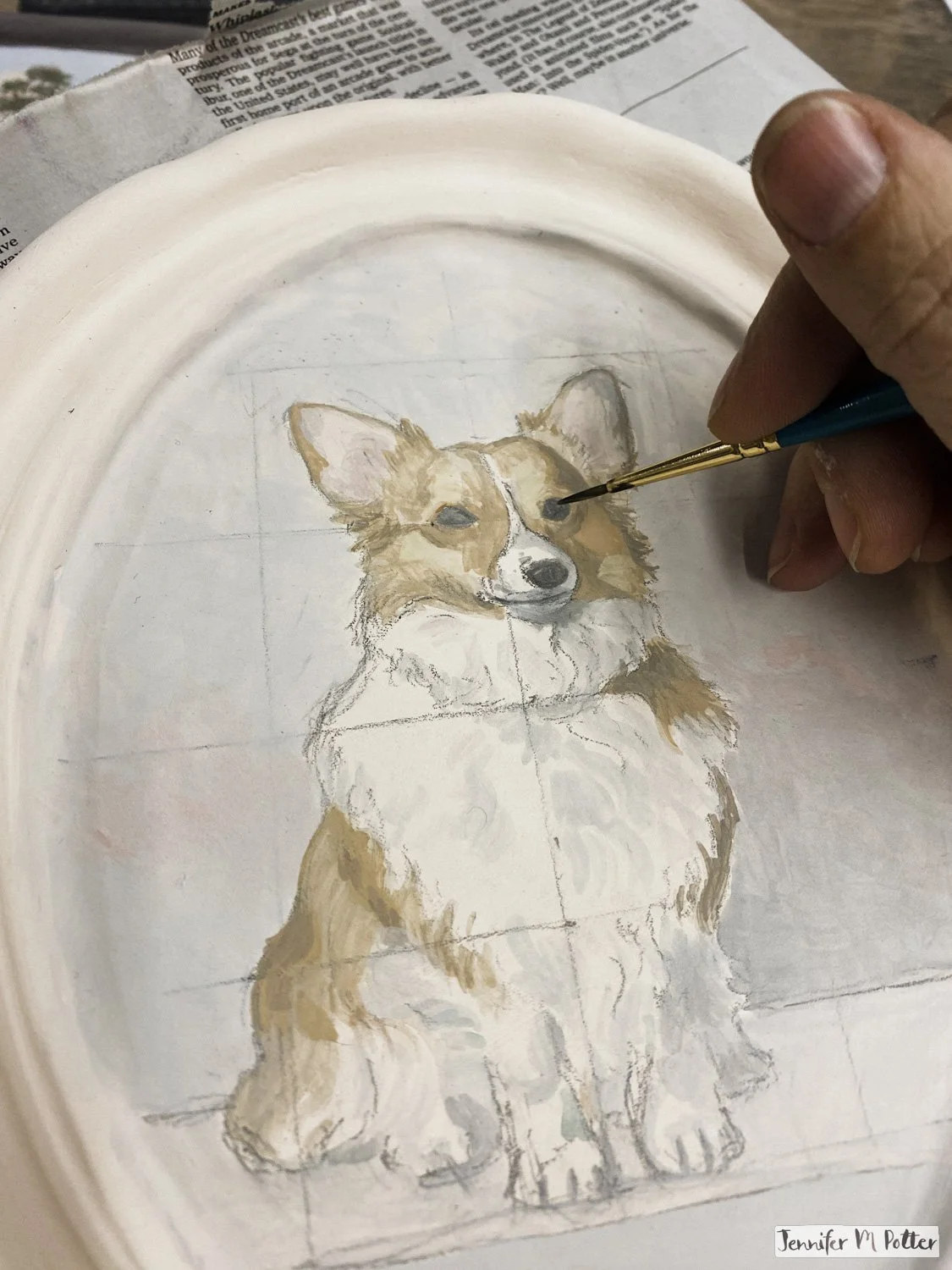
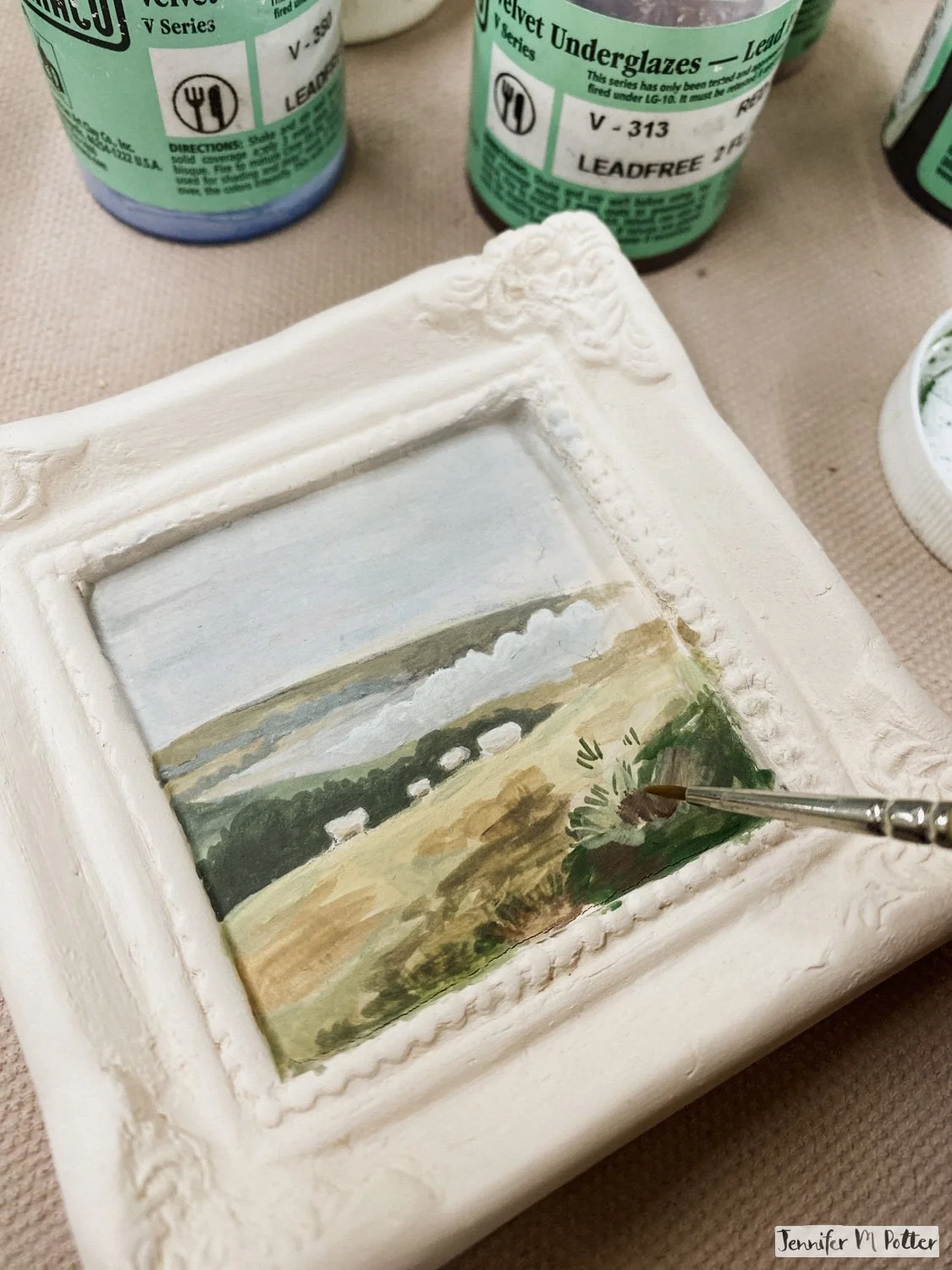
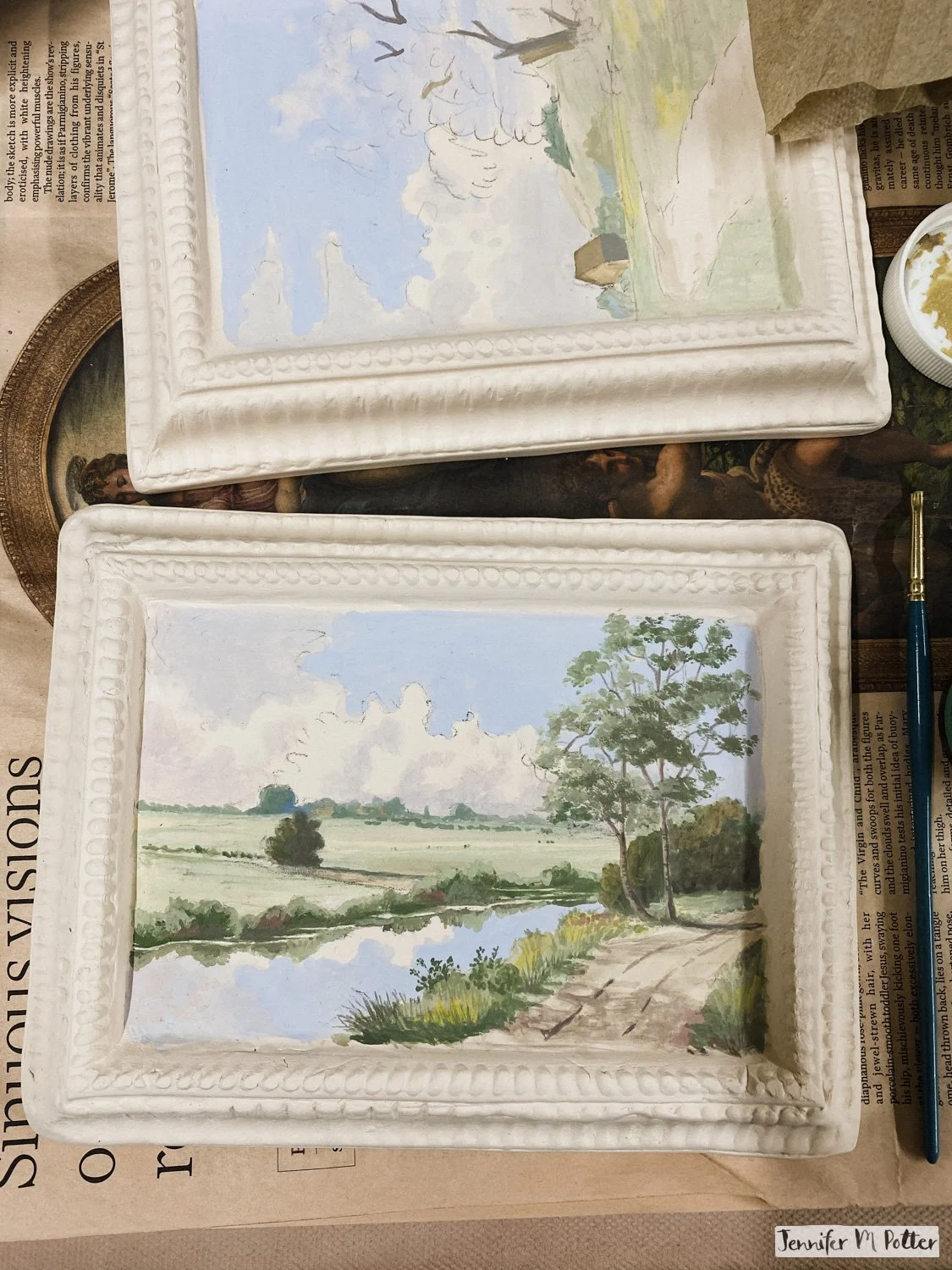
Painting a detailed landscape on the bisque canvases.

These tiny ceramic paintings are an homage to that.

Two underglaze landscape paintings in progress

The latest set is in the kiln now, getting a second bisque fire. I'm hoping the colors warm up without getting muddy—sometimes brown pigment takes over during firing, swallowing the greens and blues I mixed so carefully. I’ll share them when they’re done and we can compare together. I'm hoping the details hold.

Layers of pottery, including a few ceramic framed paintings, in the kiln
What I Did Last Year
Waiting for the ball to drop during the New Year's celebration in Hampden, Baltimore.

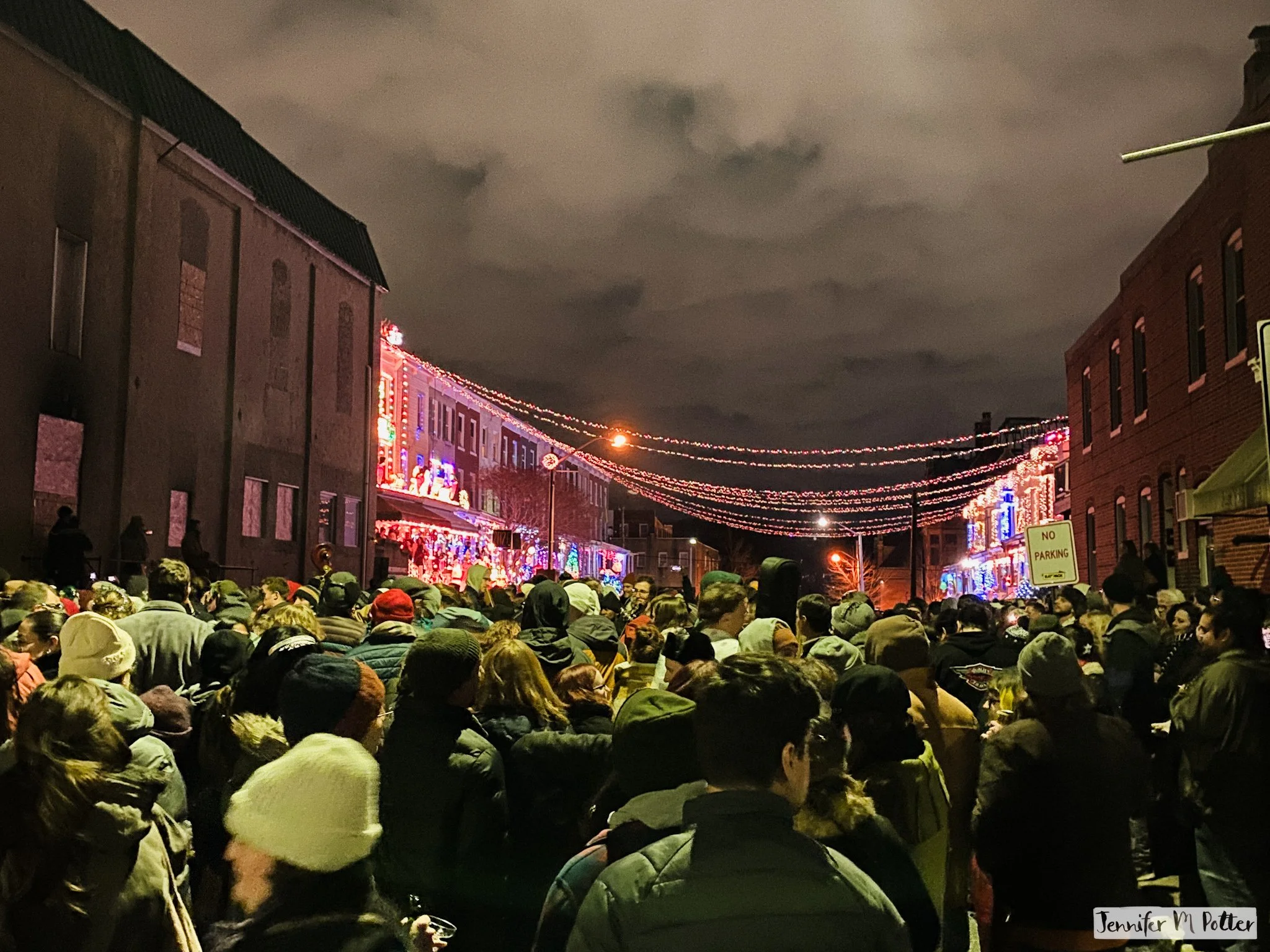
It's the new year. 2026. I took the last two weeks off from blogging—Christmas and New Year's didn't need commentary from me, and I wanted to be cozy with family. Christmas at my sister-in-law's, then Virginia to see my dad, then New Year's Eve at our place watching the ball drop on 34th Street with friends and neighbors. It felt right to step back.

But now I'm sitting here feeling overwhelmed. Last year at this time, I was charged up. I'd worked through some difficult years and was excited to move from treading water to gaining ground. 2025 started strong. Then my dad was hospitalized on February 3rd, and everything fell apart. For months it was just me, him, and my stepmom in that hospital room. All my goals for the year suspended. Back to treading water.

My dad is doing much better now—better than he has any right to, honestly. I spent the last part of the year trying to get back on track. So here I am at the start of 2026, looking for that super-charged feeling again, but instead feeling like I have more to accomplish and less time to do it in.

Is there ever enough time?

I think a retrospective is in order. When you're looking ahead at everything you want to do and feeling swamped by it all, sometimes you need to look back at what you actually did. Not to pat yourself on the back—just to remember you've been building something all along.

Here's what happened in 2025:

Nonna, a pretty pink-lined restaurant in the San Telmo neighborhood of Buenos Aires

I started blogging again. I've attempted this several times in my life and never stuck with it. But last year I showed up every week since October 1st (minus the holiday break). That's not counting Substack, where I showed up earlier in the year too.

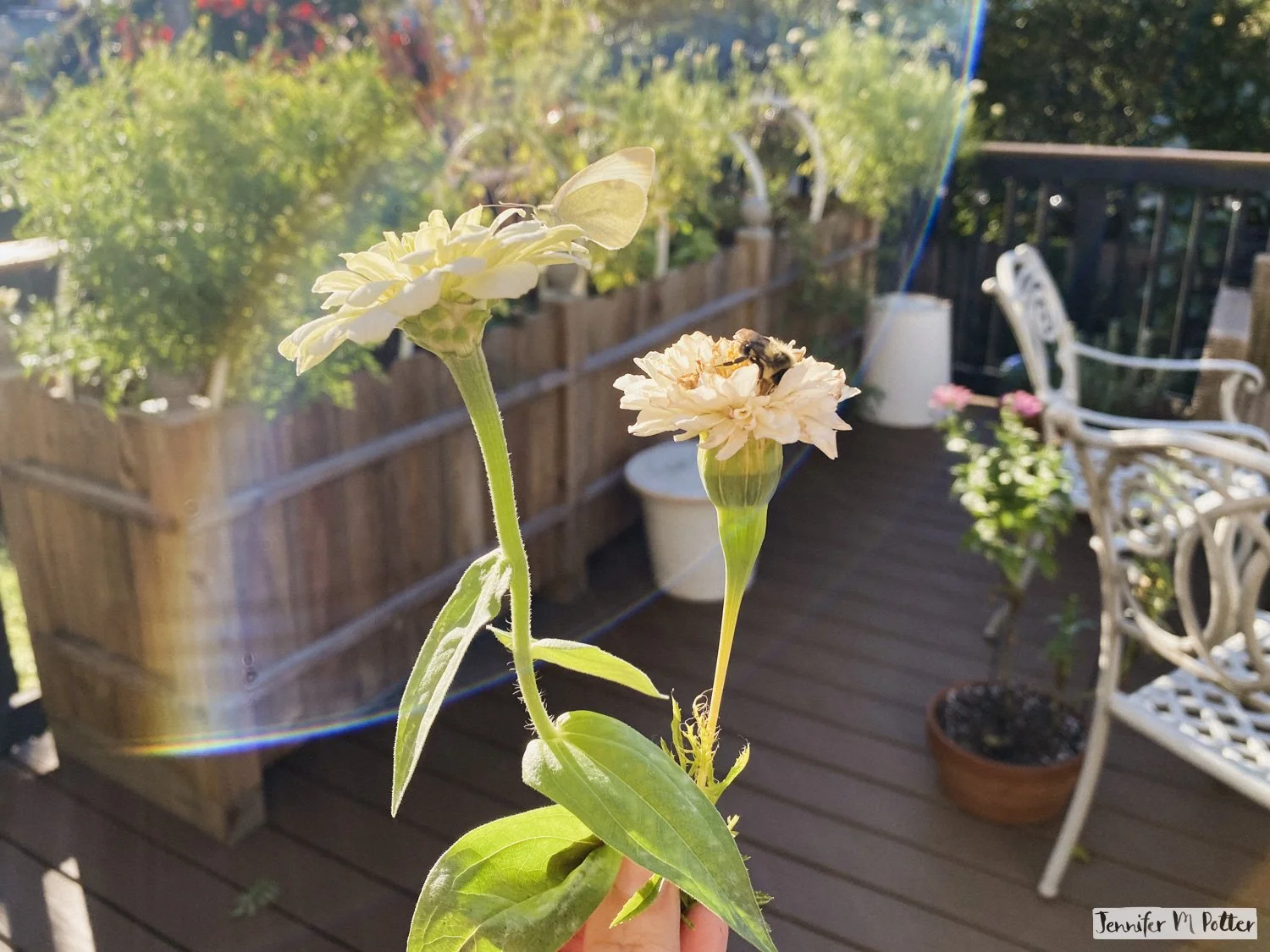
Holding two marigolds, one with a white butterfly and another with a bumblebee on it

I started gardening again. Planted a lot of things for the first time. Some things thrived and some didn’t. But I learned a lot. Including that pruning flowers is a really nice excuse to get out in the sun every morning.

A picture and a detail shot of a blue and white ceramic tulipiere I made

I applied to and became a member of the Potters Guild. It's hard to get in. This was my second attempt, but I know some who’ve tried several times.

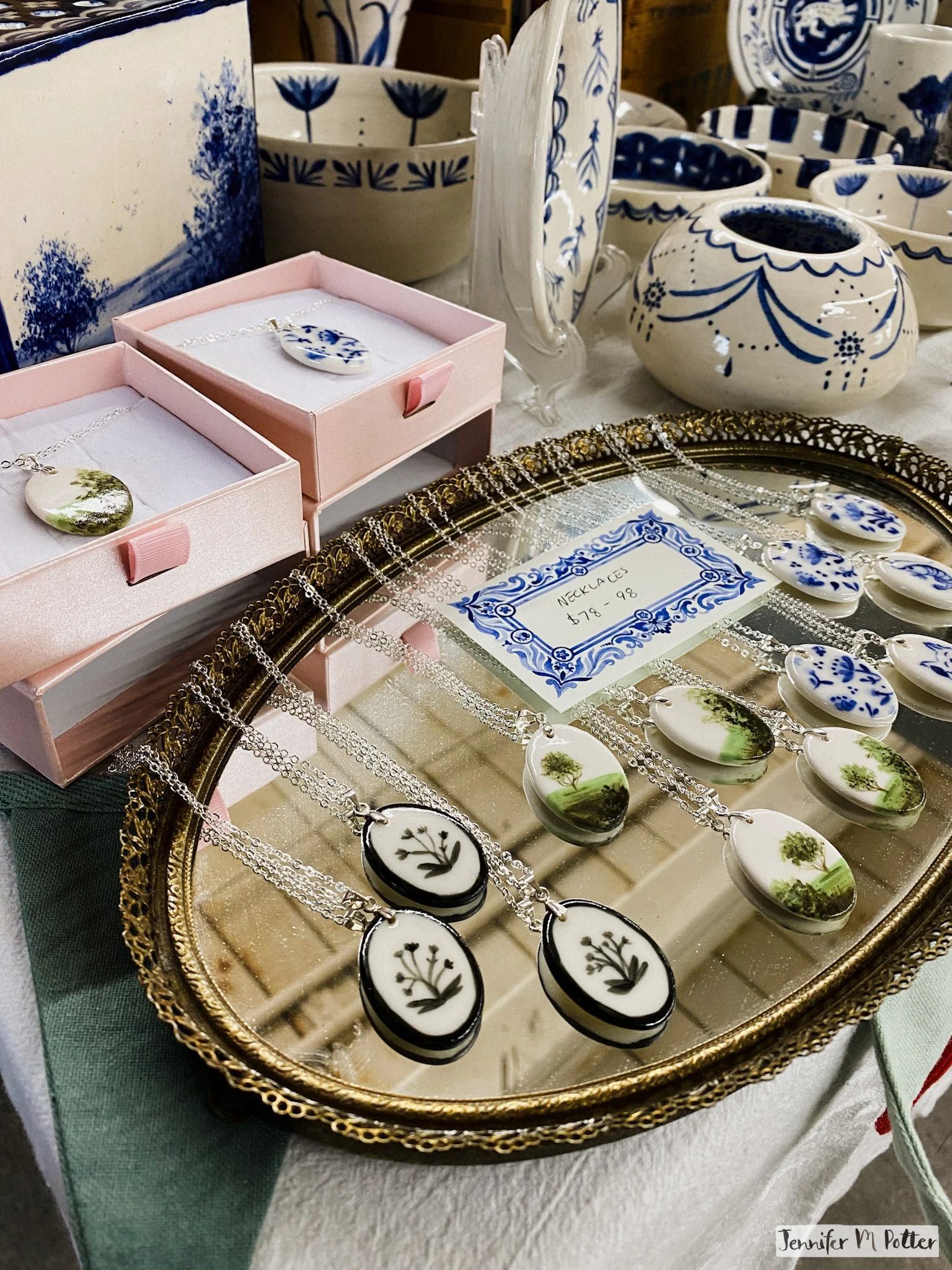
A display of hand-painted porcelain necklaces and other ceramics

I tabled at my first market and actually sold some stuff. Like many artists, I have a strange relationship with selling my work. I'm used to clients paying me to do something specific, but making something and then offering it for sale is still weird. I knew I needed to jump in and start building experience, so I did.

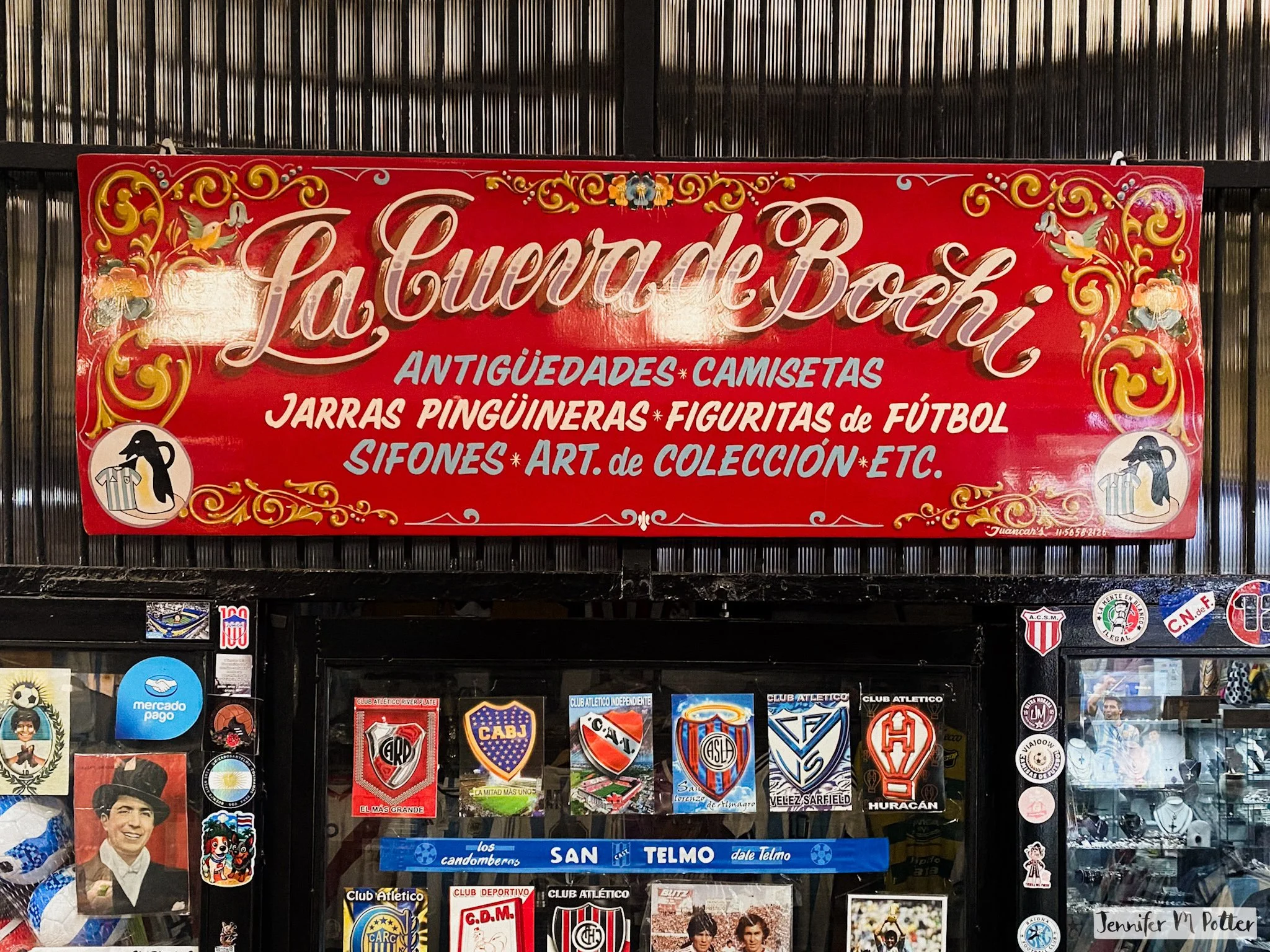
A hand-painted sign in the fileteado style in Buenos Aires

I built a habit around language learning. It's always been a dream to be bilingual or multilingual. I tried to teach myself Russian with my dad's old textbooks when I was eleven. It didn't work, but it was the beginning of many attempts—four years of French, a couple Italian classes, Duolingo for Spanish, Japanese, Danish. Despite doing well with grammar, nothing stuck. Last year I discovered comprehensible input: learning like a child, seeking out media in your target language and just listening until it clicks. I've dedicated half an hour or more most days to watching Spanish videos or listening to Spanish podcasts. I'm very much still a beginner, but I can tell it's working.

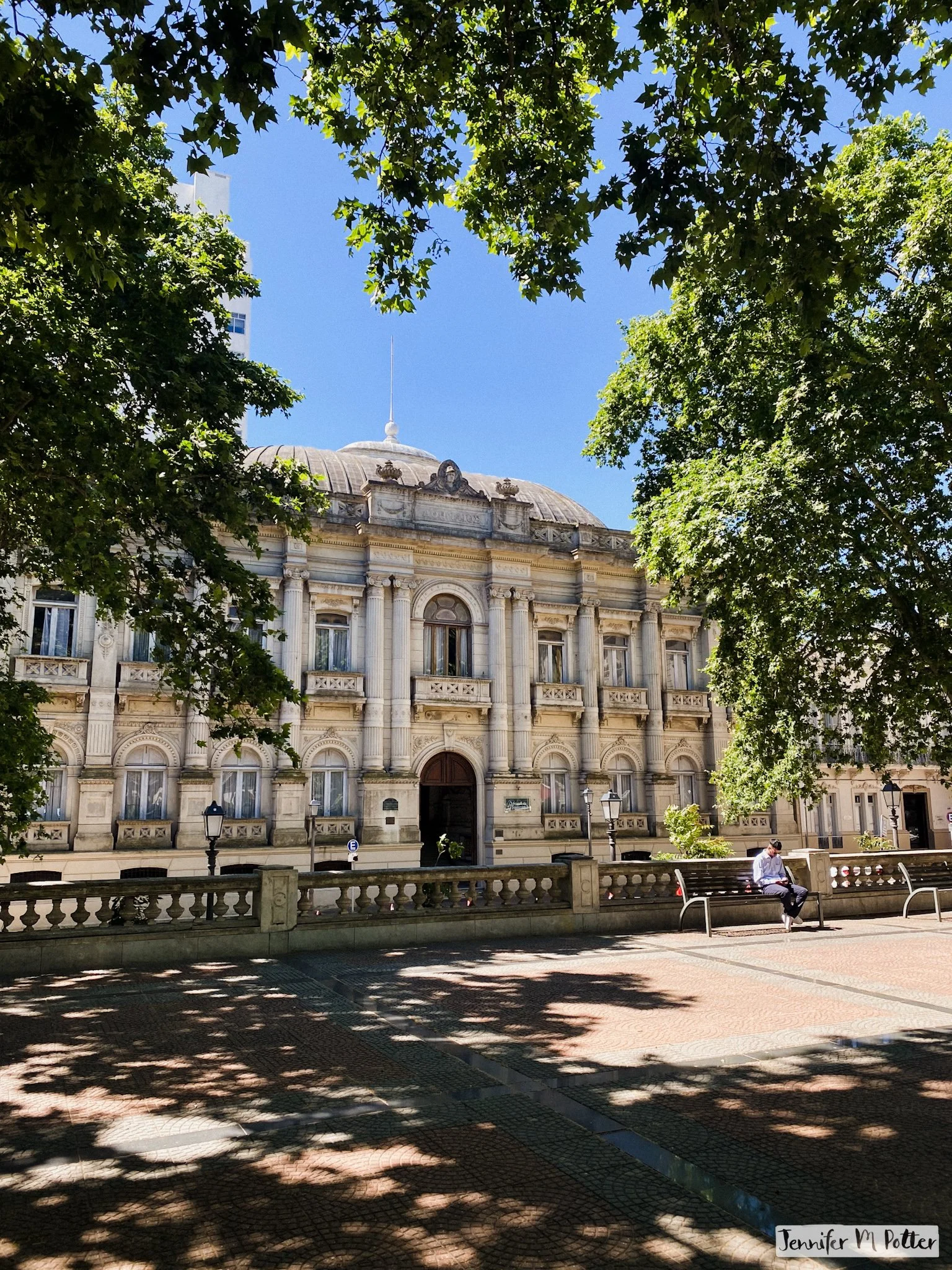
Plaza Cagancha, Montevideo, Uruguay

I went to South America. I don't know if this counts as an accomplishment, but travel is meaningful to me.

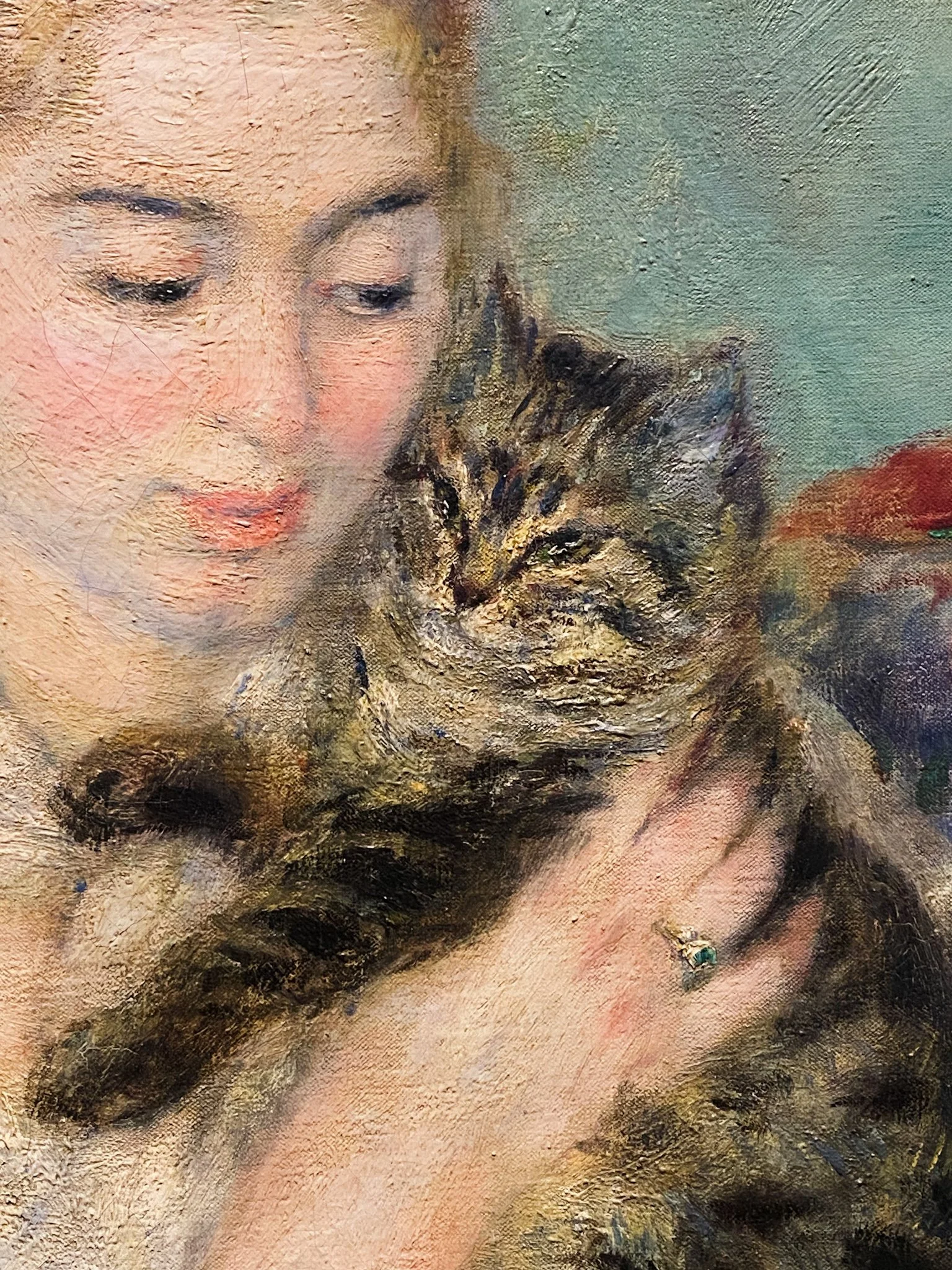
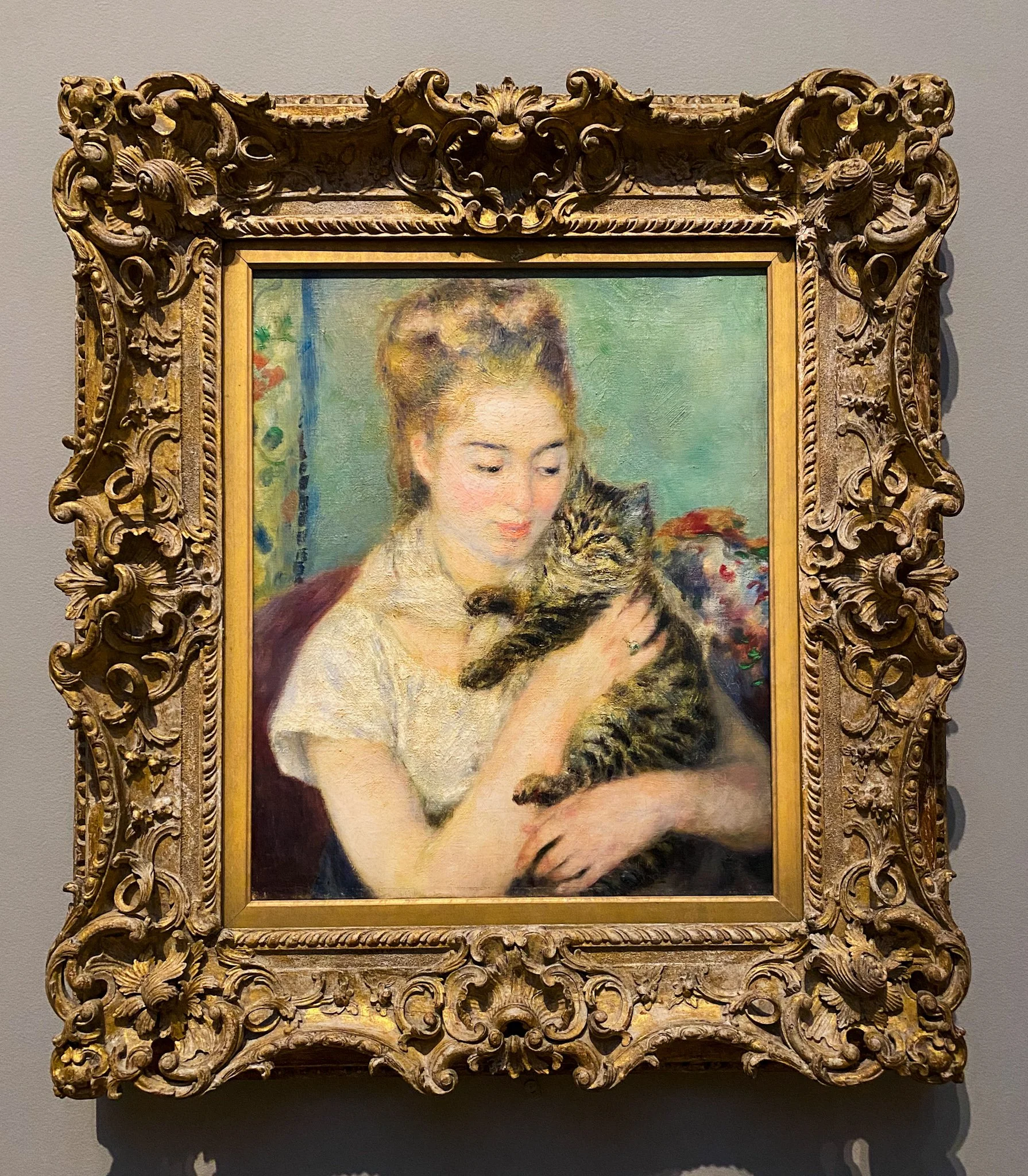
Photo of Auguste Renoir's Woman with a Cat at the National Gallery, Washington DC

I went to a lot of art museums. Again, maybe not an accomplishment, but very inspiring. I know a lot of what I encountered will show up in my own work this year.

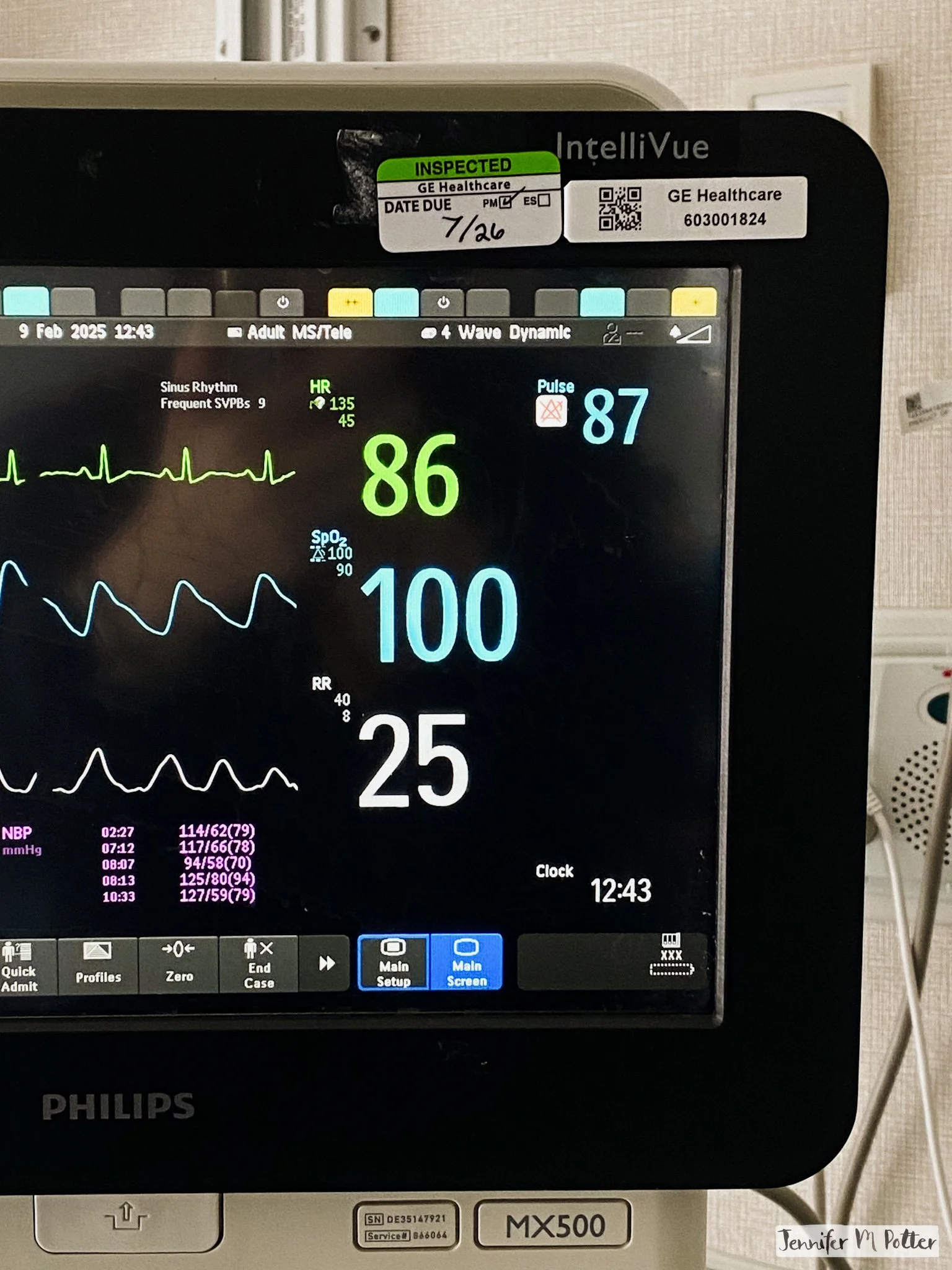
A shot of the patient monitor in my Dad's hospital room. The O2 level is not so good despite him being on 100% oxygen.

I learned I'm stronger than I thought. Going through that time with my dad in the hospital taught me I could handle one of my greatest fears. I know people have to go through this—it's part of life for most of us. But that doesn't make it any easier.

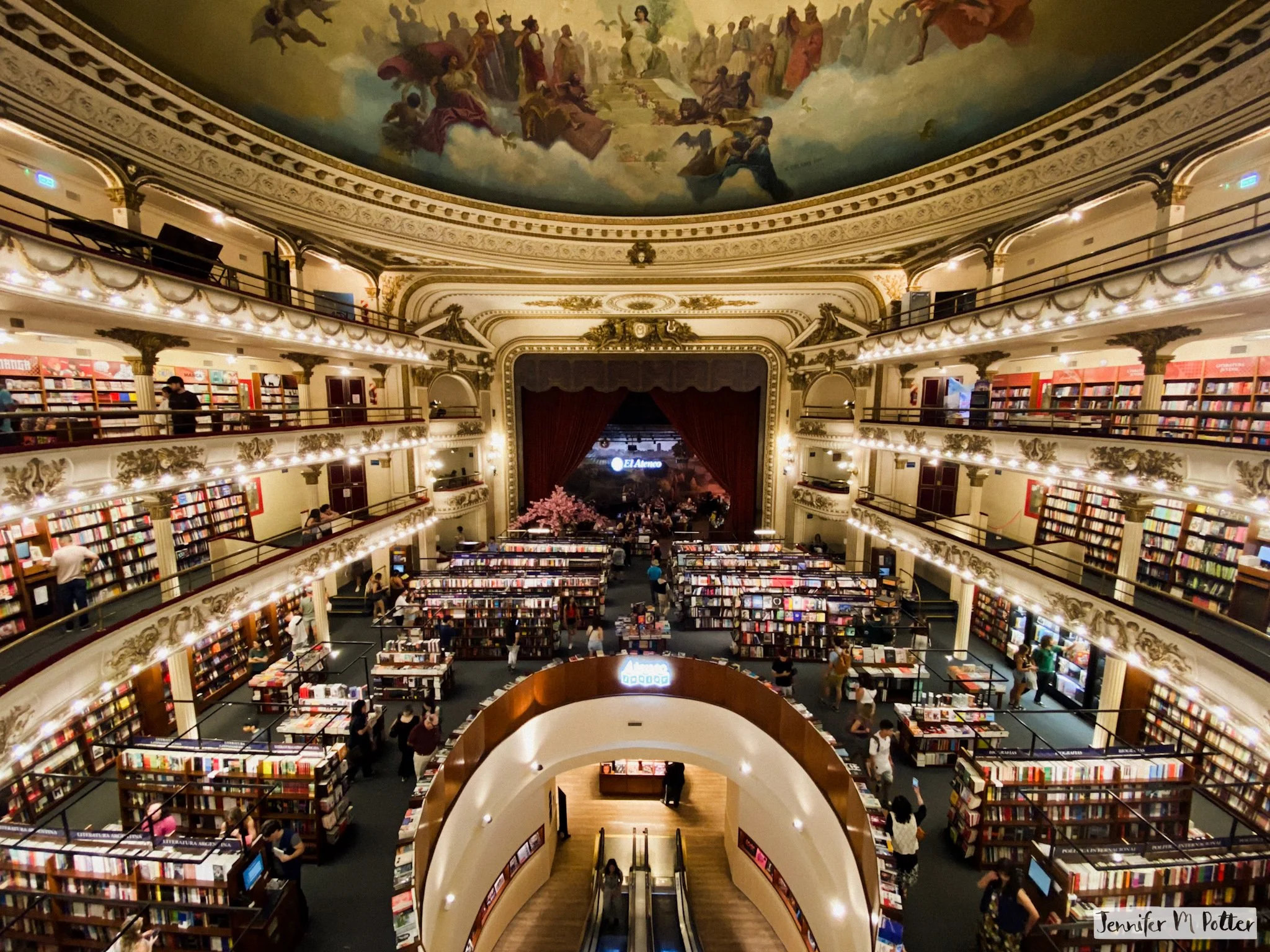
El Ateneo in Buenos Aires, a bookstore in a beautiful, old theater

I applied to literary agents and was lucky enough to talk with quite a few. I got offers and rejections. Nothing felt like the right fit at this time, but I learned some things and feel I'll be in a stronger position if I decide to make another attempt. For now I’m feeling called to other things, and that’s okay.

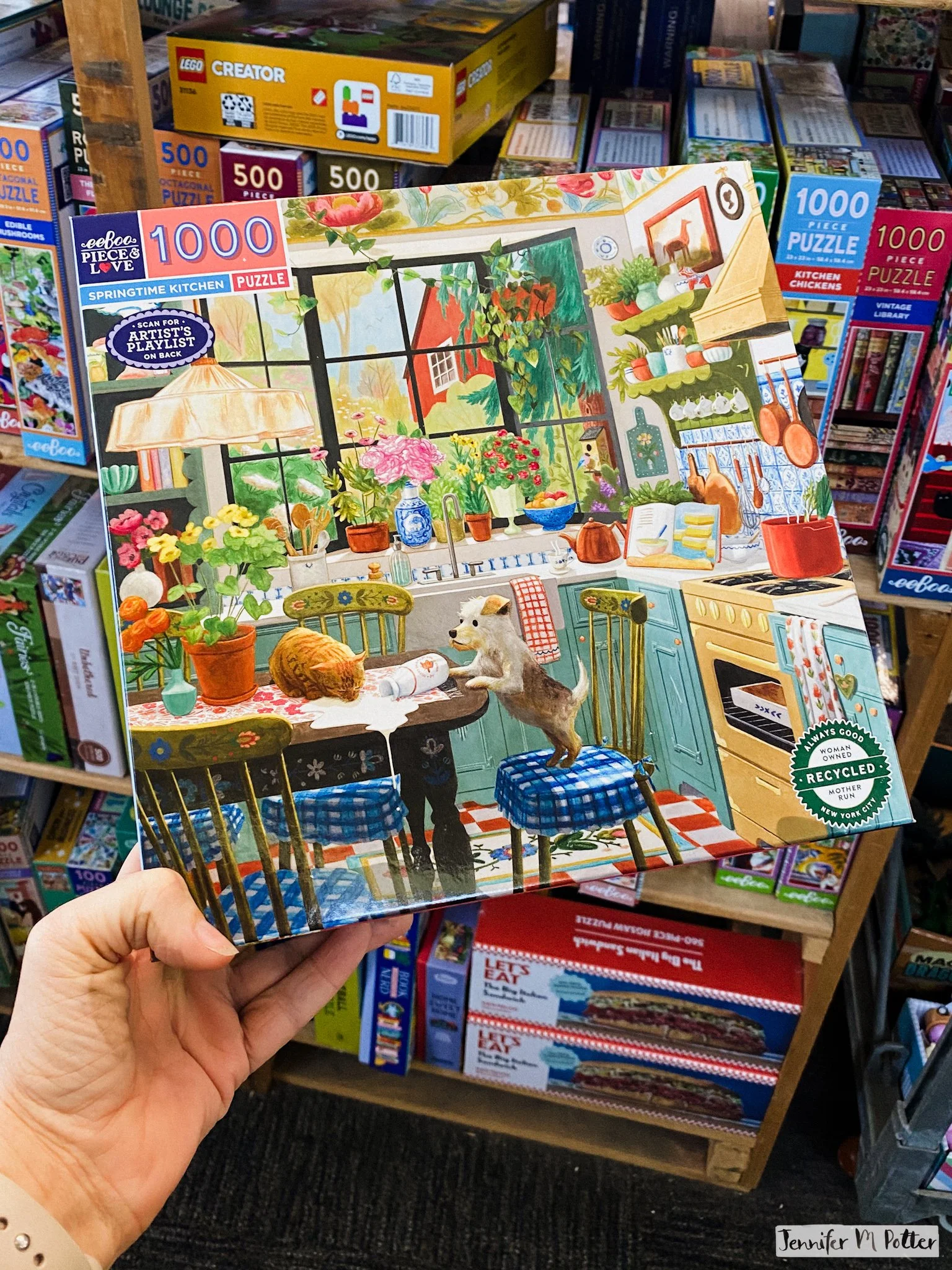
Found my first puzzle with eeBoo in a local shop!

I started earning royalties on a number of projects. Not anything I did this year, but it’s still a boon and worth mentioning. Nice when past effort pays dividends.

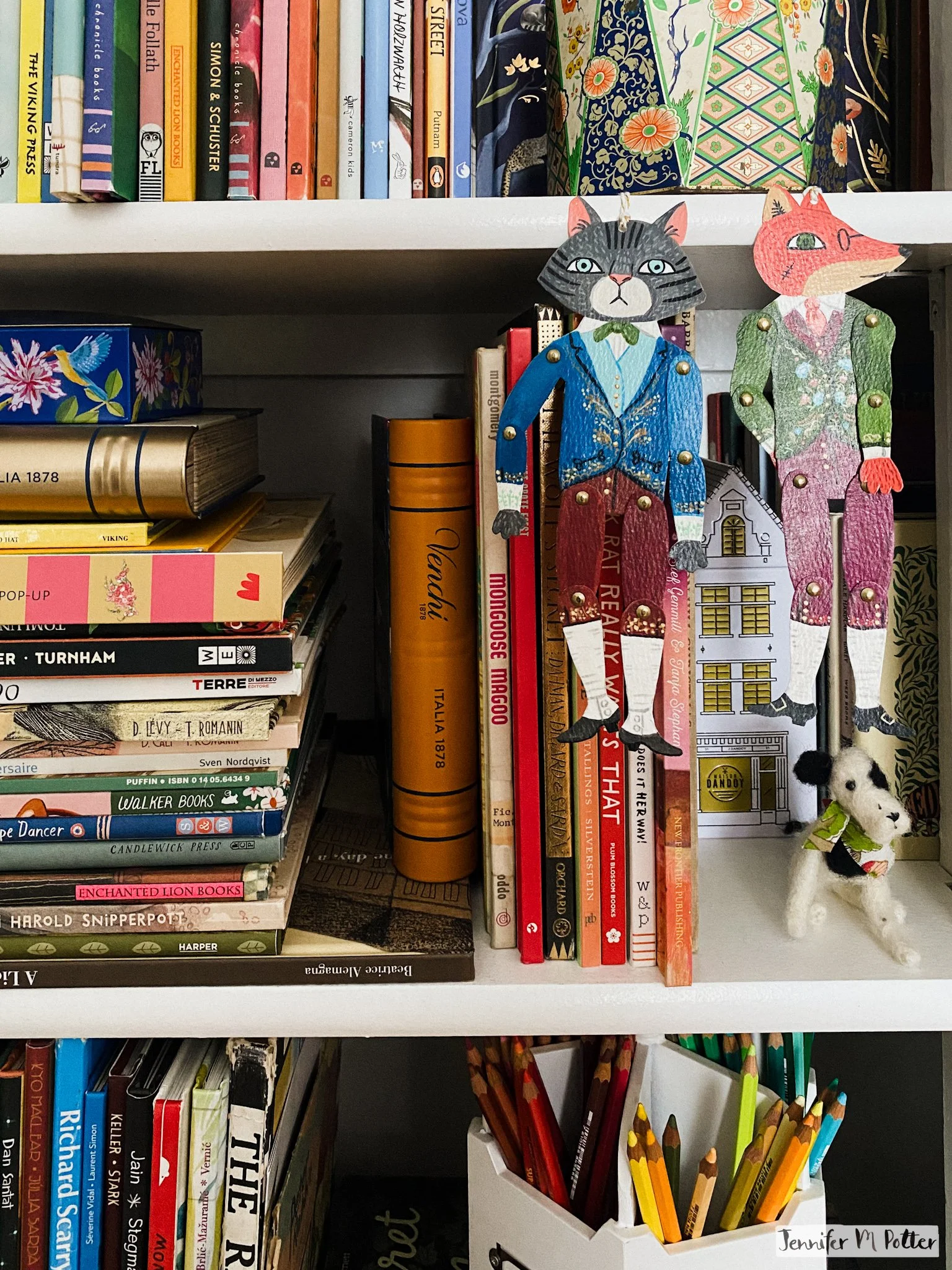
Close up of the bookshelf in my studio

I started building a feedback community for illustrators. It's practically done. I wanted to launch it last year, but with so much going on, I decided not to rush it. Also, between you and me, I’m nervous about it so maybe procrastinating just a bit.

Frisket, fully energized, frolicking in the snow.

A new year can feel like a new beginning, but you're not at the beginning. You're building on all the tracks you laid in the past year. Sometimes you were treading water. Sometimes you were gaining ground. Either way, you kept moving.

Two boxes
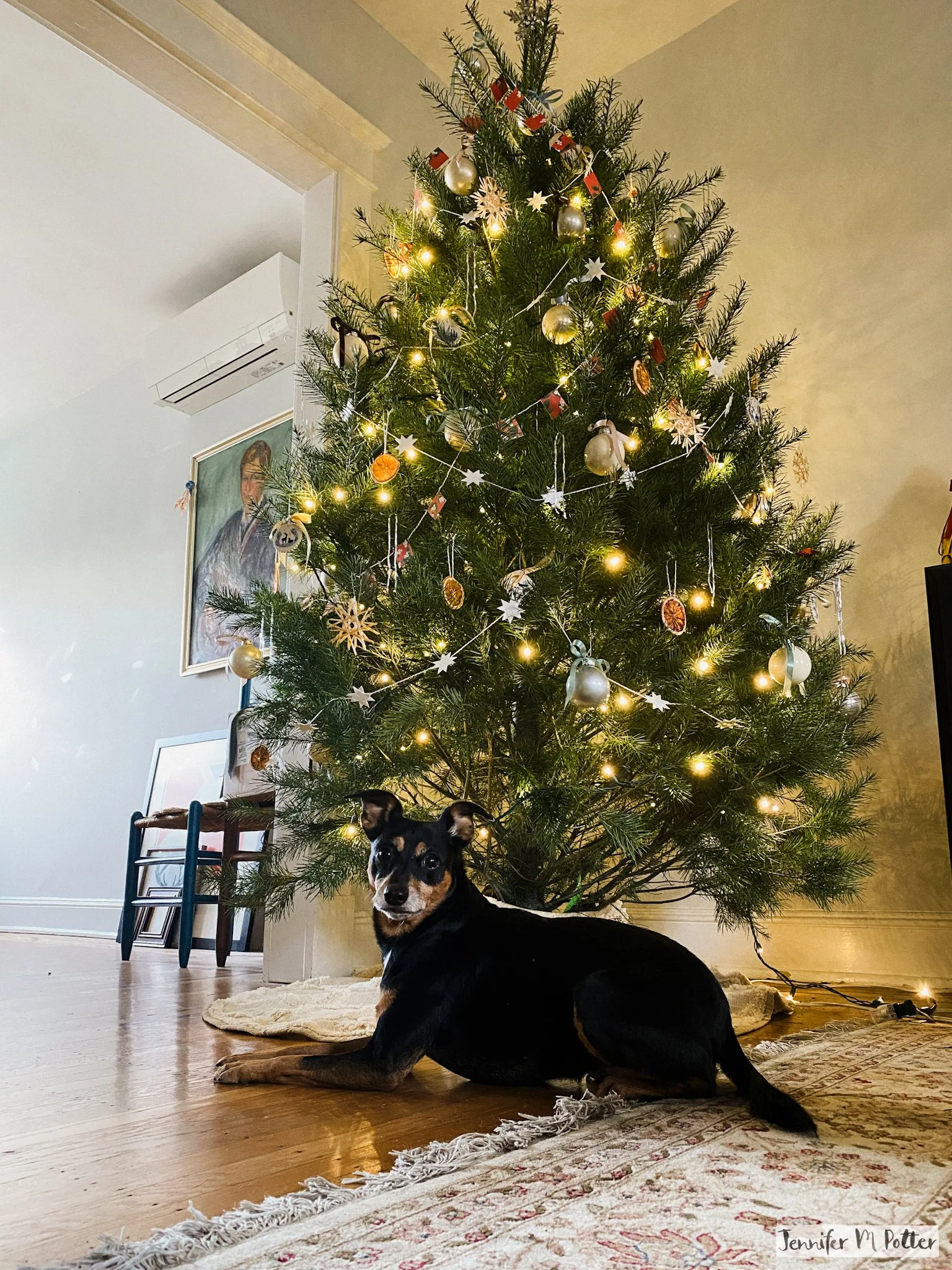
Frisket in front of the Christmas tree she swears she helped decorate

Two boxes arrived this week from a client. Samples I’m excited to show you. Samples I can’t show you until January. Or maybe February. The joys of being an illustrator.

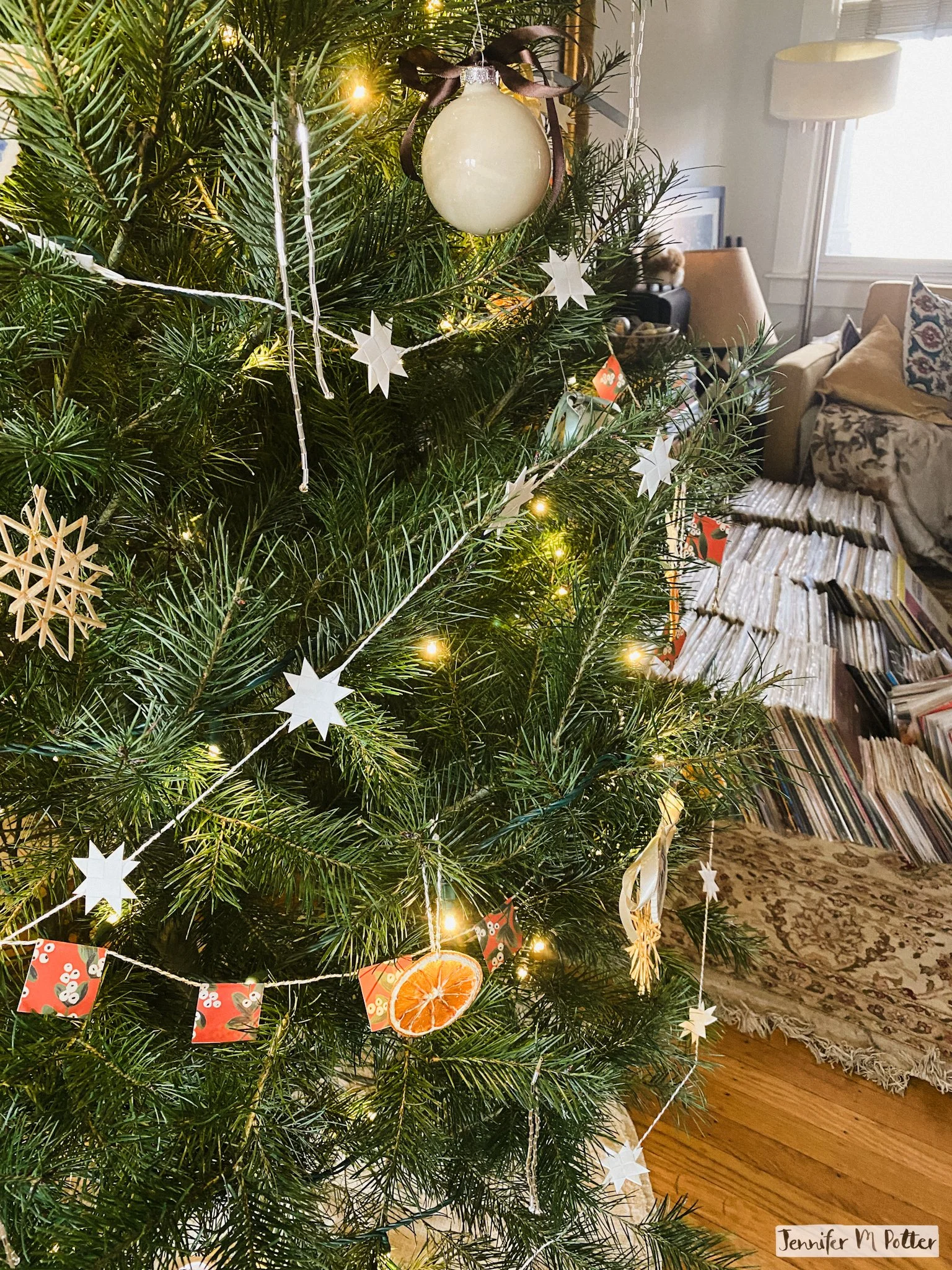
They've been sitting under the bin of Christmas ornaments, still fully boxed up. We're still playing catch-up from a month of travel followed by Thanksgiving. And then of course there was the winter market. The next day we got our Christmas tree, and that night we noticed a leak in the basement. It could’ve been way worse, but we've been vacuuming up water, dumping the dehumidifier, moving furniture, and ripping up carpet all week. But we already had the tree and it had to get decorated, even though our living room is half-full of records. Some things can't wait. The boxes can.

Decorated Christmas tree in living room with stacks of vinyl records nearby

I've been working on line art for another project for the same client this week. Working on my bed when I normally would’ve been curled up on the basement sofa. Drawing this piece while another finished piece sits downstairs in its boxes. There's something about that—creating the next thing while the last thing waits to be revealed. It all feels very in-between.

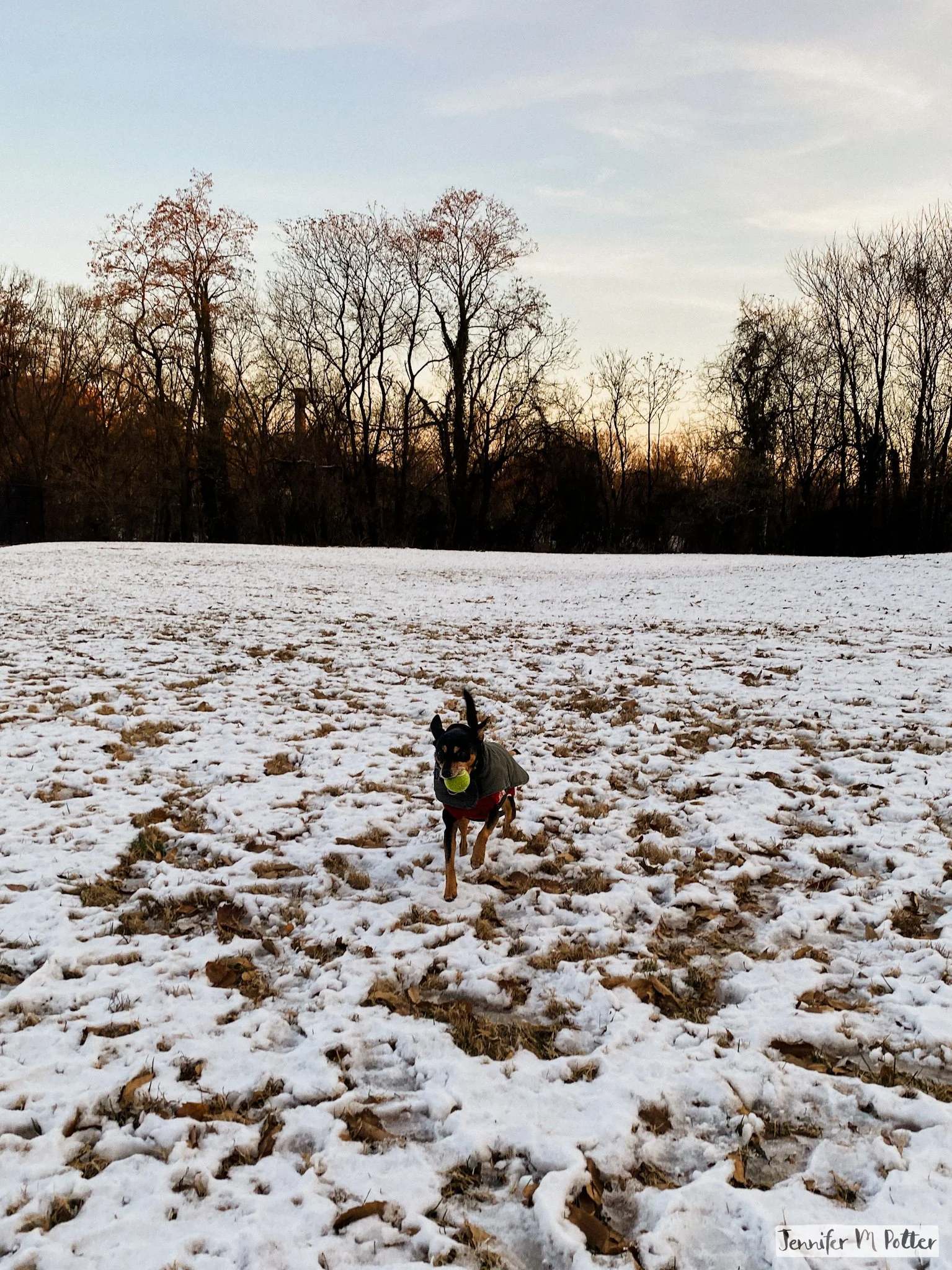
Frisket frolicking in the snow

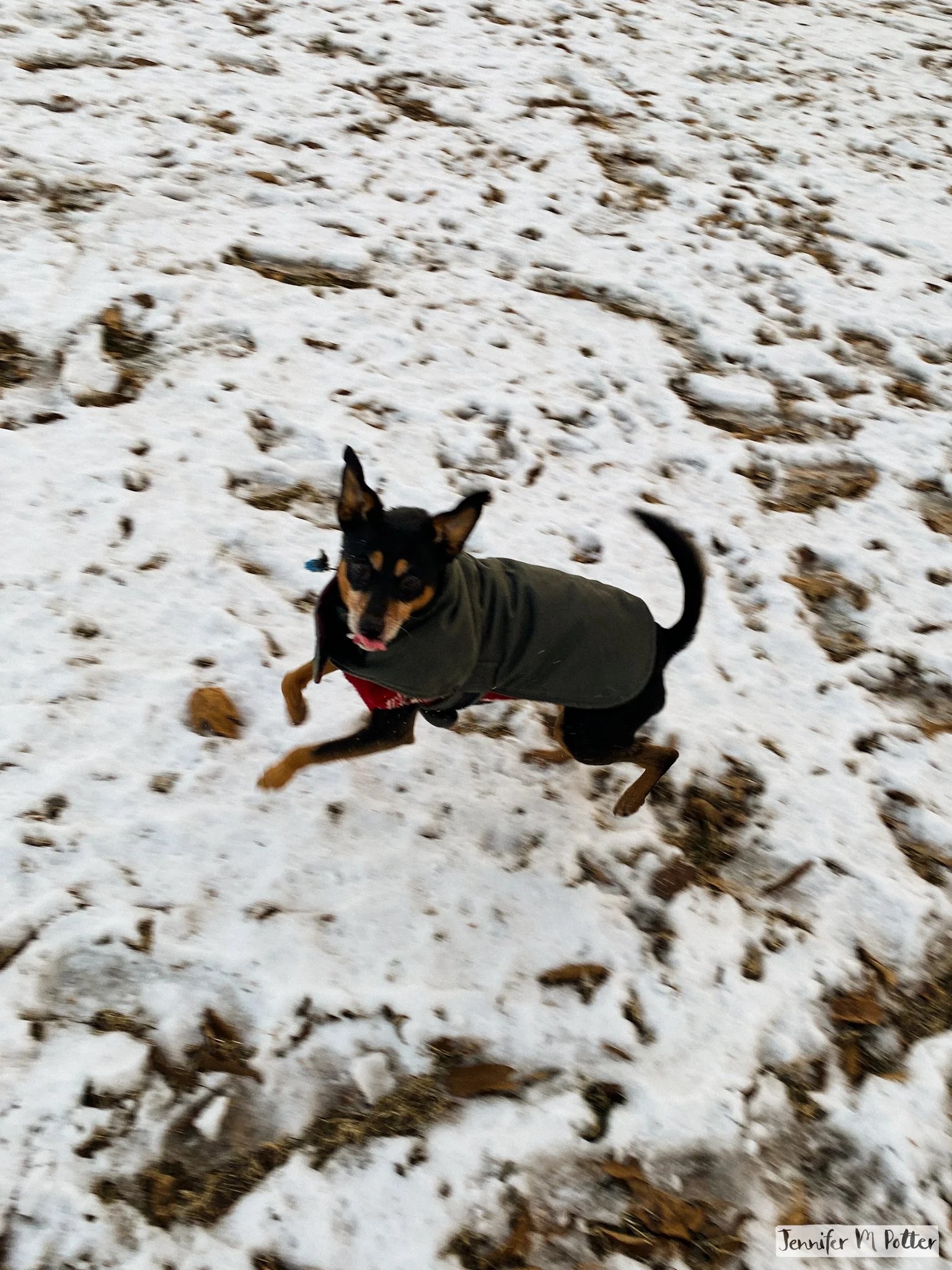
It finally snowed this week. Snow that stuck and then turned into icy patches as we dipped into the teens. Frisket ran circles in the park, frolicking hard as only snow can incite.

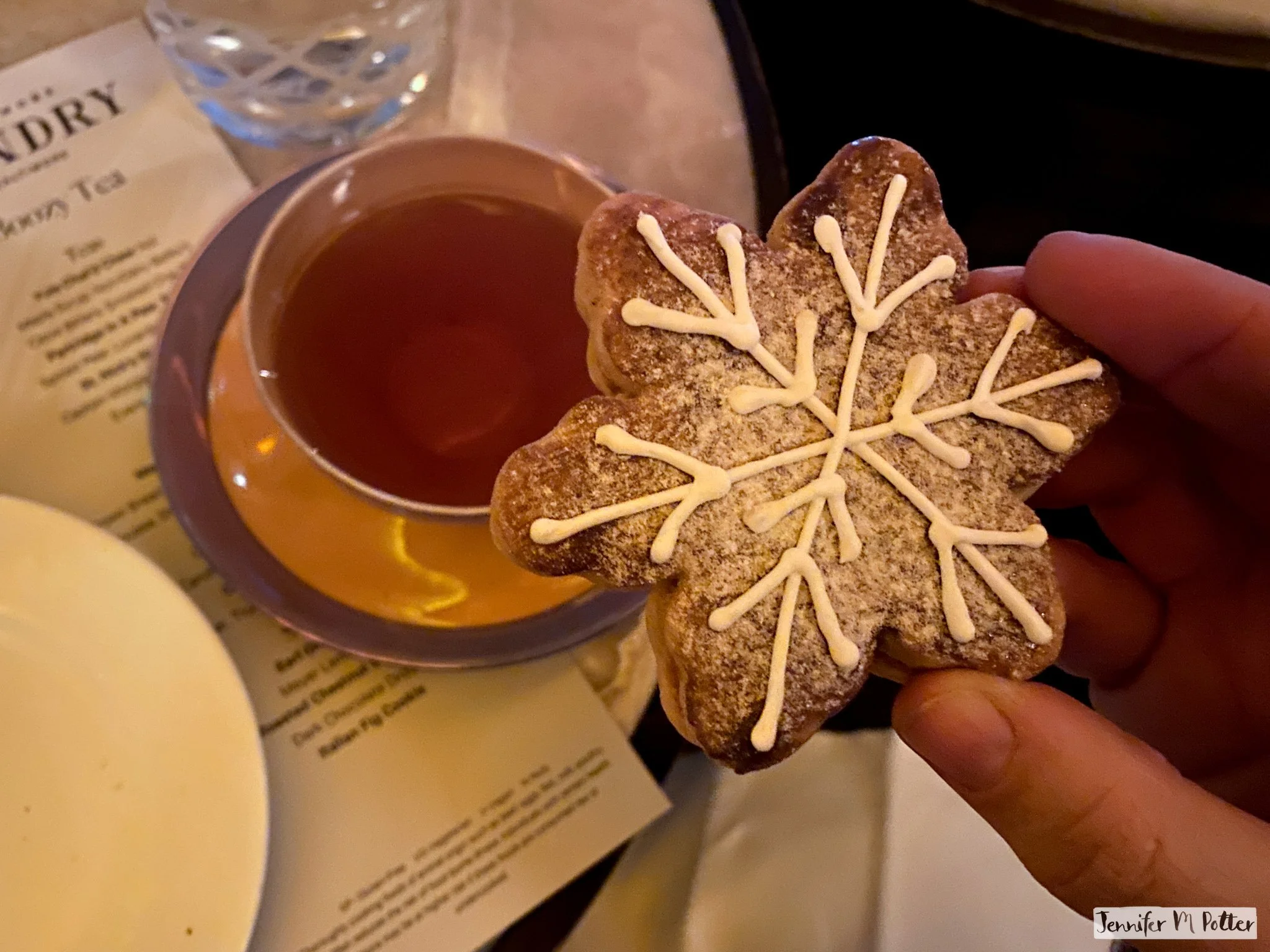
A very tasty chestnut creme cookie and a cup of delicious tea

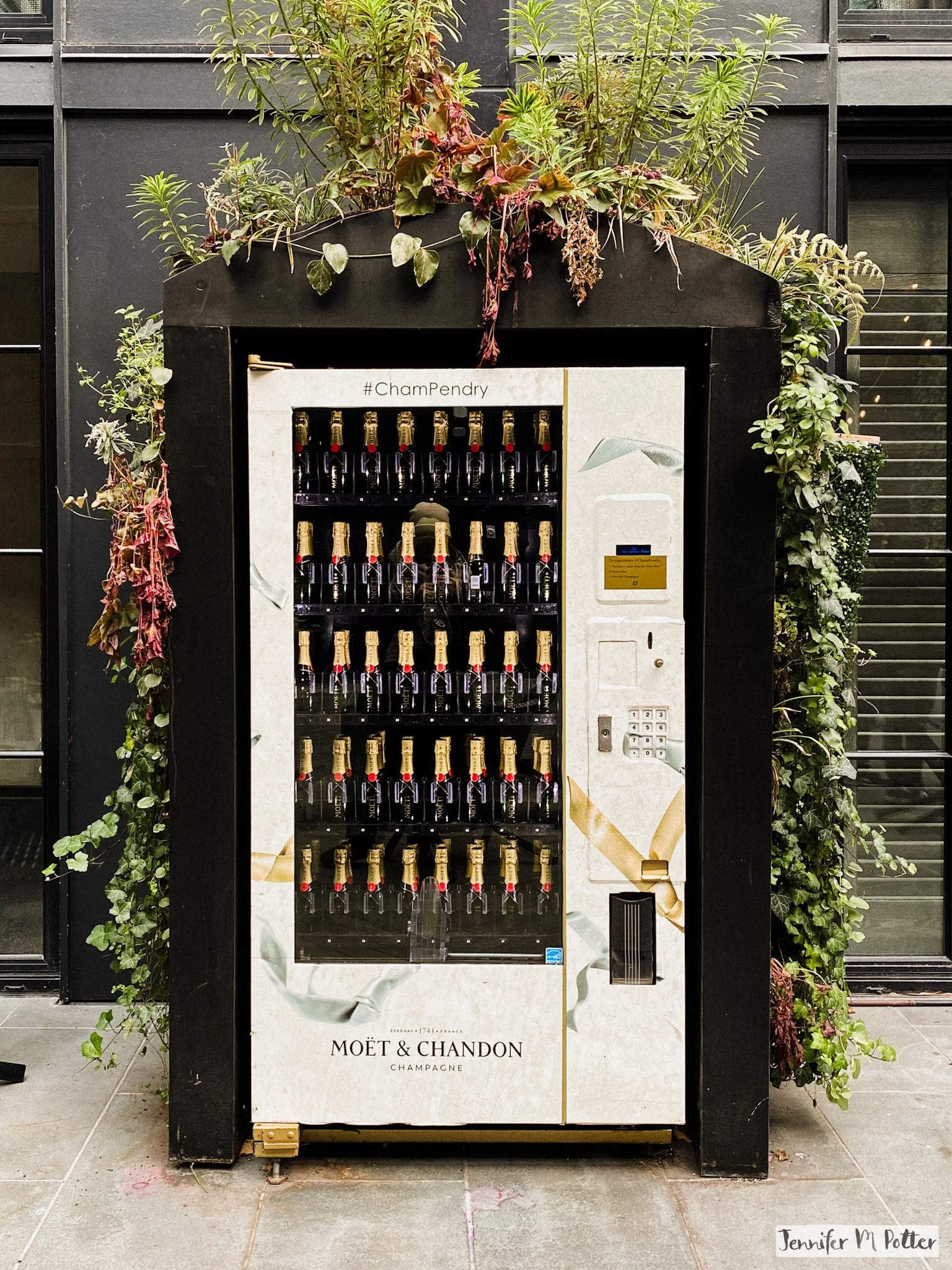
On Saturday Paul and I went to afternoon tea at the Pendry in Fells Point with friends. A special kind of splurge for the holiday season—tiny sandwiches, scones with lemon curd, the whole thing. Super fancy. There’s a champagne vending machine in the courtyard. I have mixed feelings about a champagne vending machine.

A champagne vending machine because it's NYE somewhere

The contrast of the week—ripping up wet carpet one day, drinking tea from fine china the next.

The boxes will have their moment. Just not now.

Day Before, Day Of

I did it. I tabled at my first market.

A friend asked me how I'd measure success at the market. I had a number in my head—$1,000 would feel like success, though I had no idea if that was realistic. “In this economy?”

So I started thinking about how I wanted to feel instead. I wanted to feel good about selling things. To be motivated to keep going. Feels more important than any metric.

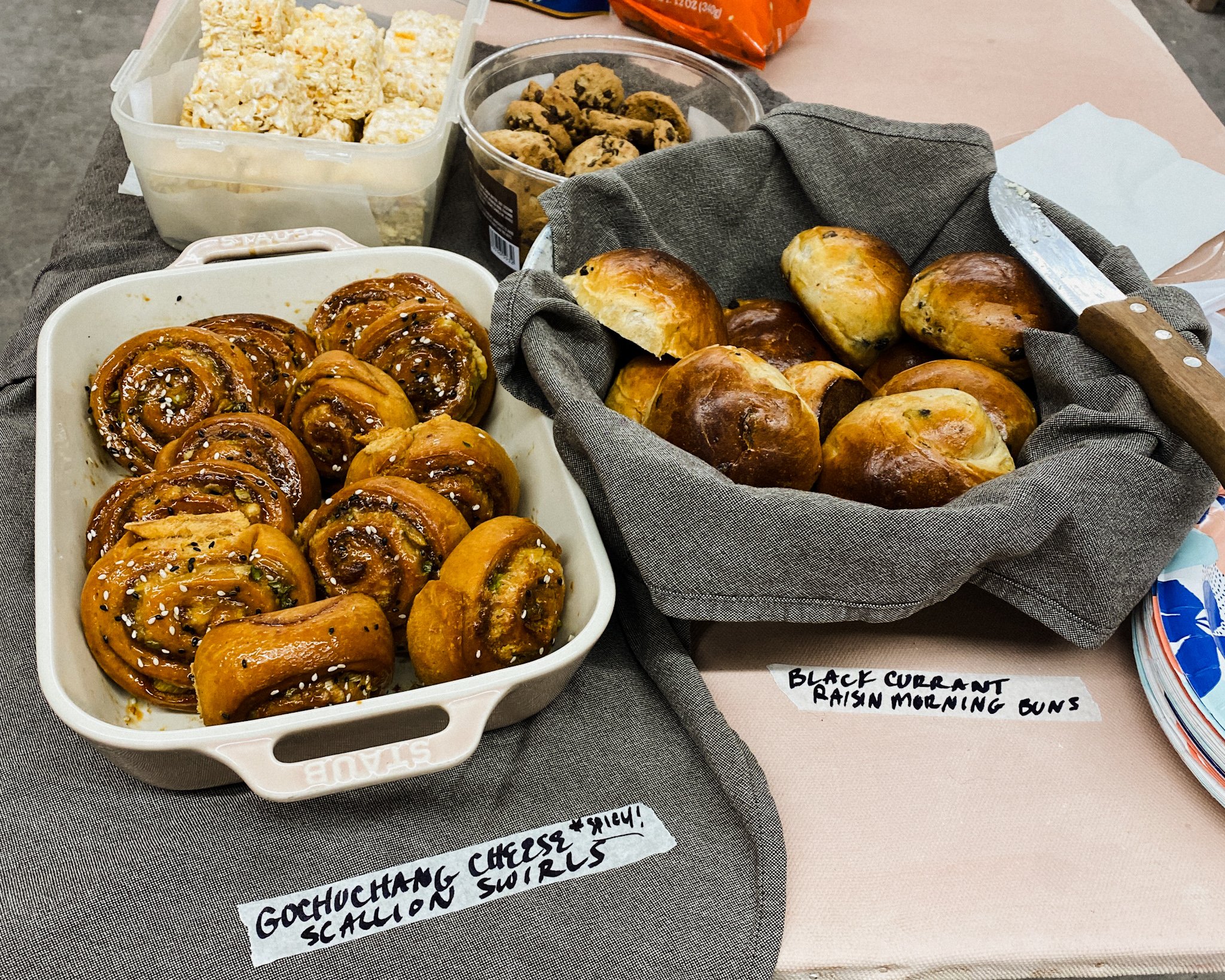
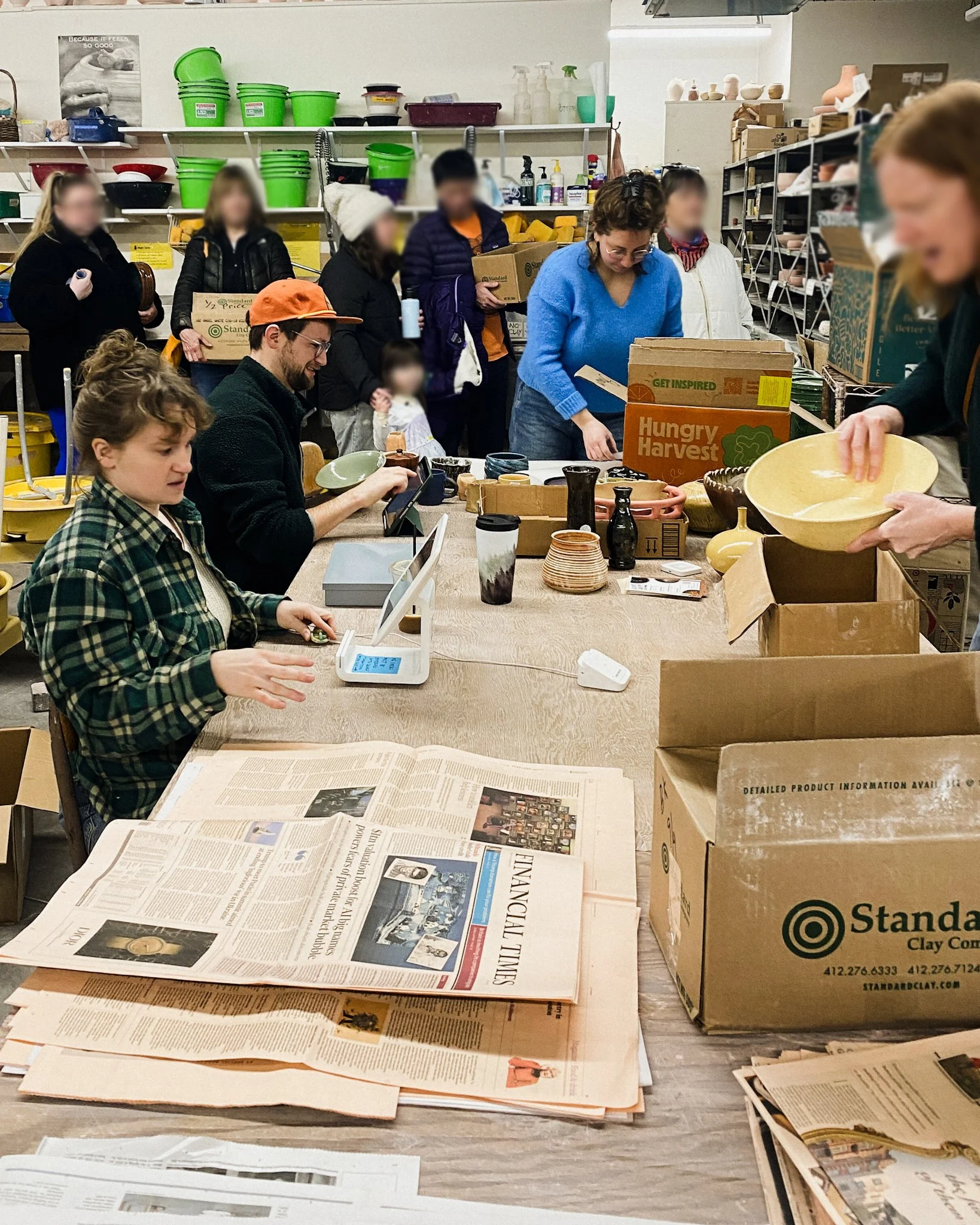
The day before, I was at the Potters Guild helping set up. We lifted pottery wheels onto rolling platforms and wheeled them into the clay alley. Mopped the floors. Drank wine, and snacked on cheddar and chocolate babka. Robin brought challah bread from Motzi. Freshly made, soft and just a little sweet.

Potters Guild members pulling ornaments from a crate

Setting up.

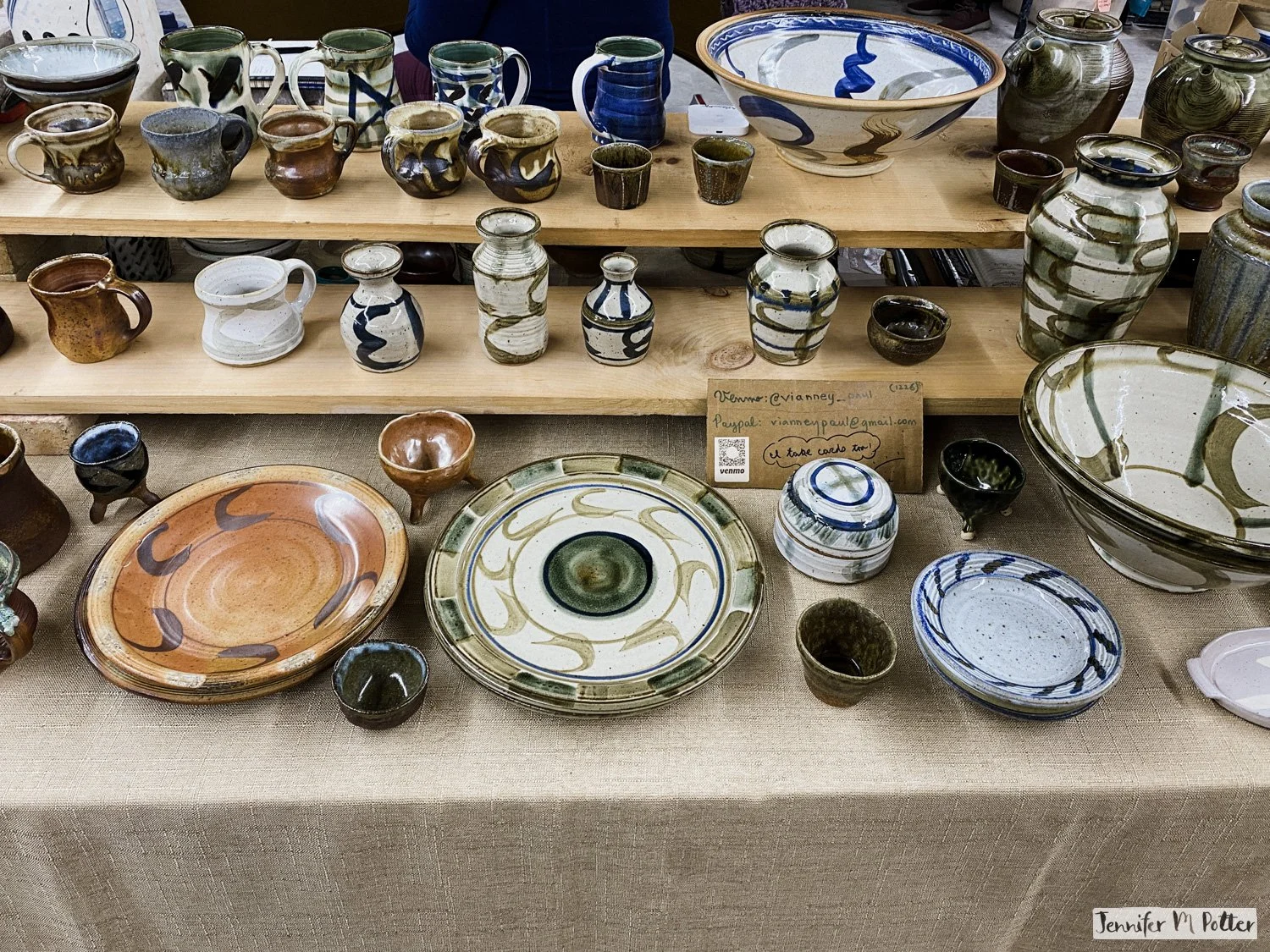
A display of pottery thrown and decorated by Vianney Paul

Vianney Paul’s multi-tiered display.

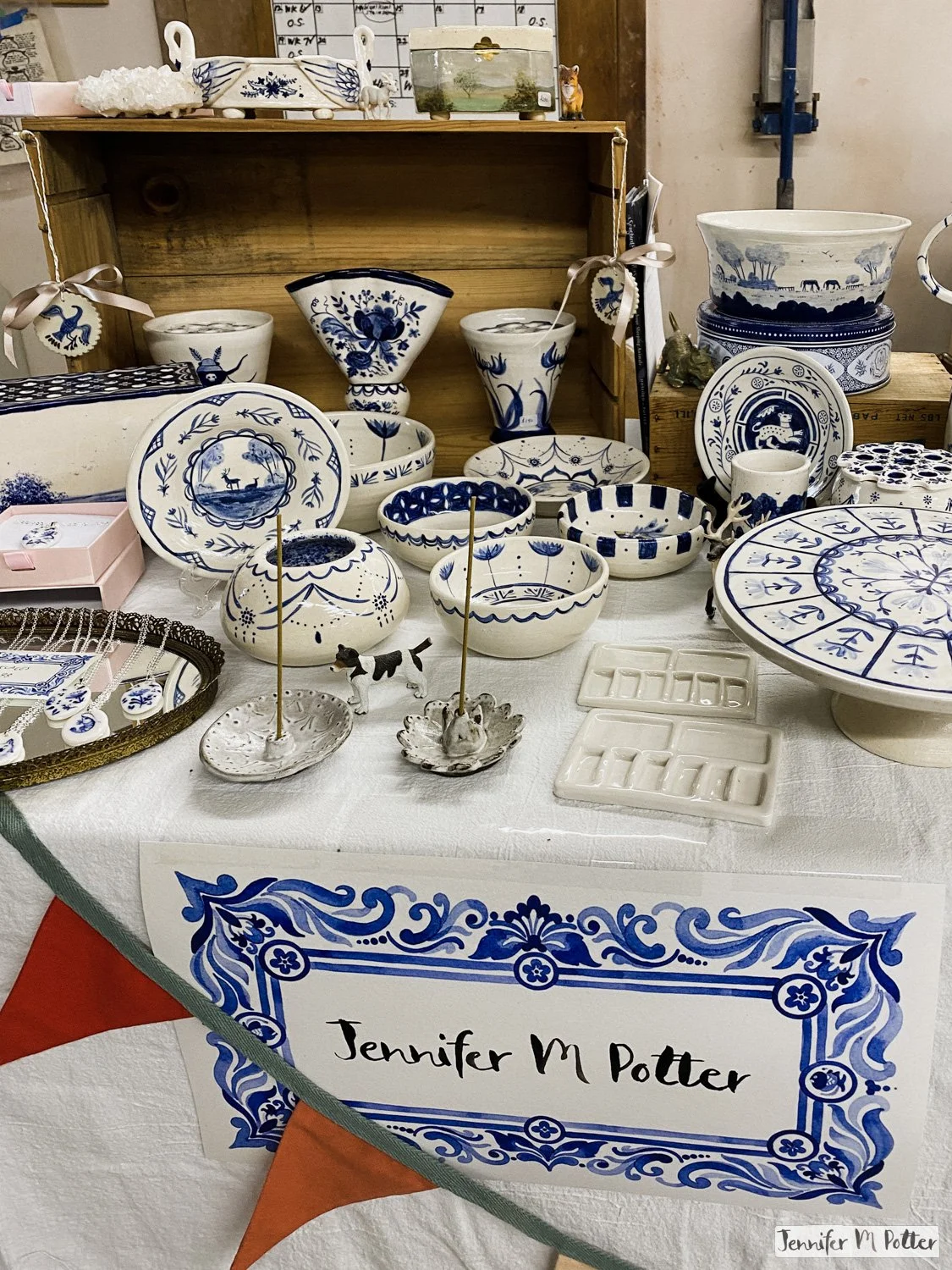
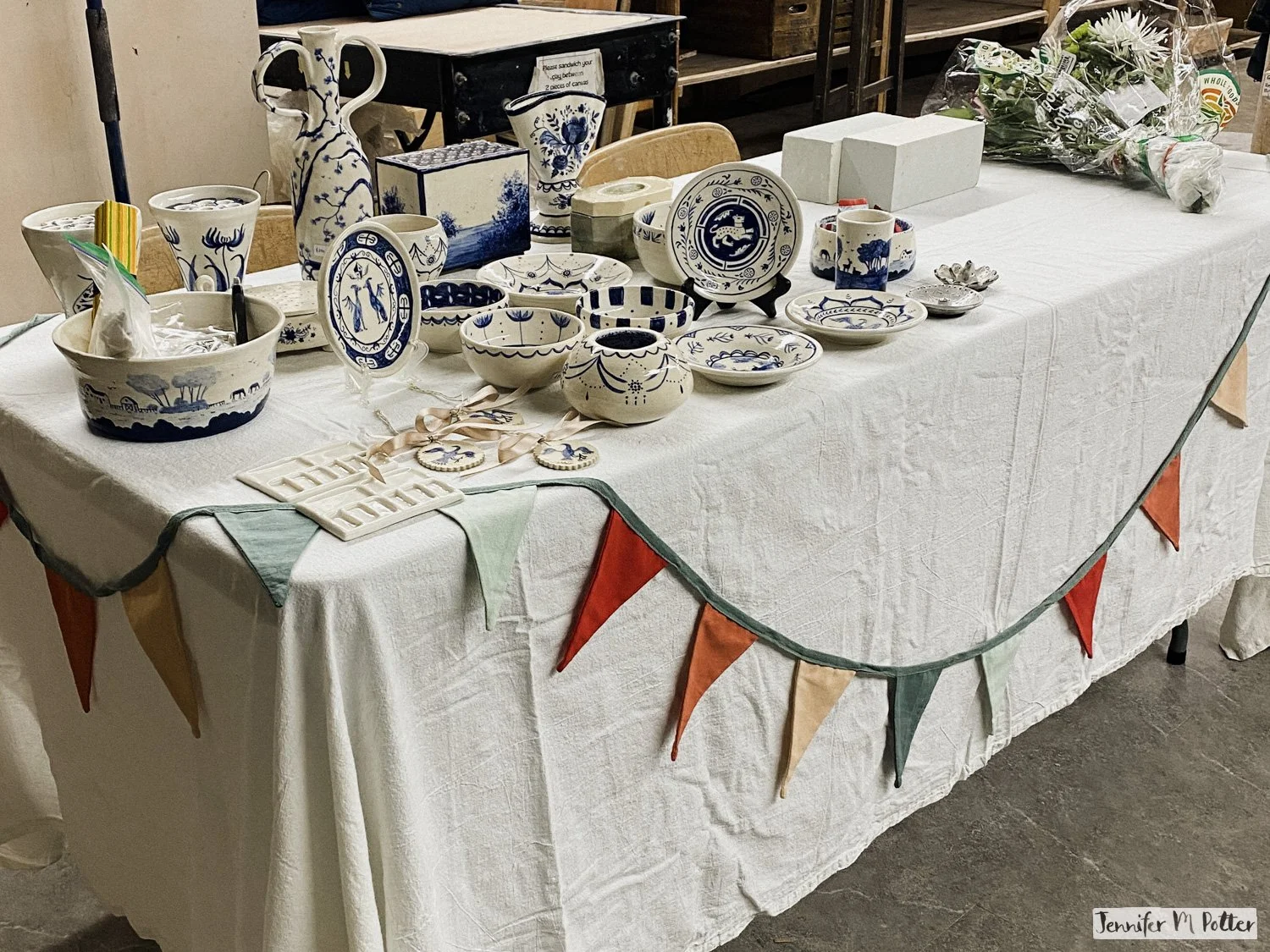
I set up my table. Laid out the linen tablecloth, wrapped it in bunting, arranged my pieces. I watched other people set up and I examined their displays. I definitely needed risers. My bowls needed height or no one would be able to see the detail on the sides.

Sorting out how to display my blue and white ceramics on the table

Looking a little samey.

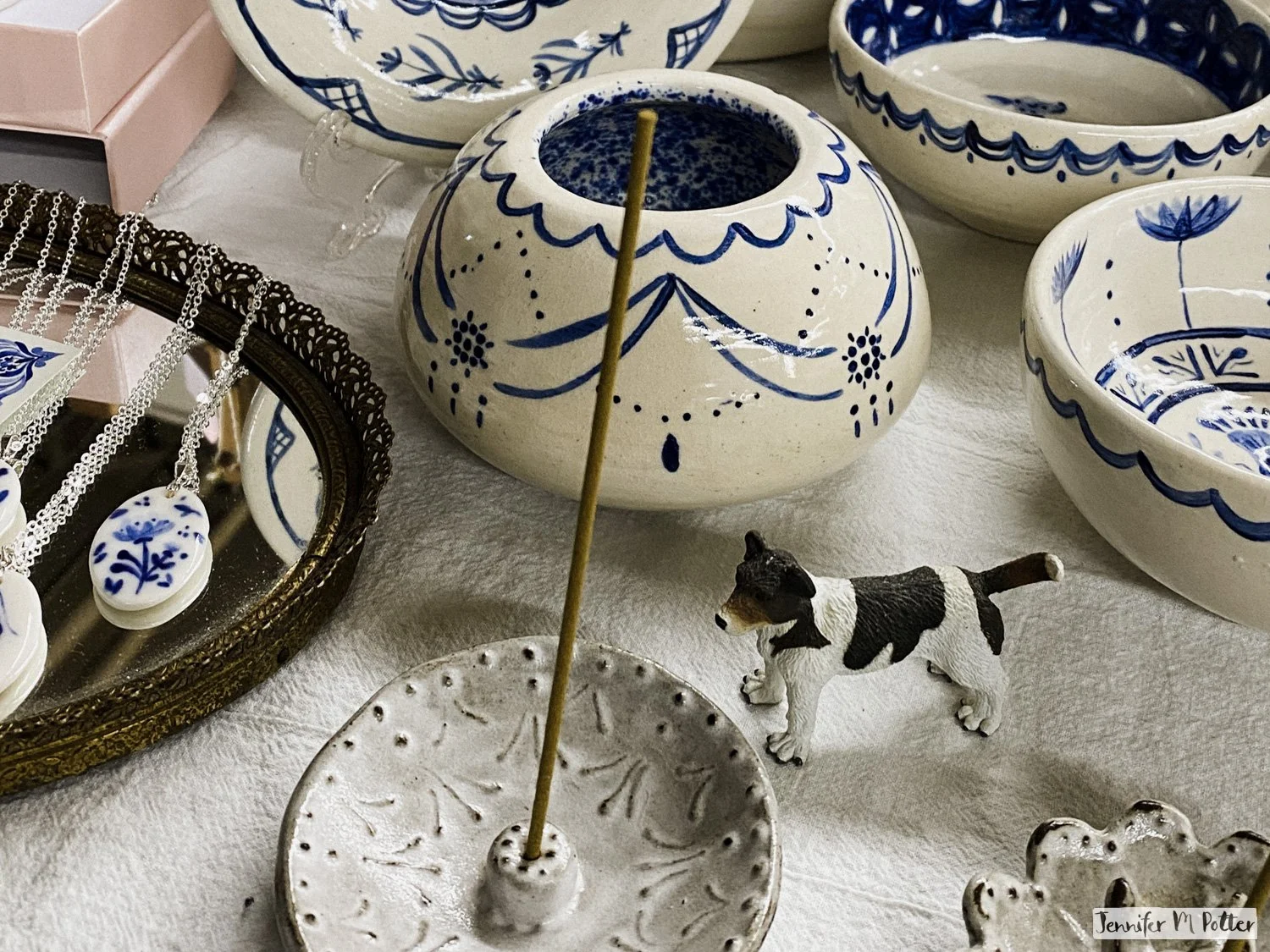
At home I pulled an old wine crate and vintage wooden cheese boxes out of the basement. Dusty and unused since our move from San Francisco, but I couldn’t part with them. I dusted them off, then grabbed a few tins to use as platforms. I went on a shopping spree through my house, picking up little things that felt like me. Mise en scène. Goose feathers I brought home from Buenos Aires. Tiny plastic woodland animals because I like them. An old brass dog I call Chester. First ever market support animals.

A small plastic dog nestled in among my ceramic pieces

Ready for orders.

I still needed signage. The morning of the market I somehow managed to whip up a semi-professional sign for the table, an email signup sheet, and small place cards for pricing. Putting those old graphic design skills to the test. Luckily I had all the paper I needed and my printer just worked.

I was going to make sandwiches but forgot to take the bread out of the freezer. Just have to figure something else out. Maybe I’ll be too busy to be hungry.

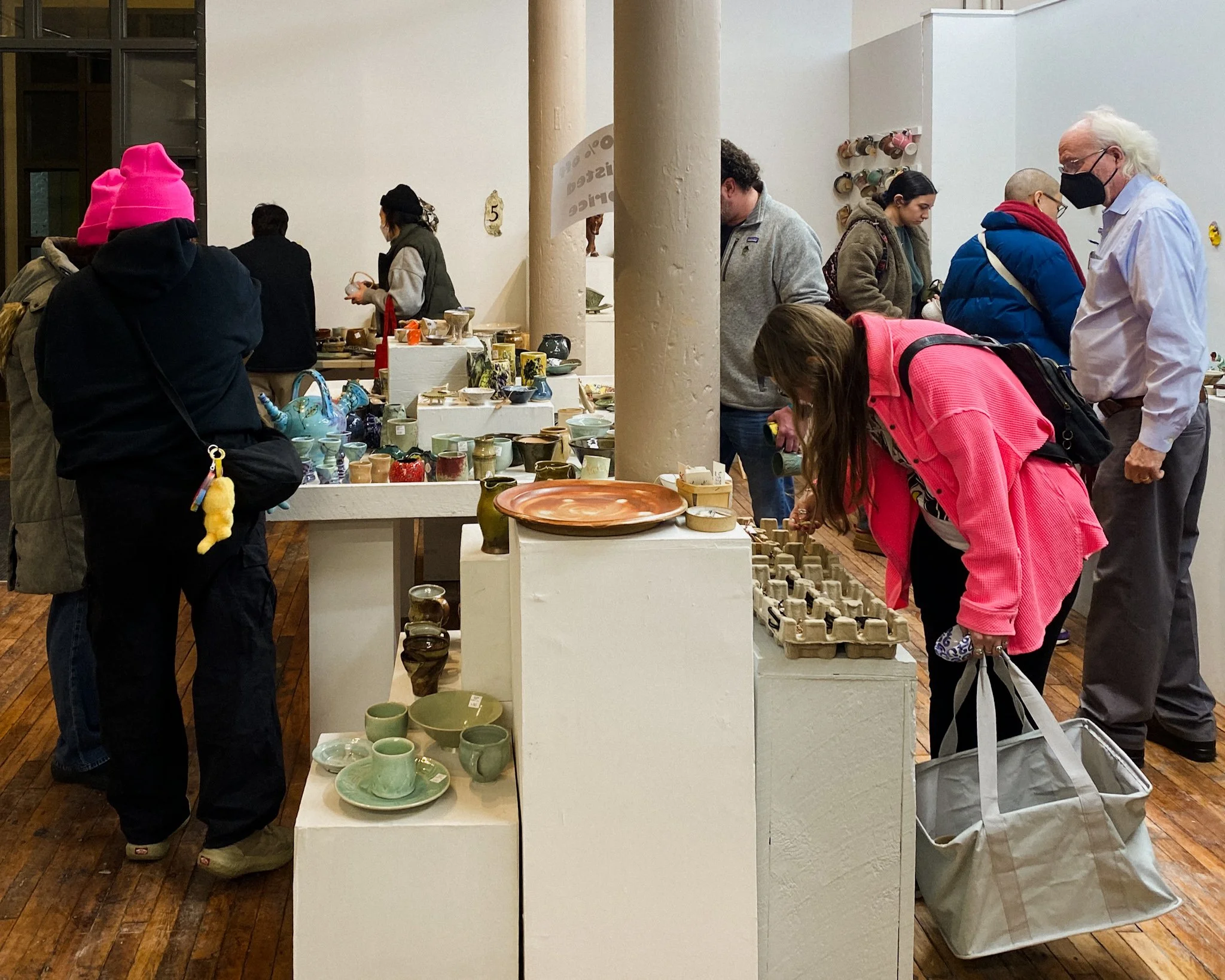
I got to the space at 10am. Doors at 11. Got the signs and risers sorted. Not enough time to put out the flowers I'd bought, but everything else was in order. There was a line of people waiting outside!

My final set up, incorporating signs, crates, tins, and small animals.

A little more lifted.

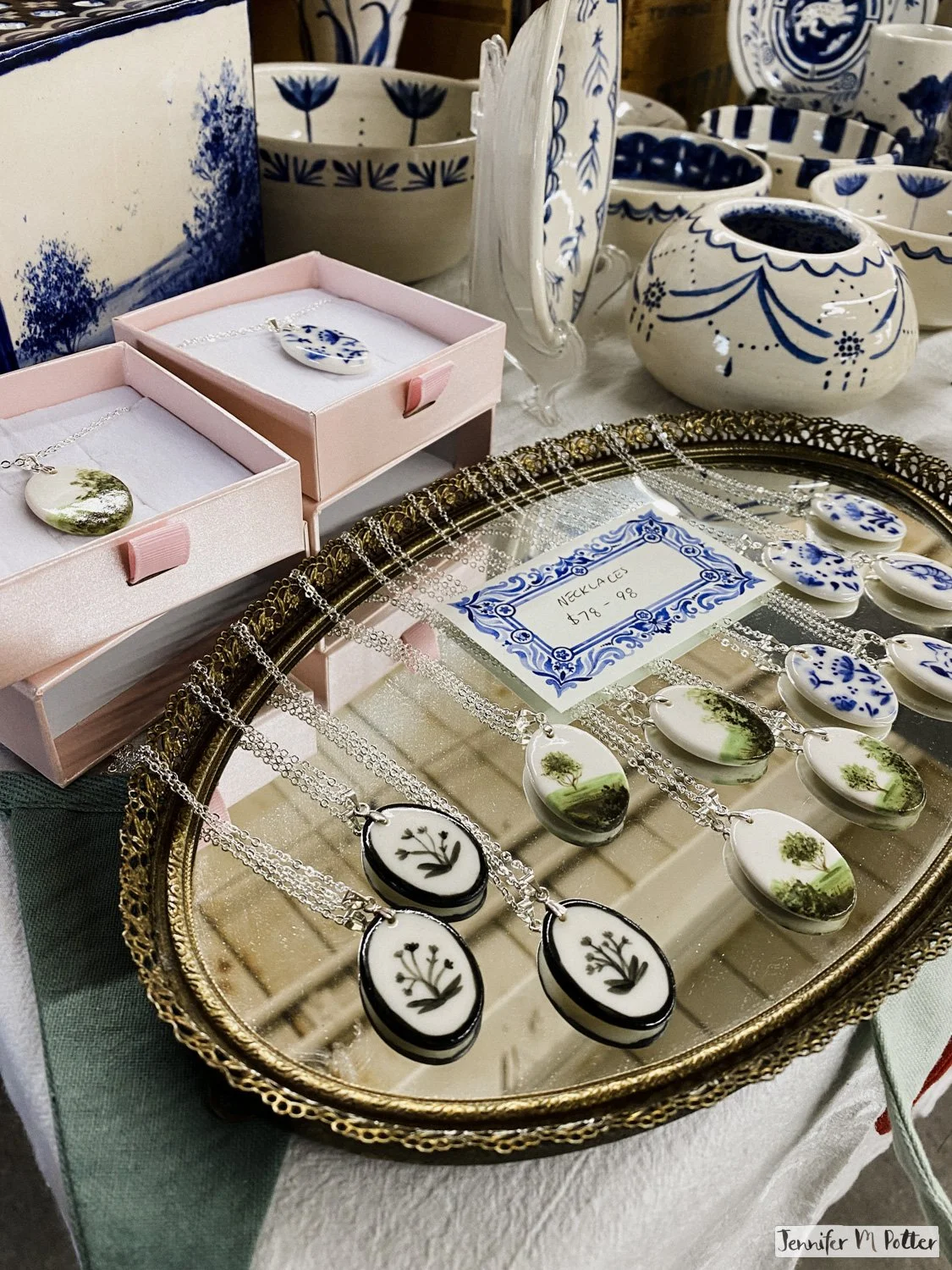
My porcelain necklaces displayed on a vintage mirror

Need to invest in a necklace stand, but this mirror I swiped off my dresser works for now.

They opened the door and it stayed open. So cold! I made a couple of sales right away—very new to the Square system, to making transactions and packaging things up, but it worked. After I think the third sale, Van—who I was sharing a table with—told me I was supposed to take the price tags off before boxing my ceramics. “Because they’re gifts.”

After half an hour I had to put on my parka. I wanted to wear my mittens too, but I needed my hands.

Jesse sold refreshments at her table. She hooked me up with a cup of hot chai and it was exactly what I needed. Warm, sweet, cozy. Then Barb closed the door and we warmed up again.

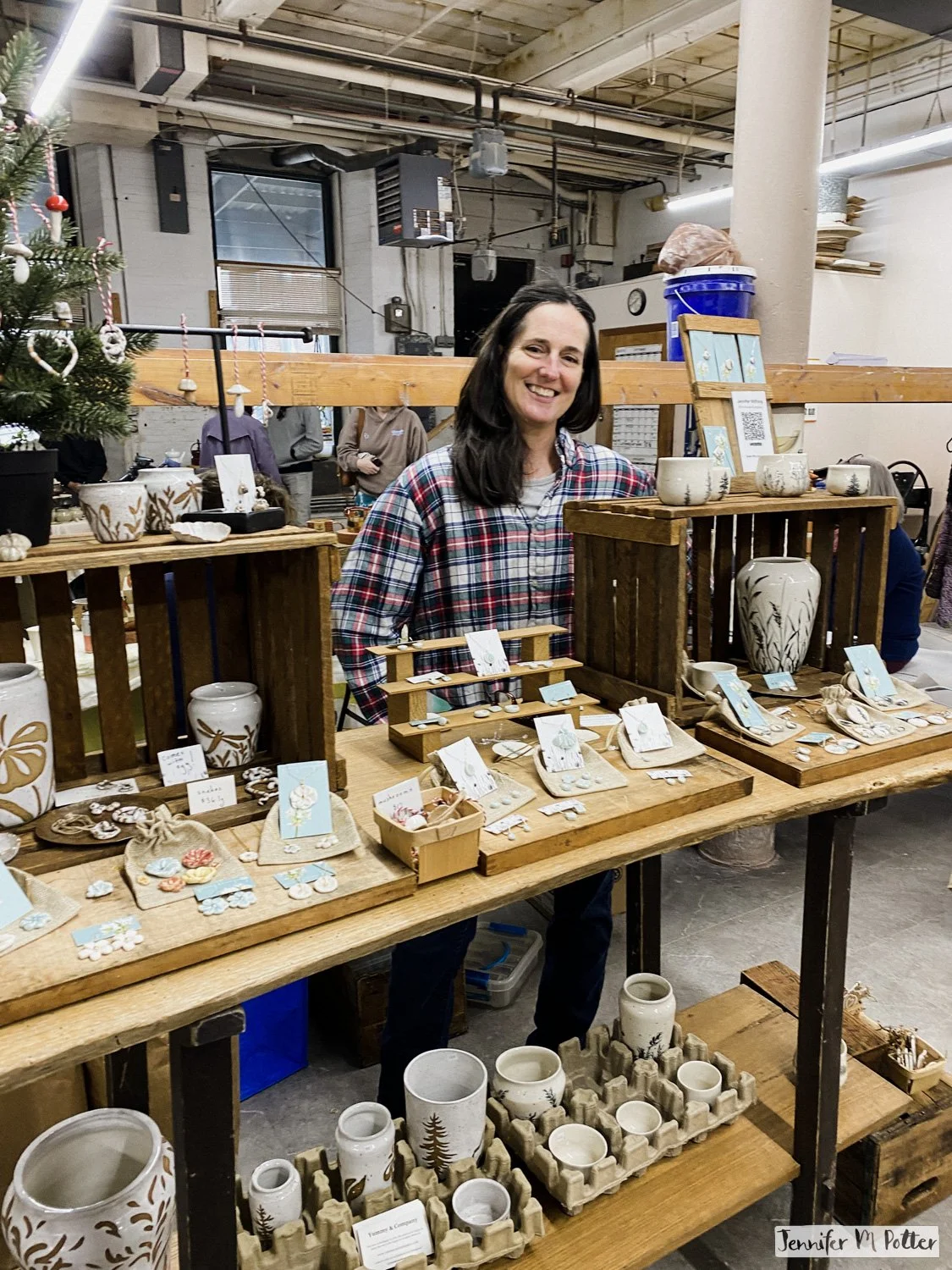
Jen Wilfong's display

Jen of Yummy & Company. The best teacher and mentor! I wrote about her here.

The next few hours were slower. There were always customers milling about but nothing like that 11am rush. My neighbor stopped by. My father-in-law. My husband. Van's husband offered to pick up lunch for us at Ekiben. I got the tofu bao. My favorite. They make the best tofu, crispy on the outside, soft on the inside. As it should be. I didn't love eating while people were shopping, but I just had to say it was Ekiben and they understood.

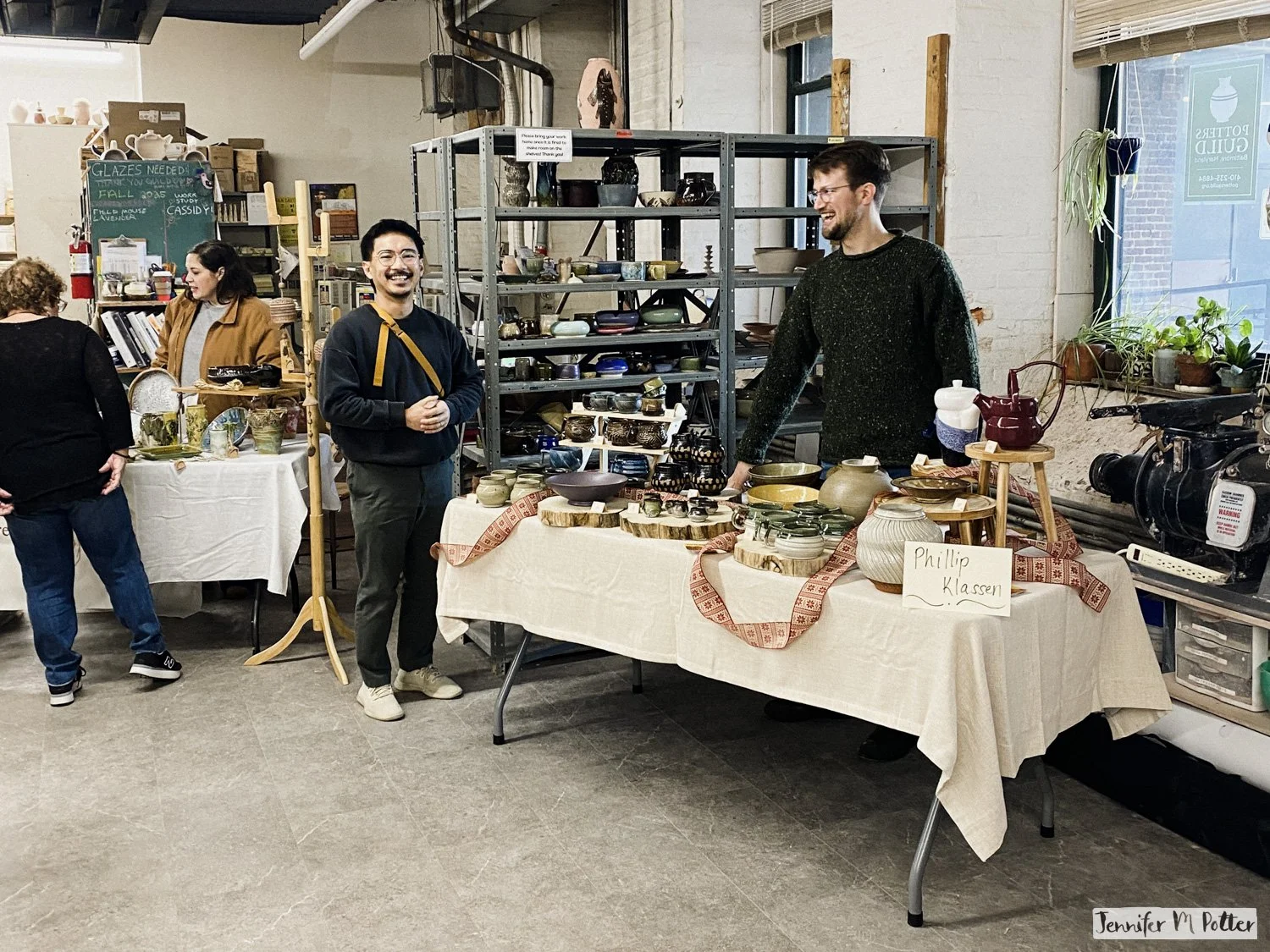
Phillip Klassen's display

Phillip Klassen (right) and his partner, Abe (center).

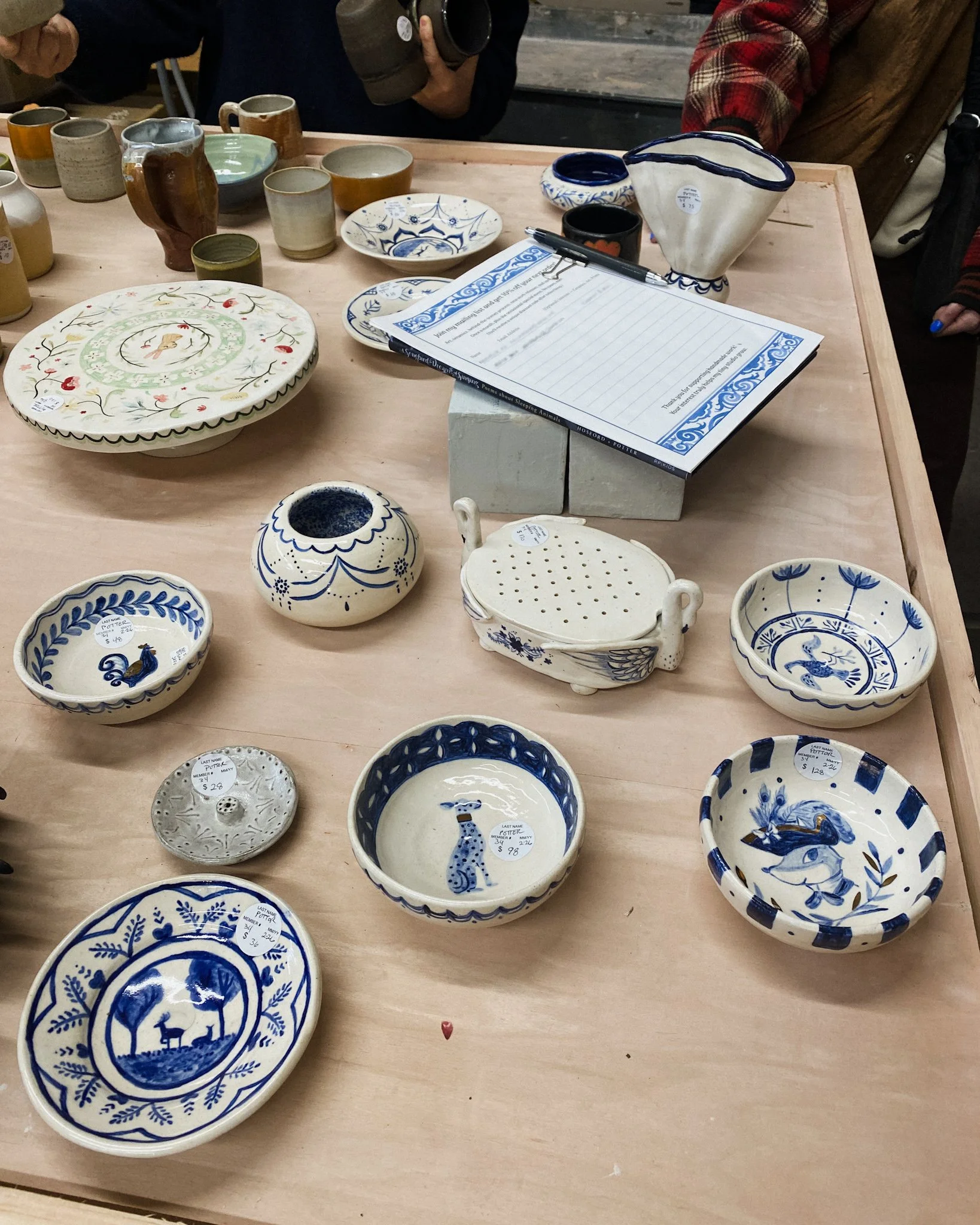
I made my biggest sale toward the end of the day. A $190 vase. Most of what sold was smaller—porcelain watercolor palettes at $18, trinket dishes at $68. But that one $190 sale felt pretty good. I probably could have undercut myself and sold more pieces. But I knew that if someone connected with my work, they'd want to pay what it cost. Hand made, hand illustrated. Functional, sure, but also art.

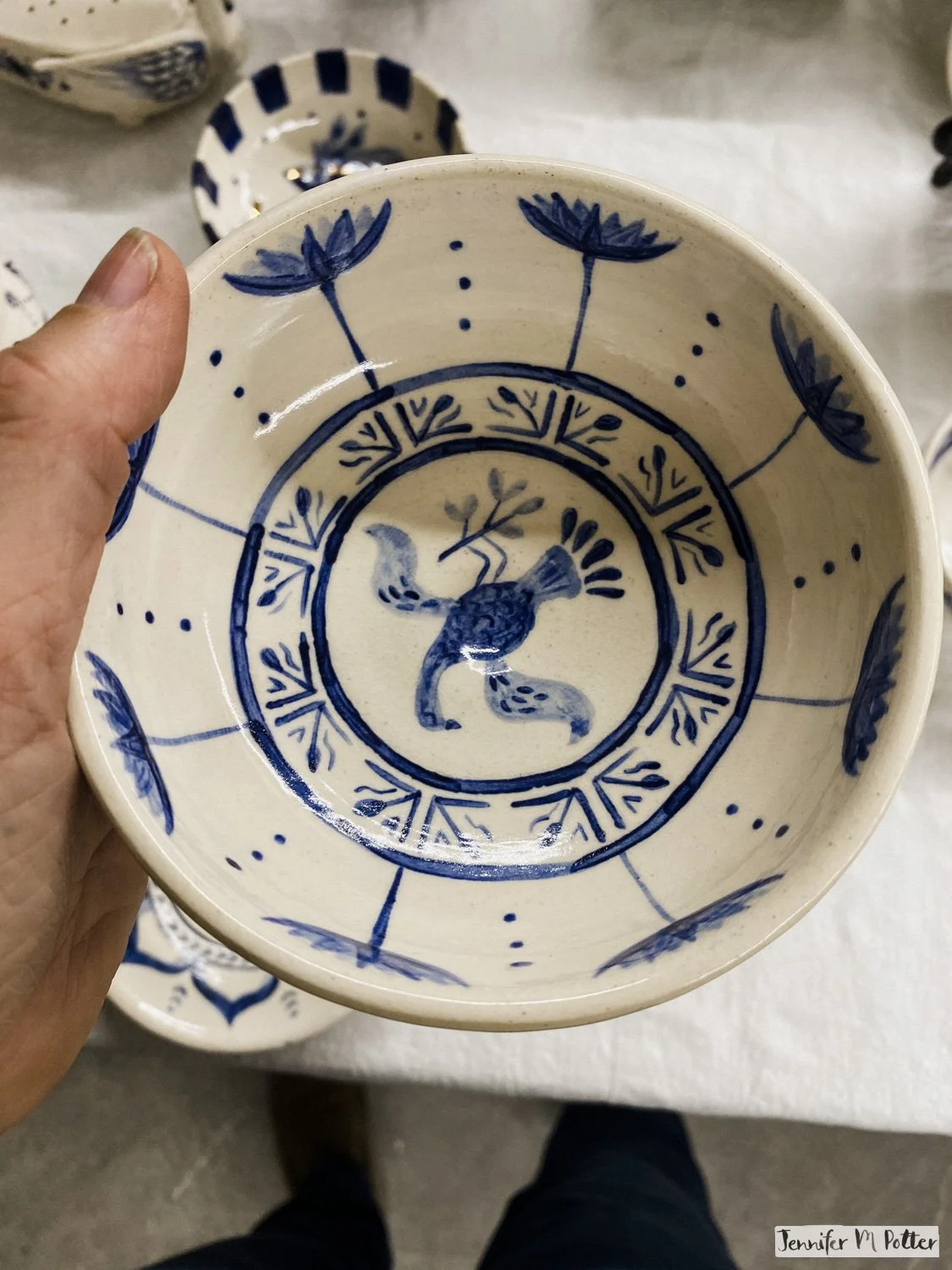
A close up of a bowl I painted with a bird and 1920s/Egyptian art-inspired designs.

I didn't hit $1,000, but I didn't lose money either. I sold some stuff and learned a ton. And I came out of it feeling pretty good. So I guess I hit one goal.

Time to research markets for 2026.

What a dish costs
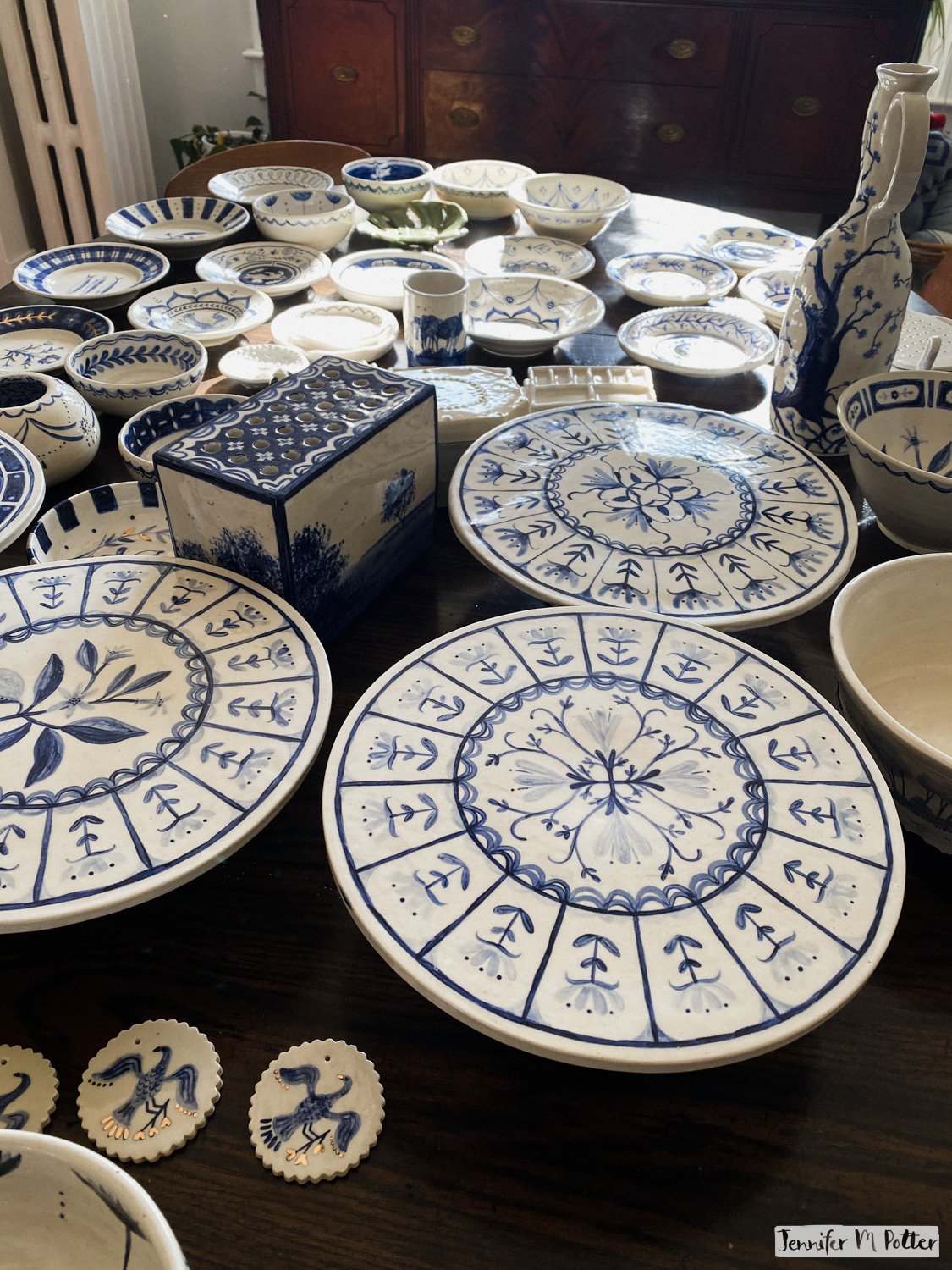
A bunch of my ceramics, mostly blue and white, all laid out on the dining table

I've been sitting at the dining table with a sheet of price stickers, trying to figure out how to price the ceramics I'm taking to the market this weekend.

It's harder than I thought it would be. I keep starting with time. How long did it take me? Three hours? Five? When I was consulting as a creative director in San Francisco, I got paid $150 an hour. Is that what my time is worth? If so that's $750 on labor alone. But I can't sell a small dish for $750. At the other end, minimum wage would put it at $75—still a lot, and that's without materials. That feels depressing. I don't want to make minimum wage. I have way more specialized knowledge now than I did then.

When someone commissions an illustration, I still think in hourly rates. It's how I know what's fair. But I'm learning that making products is different.

Because I'm two people now. I'm the labor, and I'm the business owner. Worker Jennifer can make $15 an hour. But Entrepreneur Jennifer takes the whole piece—materials and labor—and marks it up to cover overhead and profit. Overhead isn't just clay and glaze. It's market fees, hosting fees, transaction fees, broken pieces, kiln fails, experiments that don't work out, shipping materials, photography, the time spent writing numbers on pricing stickers. If the dish costs $75 in parts and labor, that's just production. Running a business costs more.

Worker Jennifer might get minimum wage right now. But Entrepreneur Jennifer needs to take home a profit on top of that, because maybe someday I'll want to hire help—hopefully for more than minimum wage—and still be able to do things like go out to eat on occasion and buy Christmas presents.

Hiring help! I haven’t done a single market yet and already I’m getting ahead of myself.

I'm a complete noob at this. My business has always been commission-focused, so I've never managed sales and inventory. Many illustrators deal with products and overhead—prints, notebooks, cards, pins. You spend ten hours on an illustration and make infinite prints from it. But you spend ten hours on a pot and you've got…one pot.

But I'm getting more comfortable with it. With the idea that pricing isn't about what I used to make or what feels fair compared to my old life. It's about what it costs to make this thing and run this business and still have something left over.

The market is Saturday. I'll let you know how it goes.

Sketches from South America

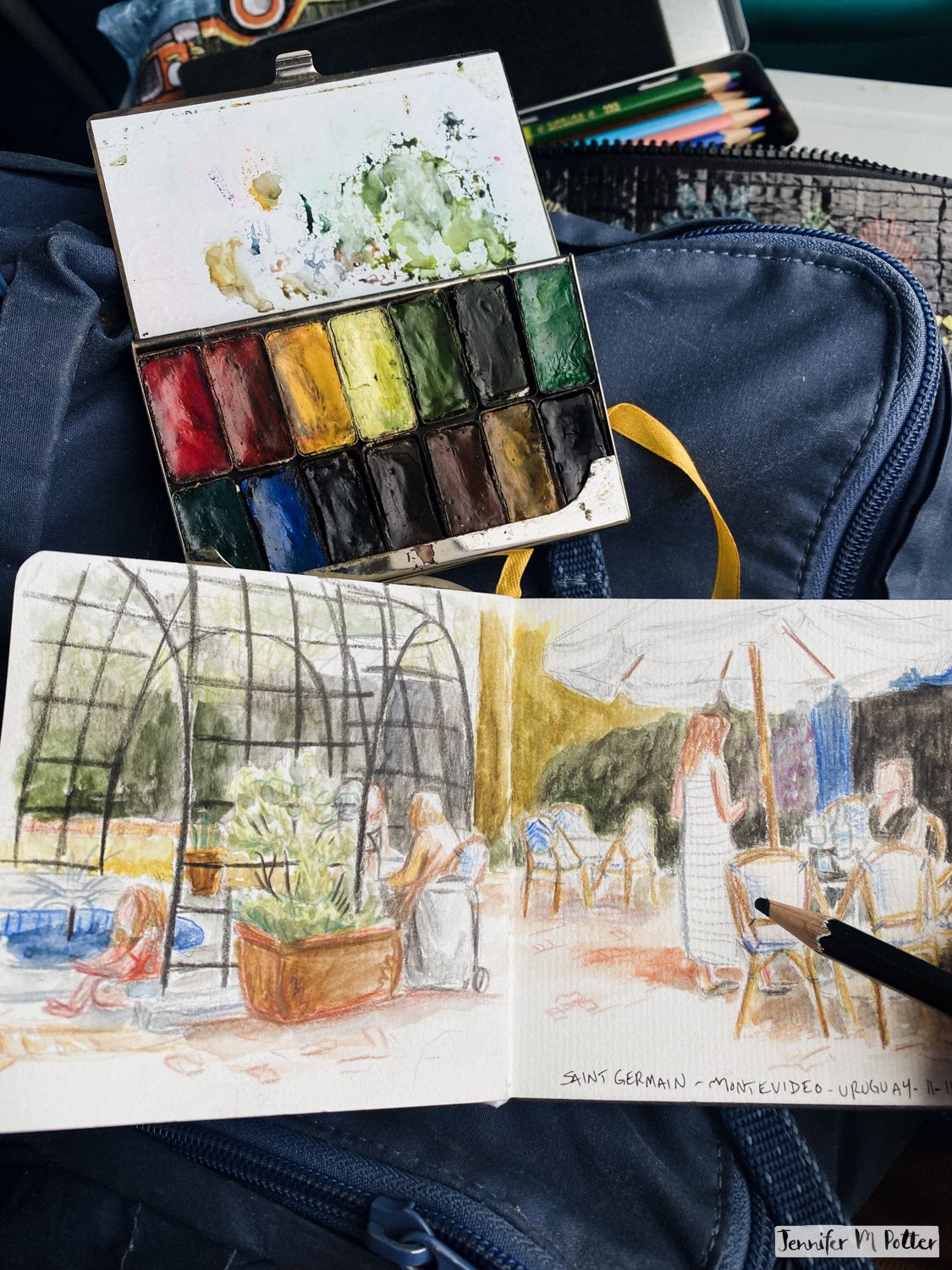
The ferry from Montevideo to Buenos Aires had very dirty windows. We couldn't look out on the Rio de la Plata, so I pulled out my sketchbook and drew something from the previous day instead—the café at Alliance Française where we'd stopped for croissants. Saint Germain, it's called. I had a delicious pistachio croissant. The jasmine was blooming outside and there were kids playing in a fountain.

Sketch of a scene from Saint Germain in Montevideo

The second sketch happened on our third day in Buenos Aires. We were about to move from our interim hotel to the one Paul's company had booked, but Paul wasn't feeling well so he stayed back to rest. I wanted to walk around a bit, explore the Retiro neighborhood. I found a shady spot with a view of this ornate rooftop—lots of detail, beautiful architecture. Later I learned it was the Palacio San Martín.

Sketch of the roof of the Palacio San Martín

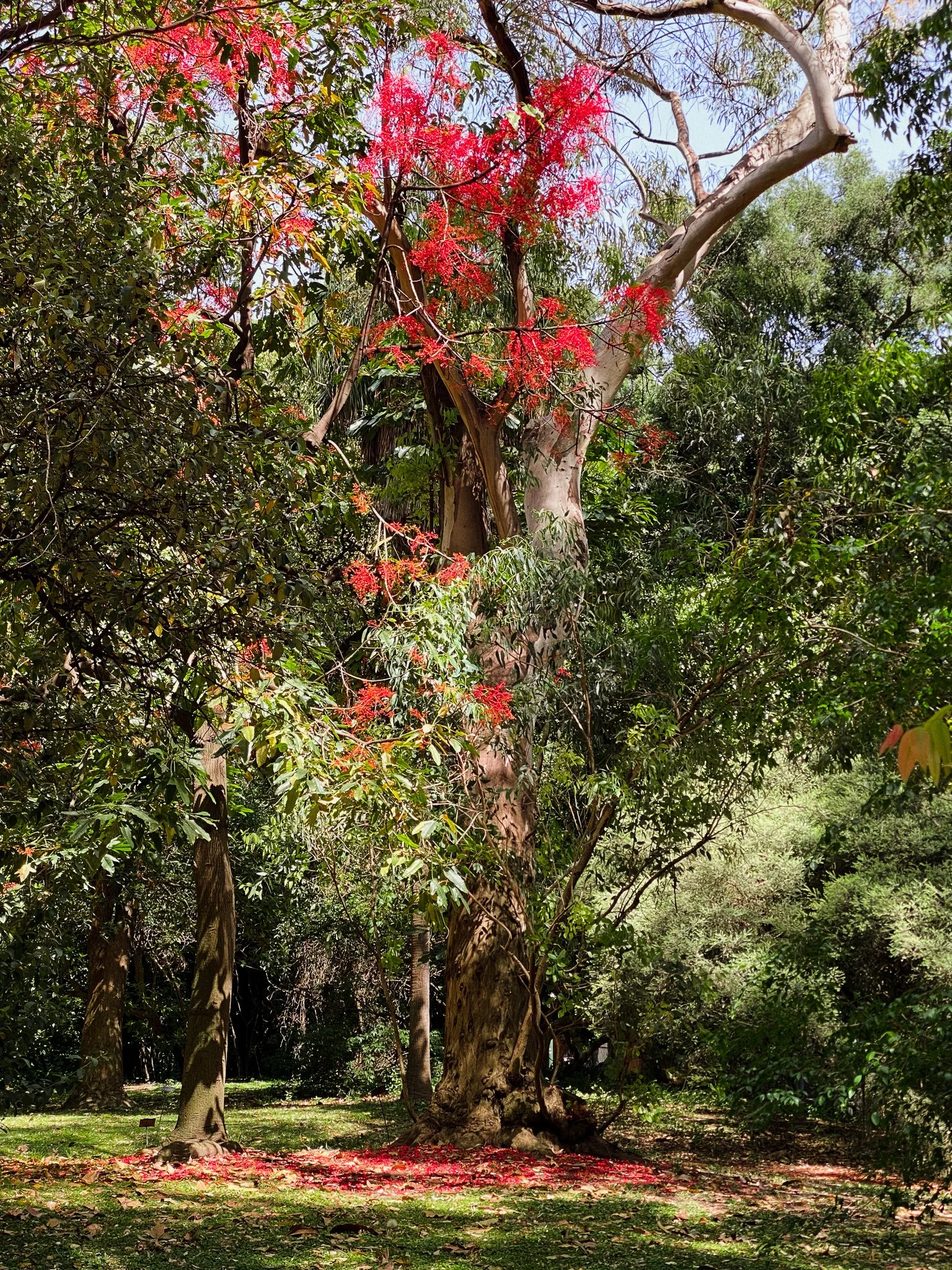
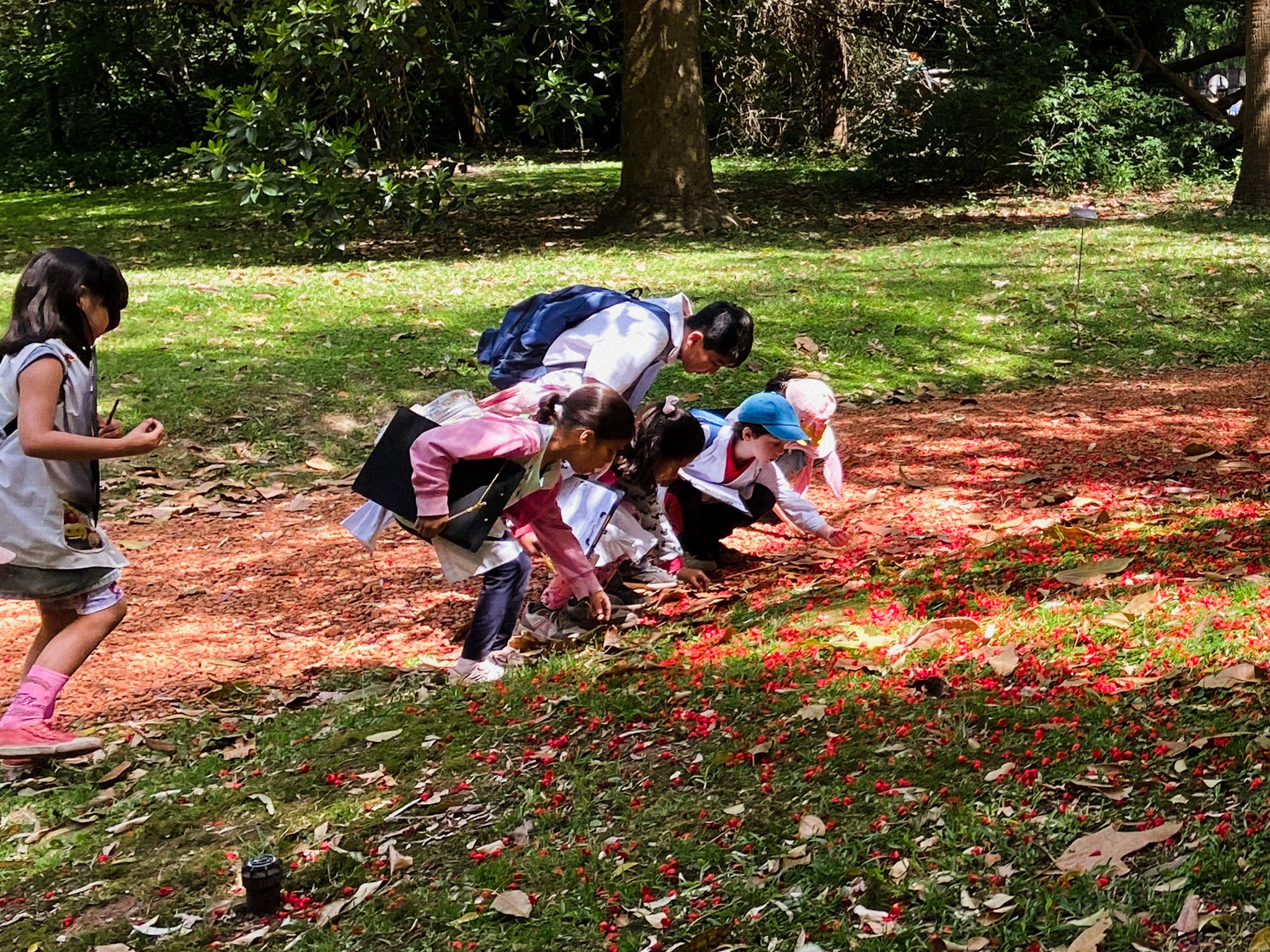
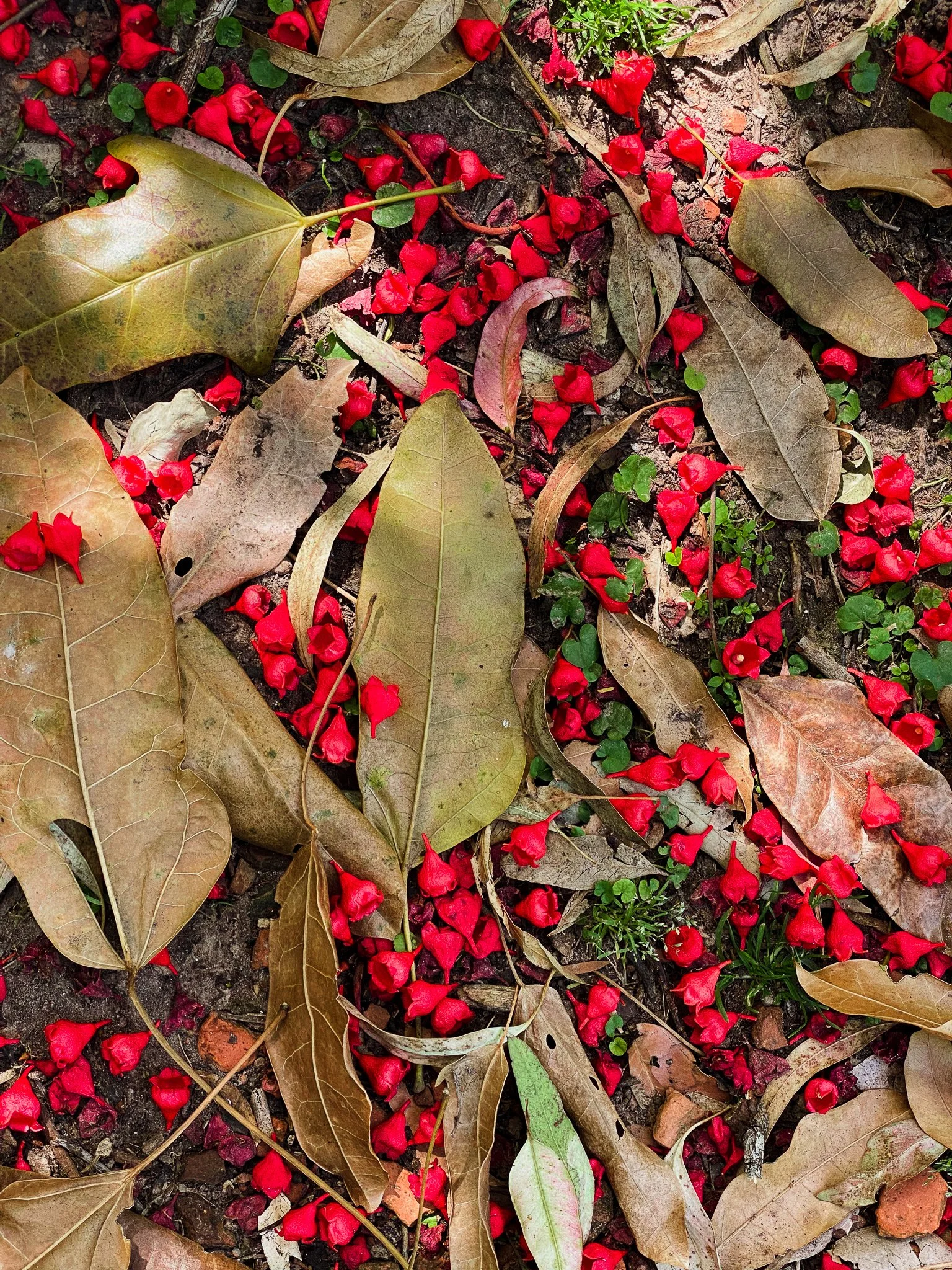
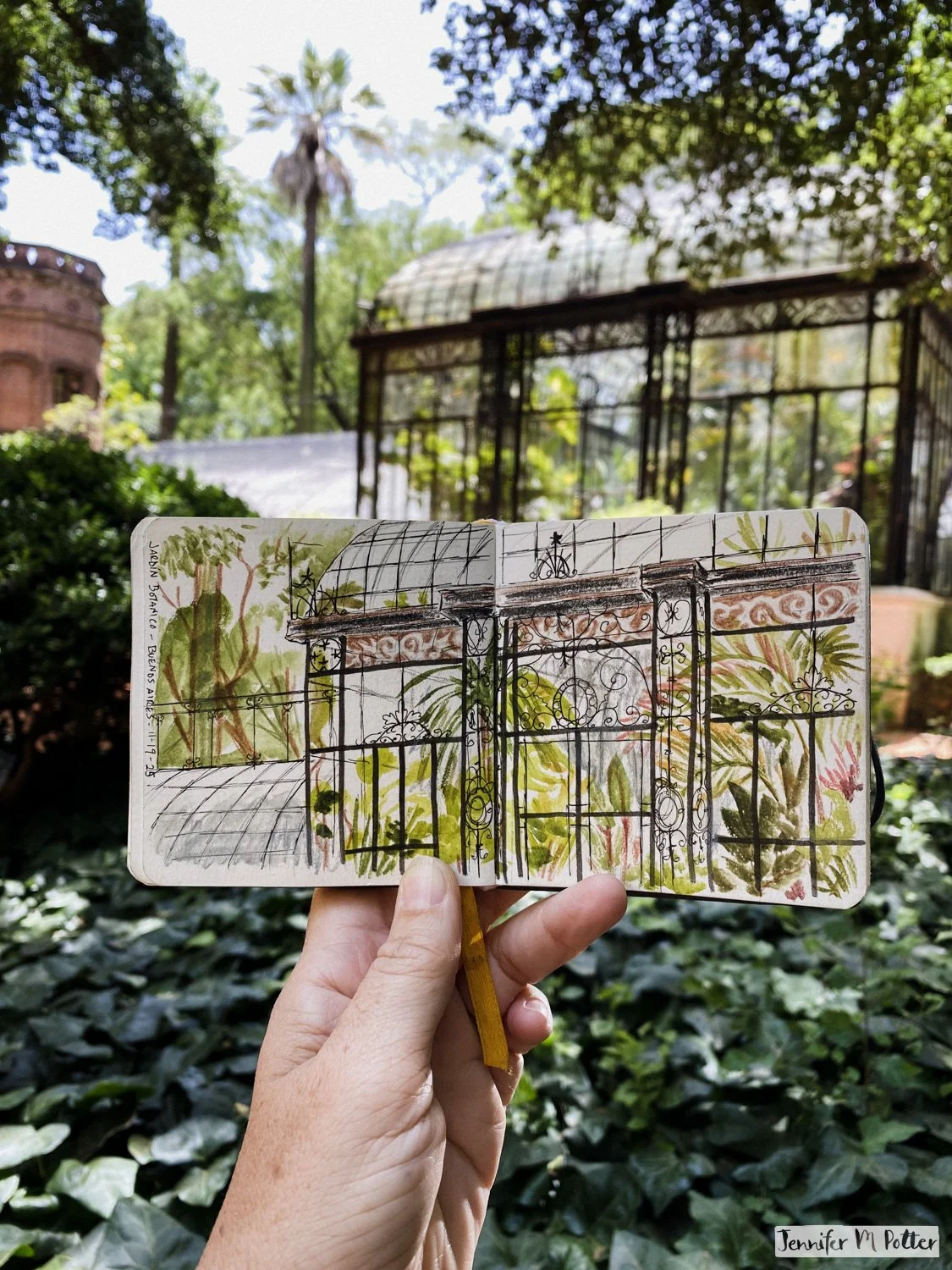
The third sketch was done a few days later in El Jardín Botánico. We'd spent the previous day at the Ecoparque seeing animals, which was wonderful but hot hot hot. The botanical garden was shady and cool. I took pictures of a flame tree with red flowers scattered on the ground beneath it, and right after, a group of school kids arrived and got excited about the same flowers, picking them up off the ground. It was really cute.

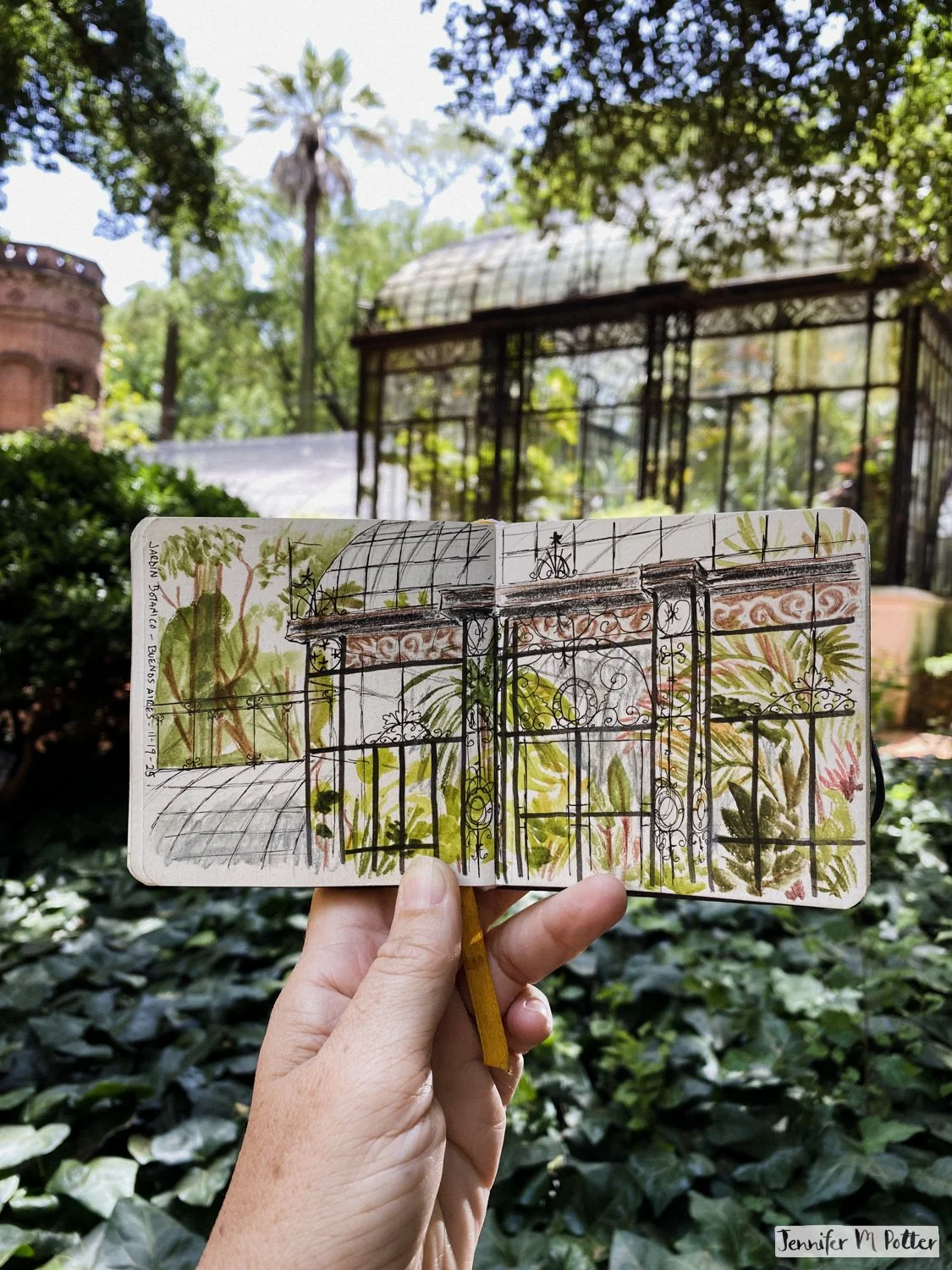
I sketched the greenhouse—wrought iron and glass, very ornate, housing tropical plants. It was a lovely spot to sit for a while.

Sketch of the greenhouse in the Buenos Aires Botanical Garden

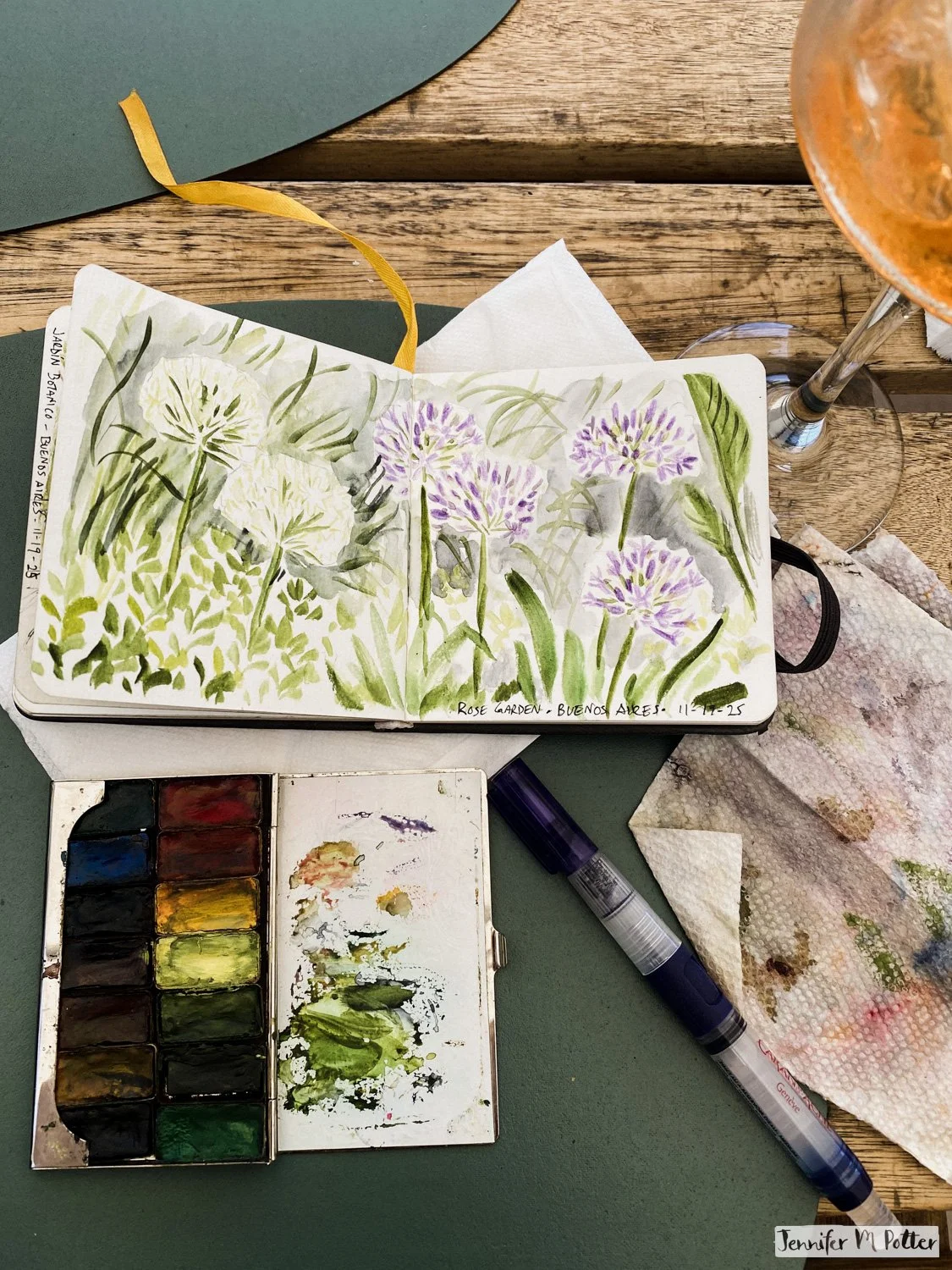
I did the fourth sketch near the rose garden in Parque 3 de Febrero. After visiting the rose garden, I went to lunch to get gnocchi at a place I'd read about. Paul was doing work stuff, so I was on my own. While I waited for my food, I pulled out the sketchbook again and drew the alliums surrounding the patio.

Sketch of alliums in bloom

I enjoyed a spritz with my gnocchi. Not a bad way to spend an afternoon.

Lenses

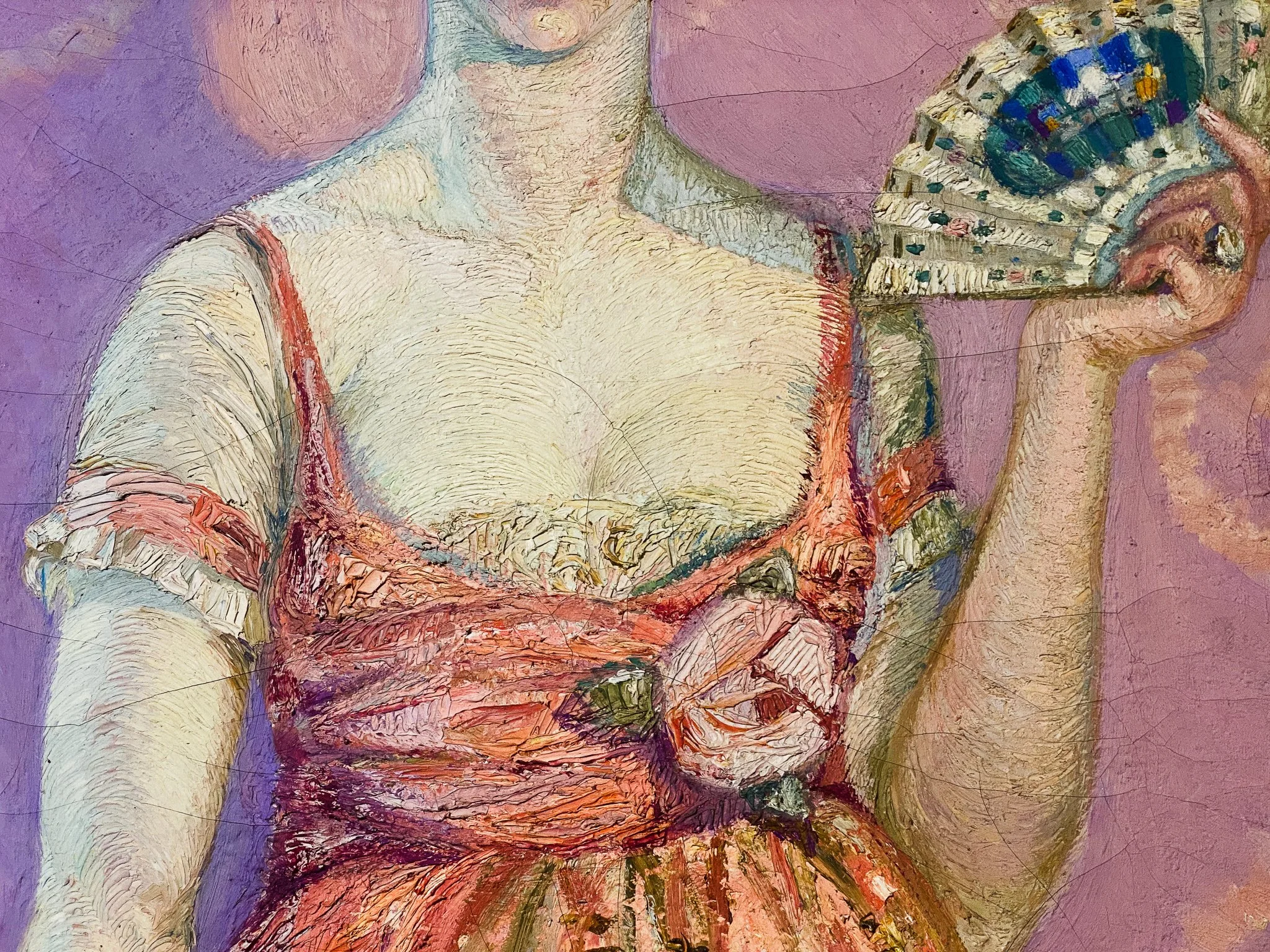
I photograph the paintings I want to remember. The full piece, the museum label, closeups of the surface. I’m collecting information to pore over later, to remind myself how someone achieved a particular effect.

Detail of La dama del abanico by Carlos Alberto Castellanos

Detail of La dama del abanico by Carlos Alberto Castellanos

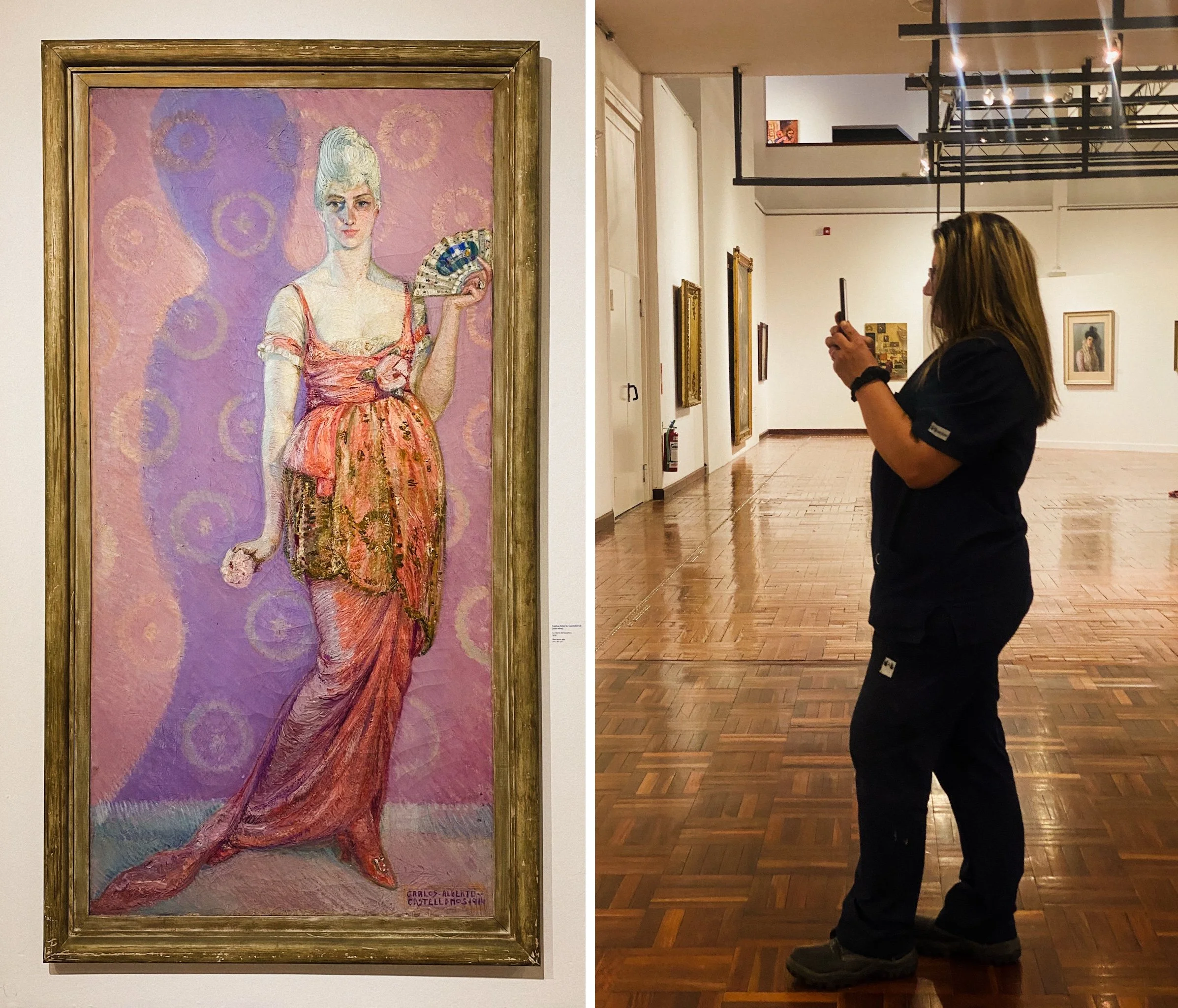
At museums here in South America, I’ve been watching other people take pictures, too. Sometimes we’re photographing the same pieces, sometimes completely different ones. I’ve started wondering what lens they’re looking through. Are they studying technique like me? Sharing proof they were here, that they saw this? Trying not to forget they felt something? Or maybe they don’t know how else to interact with art—these days snapping a picture is a way to preserve something’s essence. A bookmark in a passage. A licked and sealed envelope.

Left: La dama del abanico by Carlos Alberto Castellanos; Right: A woman taking a photo of the painting

Left: La dama del abanico by Carlos Alberto Castellanos; Right: A woman taking a photo of the painting

I try not to photograph everything that catches my eye. Sometimes I just sit with it, let it be ephemeral. It comes with a sense of unease. What if I forget how wonderful it was?

It's easier with famous pieces, since I know I’ll encounter them again sometime. (This is where I'd include pics of Frida Kahlo and Diego Rivera paintings had I chosen to photograph them.)

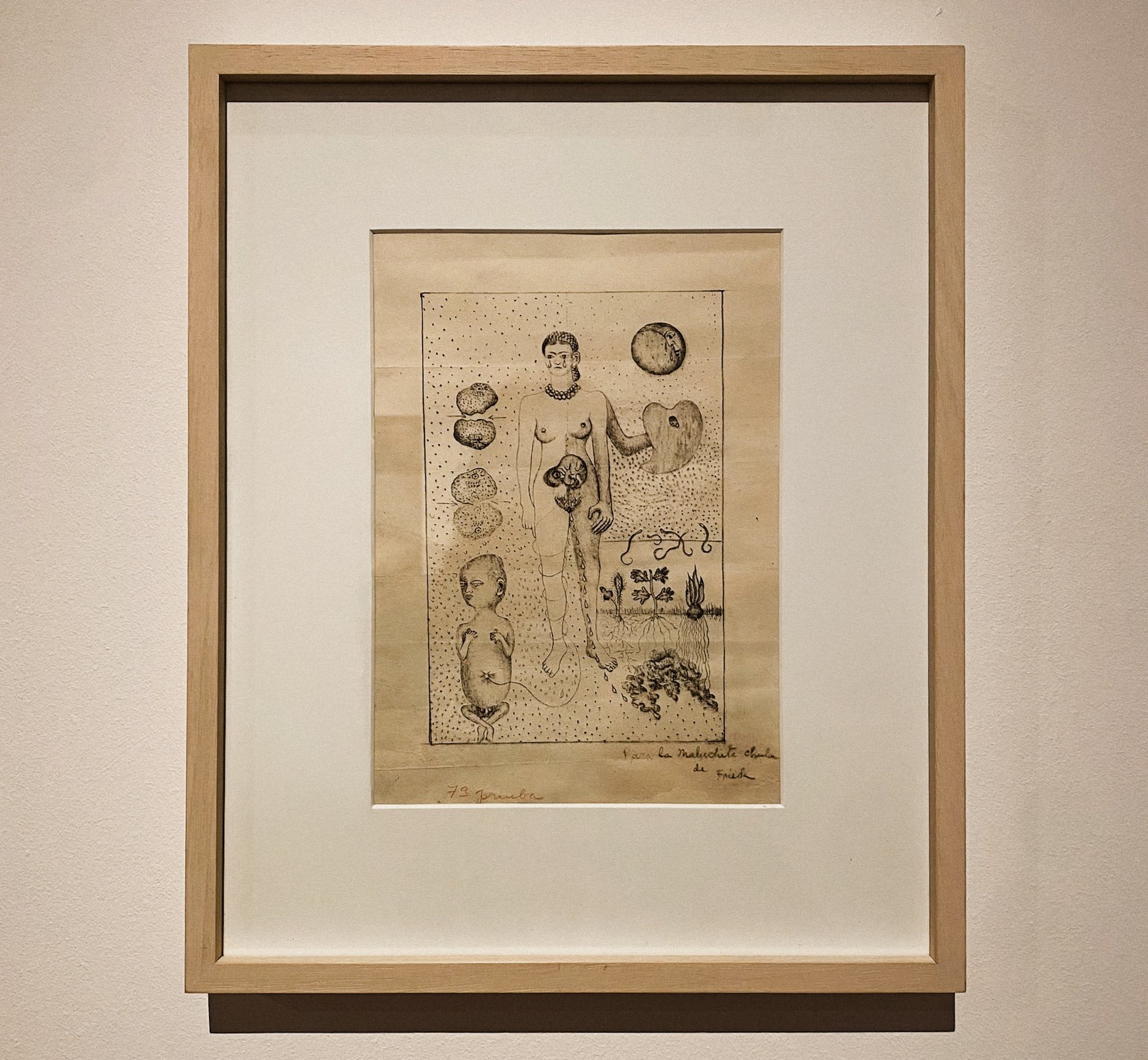
But here's a Kahlo drawing I thought you might like to see. For your particular lens.

A drawing by Frida Kahlo

Untitled by Frida Kahlo

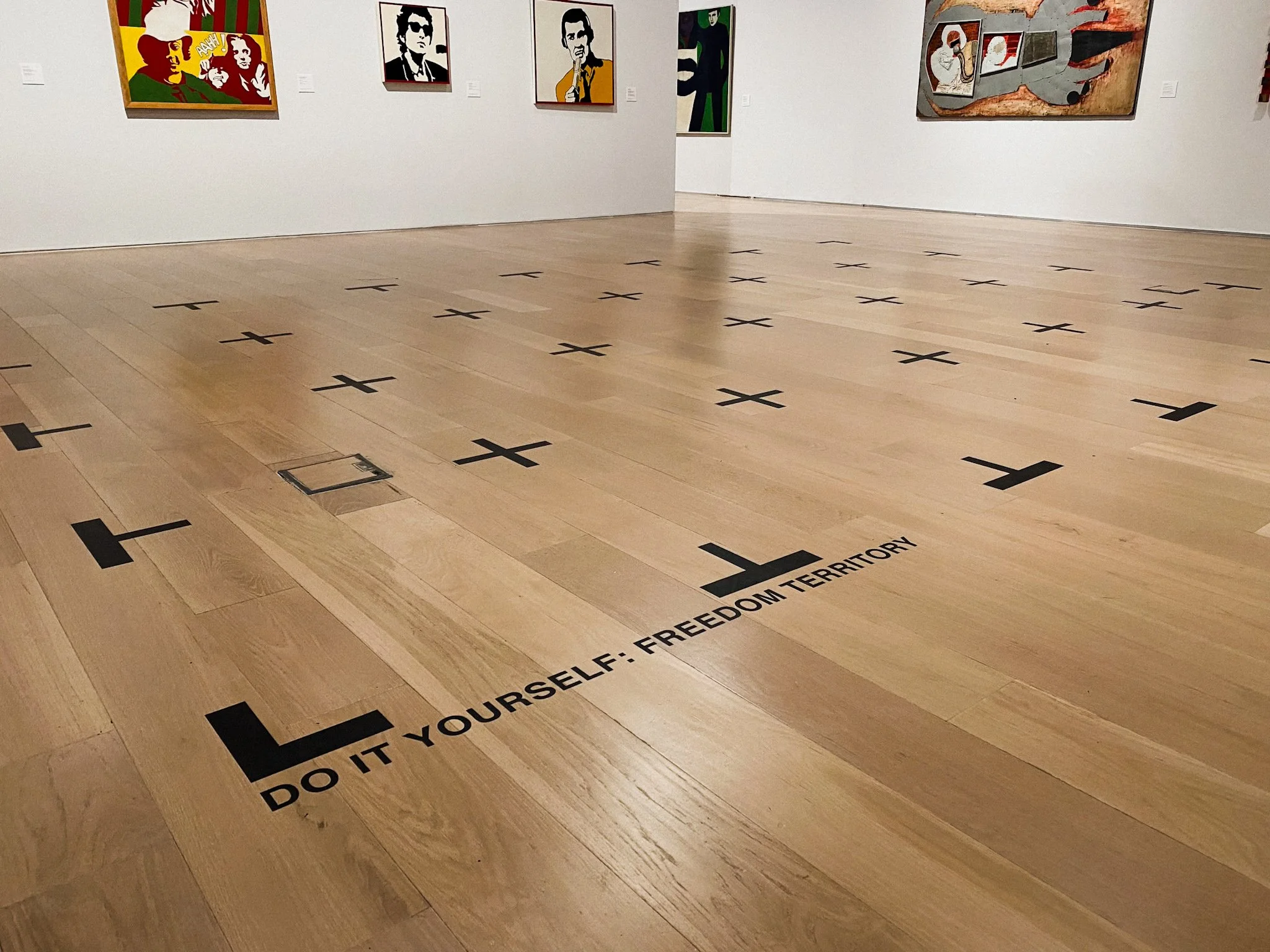
At the Museum of Latin American Art in Buenos Aires, there was a provocative piece—a grid on the floor with a label that read: DO IT YOURSELF: FREEDOM TERRITORY. I almost walked around it like everyone else. Then I considered that passive viewing was a kind of prison. It's the norm to not touch the art—rightfully so. But I could see this was meant to be interacted with. An invitation to defy convention. Stepping inside was a kind of freedom.

So I did. I walked a few grids forward, up a few, over a few. Hopped to one. I was aware the whole time that the docent and other patrons could see me choose to engage while everyone else skirted around it. An outsider inside the art. A little self-conscious, I suppose, but at least I was free.

Then I stepped out and took a picture. So I’ll remember being free.

Photo of Do it yourself: Freedom Territory by Antonio Dias

Do it yourself: Freedom Territory by Antonio Dias

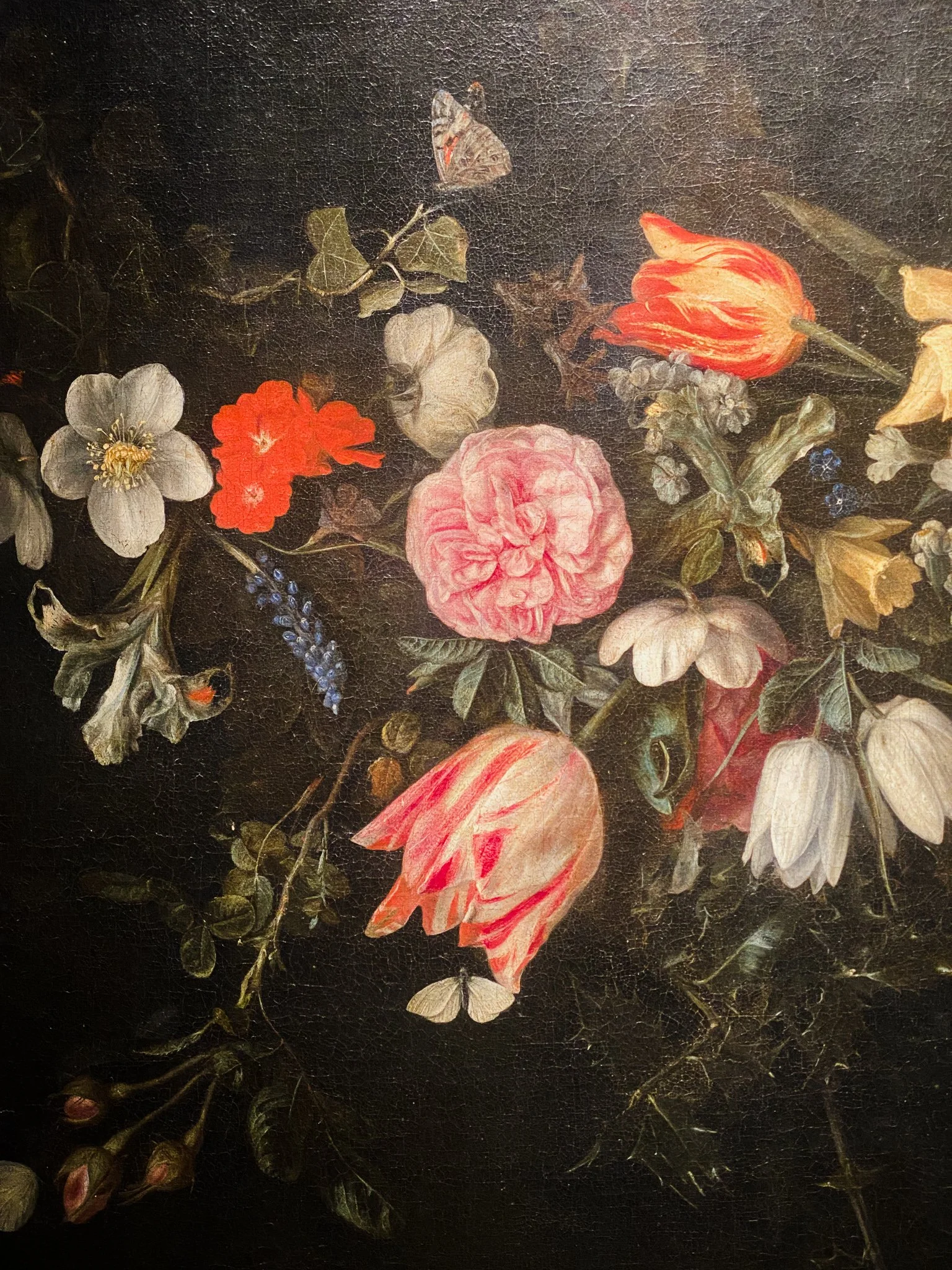
Speaking of touching the art, at the Rijksmuseum in Amsterdam a few years ago, I watched a family—a mother and two teenage daughters—taking selfies with the art. We'll, not with the art, but in front of it. Glamour shots of themselves posing with a crown of flowers exquisitely rendered in oil by some Dutch master. Priceless art reduced to little more than wallpaper. In an attempt to get the perfect shot, one of the teens backed into a canvas, hitting it with her (unchecked) backpack. I was horrified. They heard me gasp. They looked chagrined but it didn't stop them taking more shots for the ‘gram.

Detail of Garland of Flowers by Jan Philip van Thielen

Detail of Garland of Flowers by Jan Philip van Thielen

This morning at breakfast I spoke with a man who said he won't be going to any art museums in Buenos Aires because he doesn’t like art. That’s a lens too. I wonder if he means he doesn’t like art with a capital A, art that takes context and possibly a bit of pretension to parse. Would he like the art I like? The seventeenth, eighteenth, and nineteenth century stuff, the beauty and craftsmanship? Maybe he'd find the portraits stuffy and the pastoral scenes banal. We'll never know. He’ll take his pics at the Railway Museum instead.

What I Look For Now

I'm in the hotel looking through photos from the museums we've visited in Montevideo and Buenos Aires. We're in South America while my husband attends a work conference, and I've been spending days wandering through galleries—four museums so far.

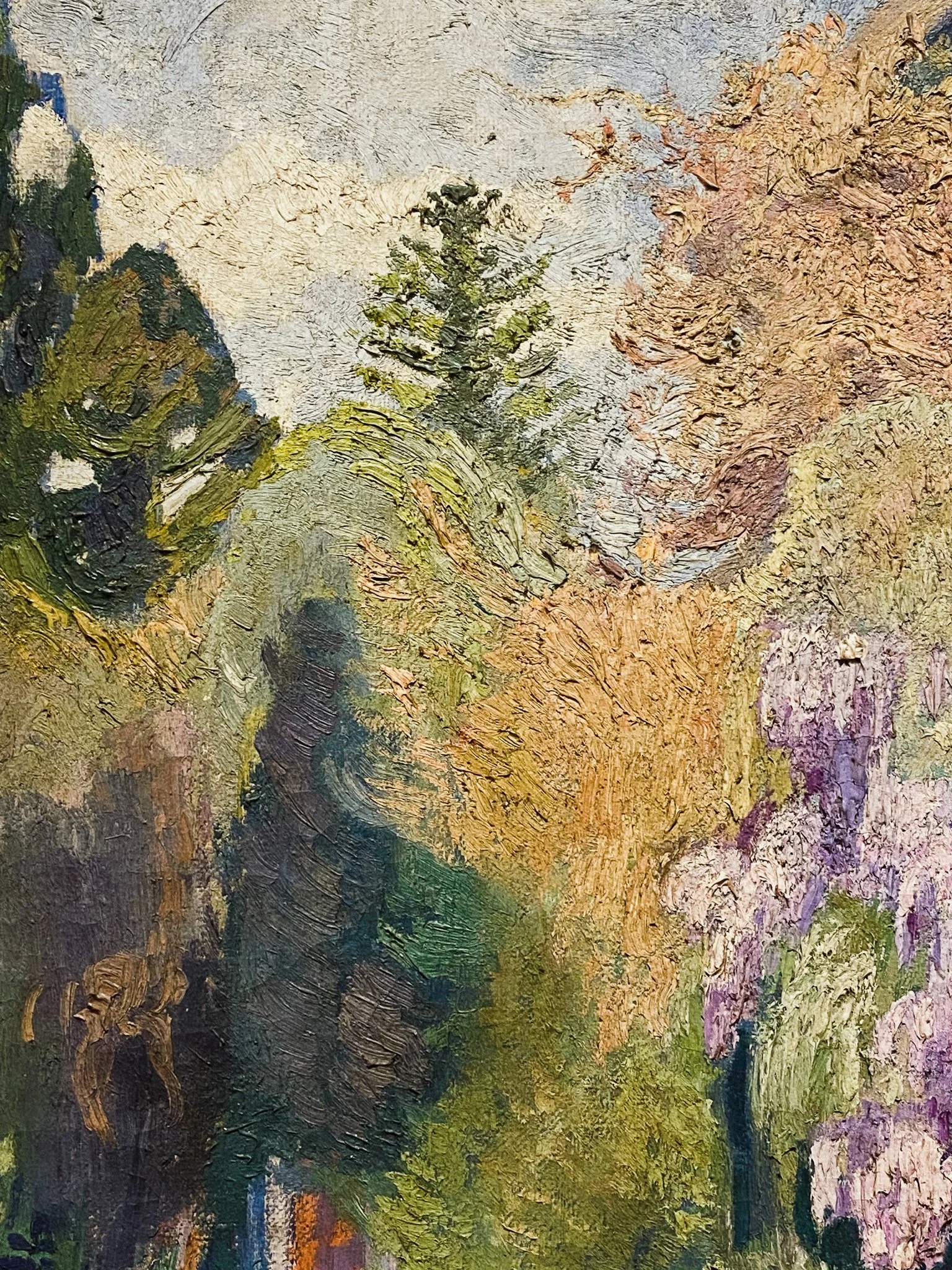
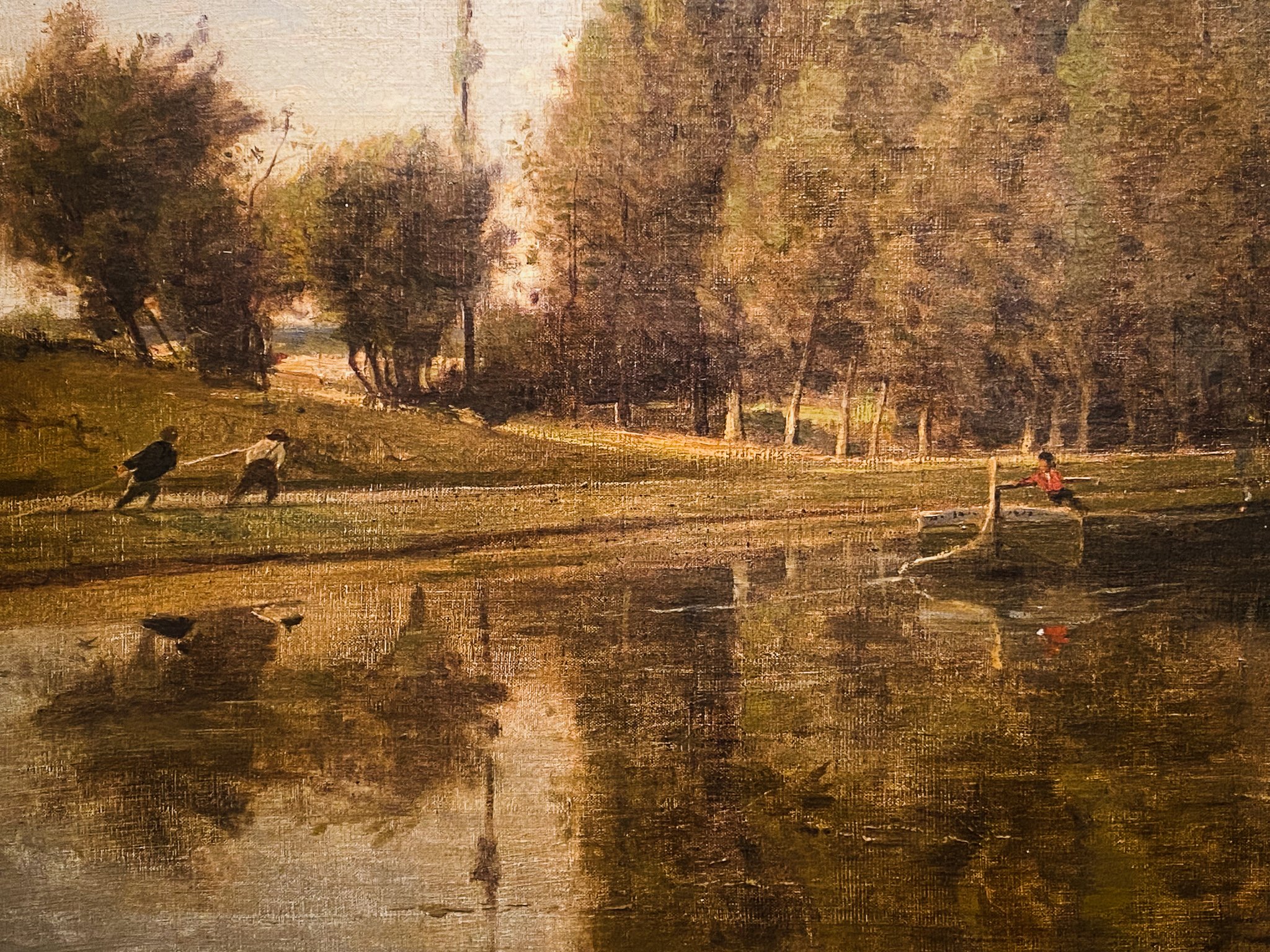
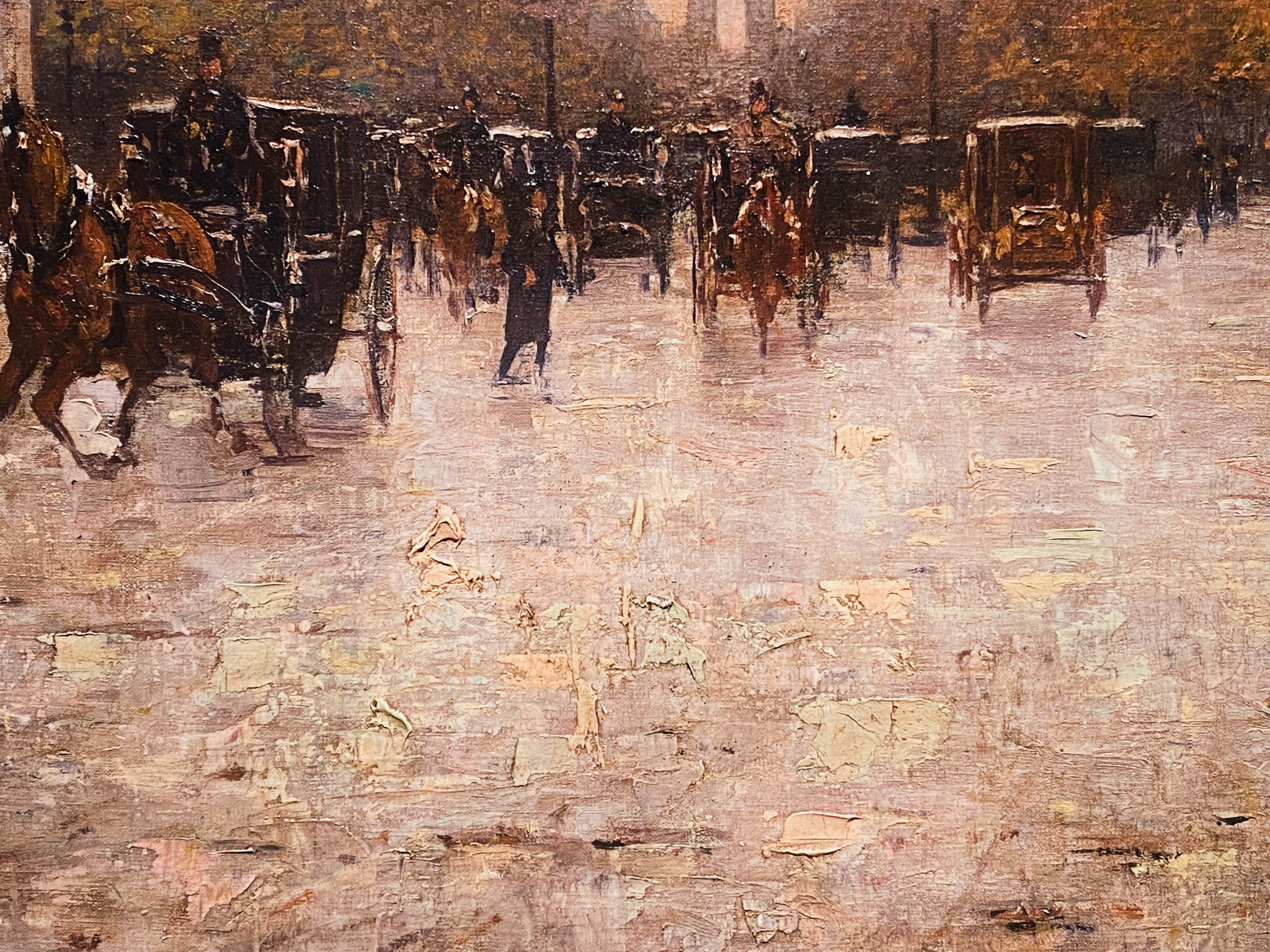
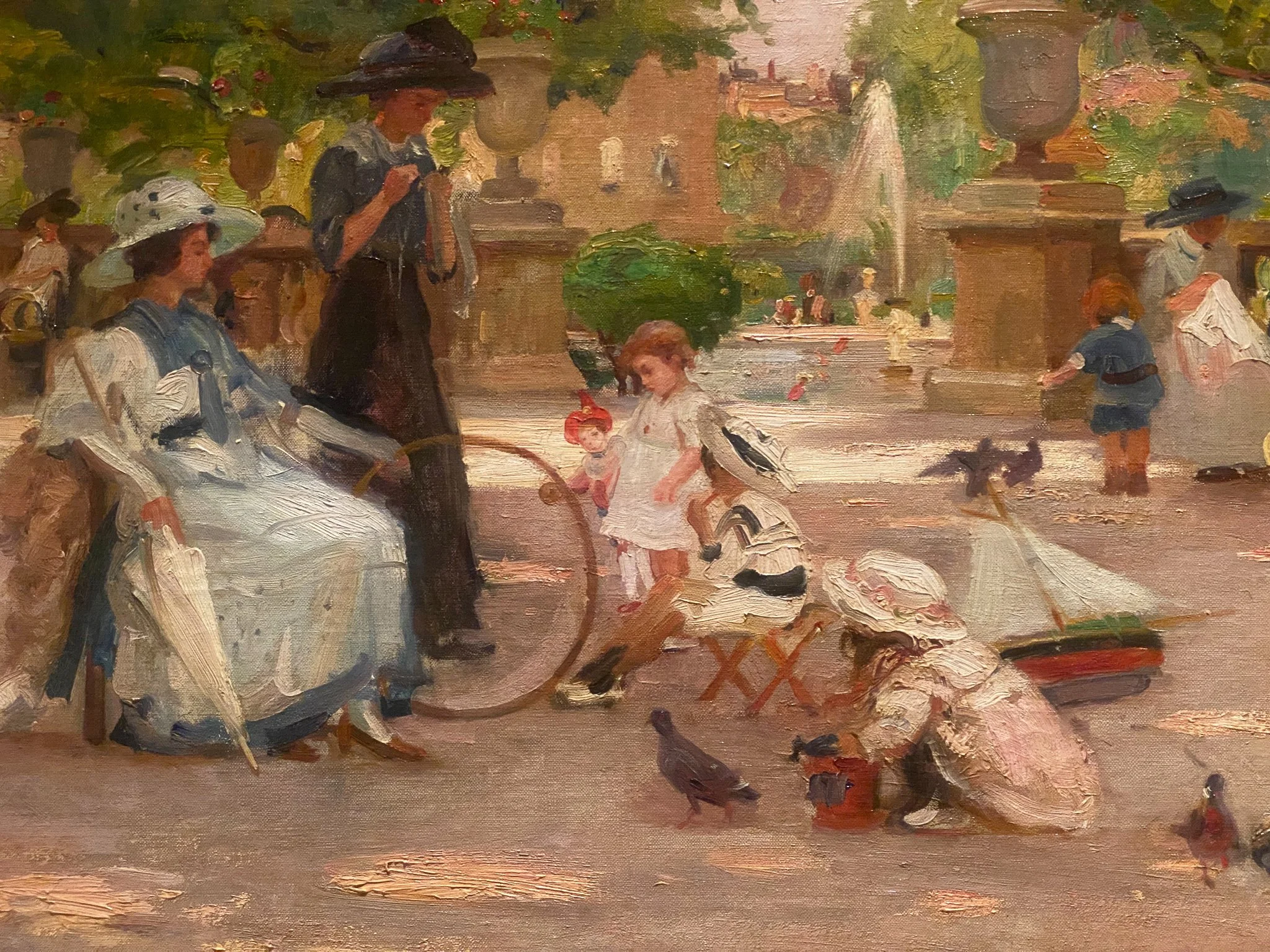
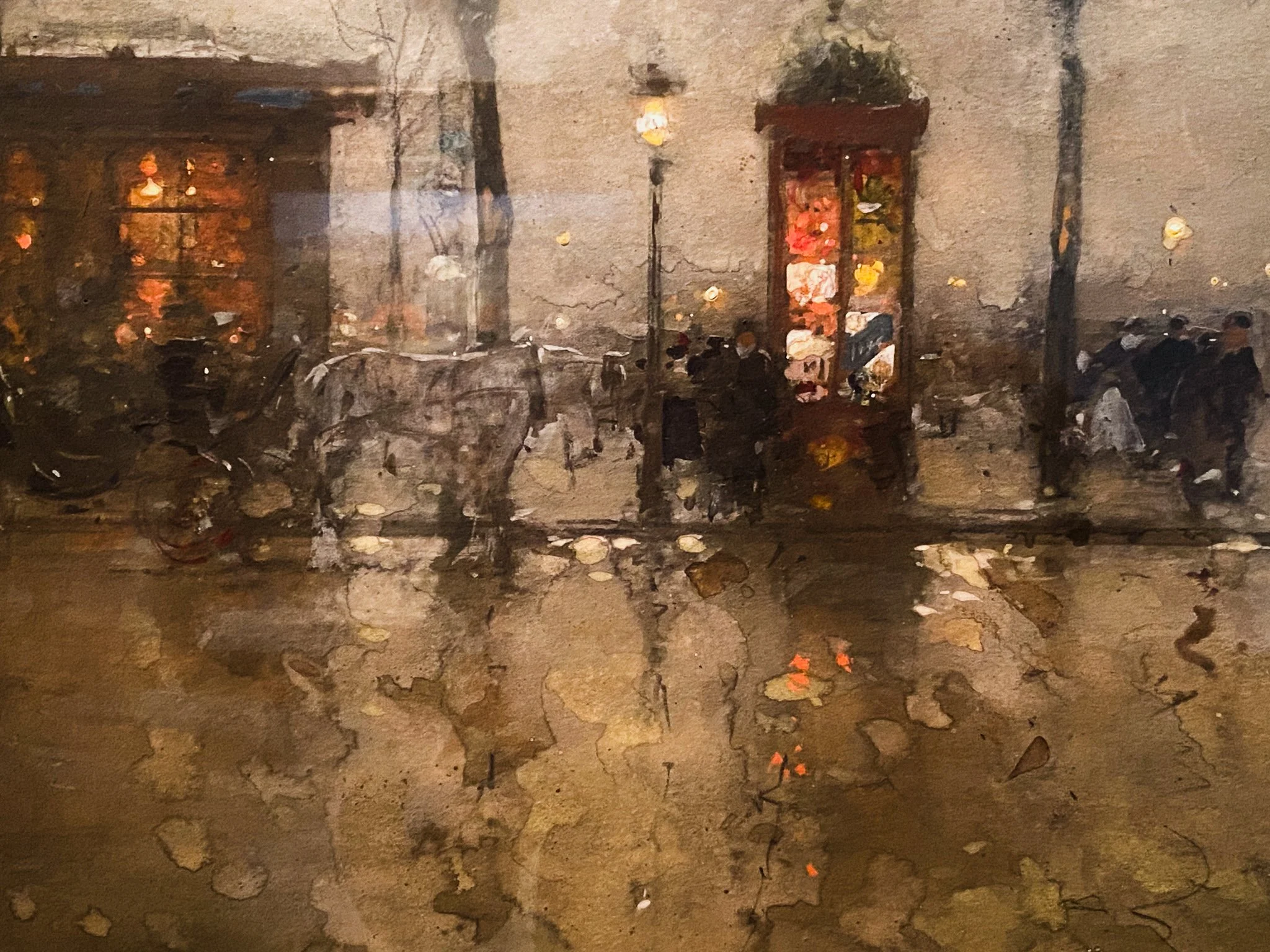
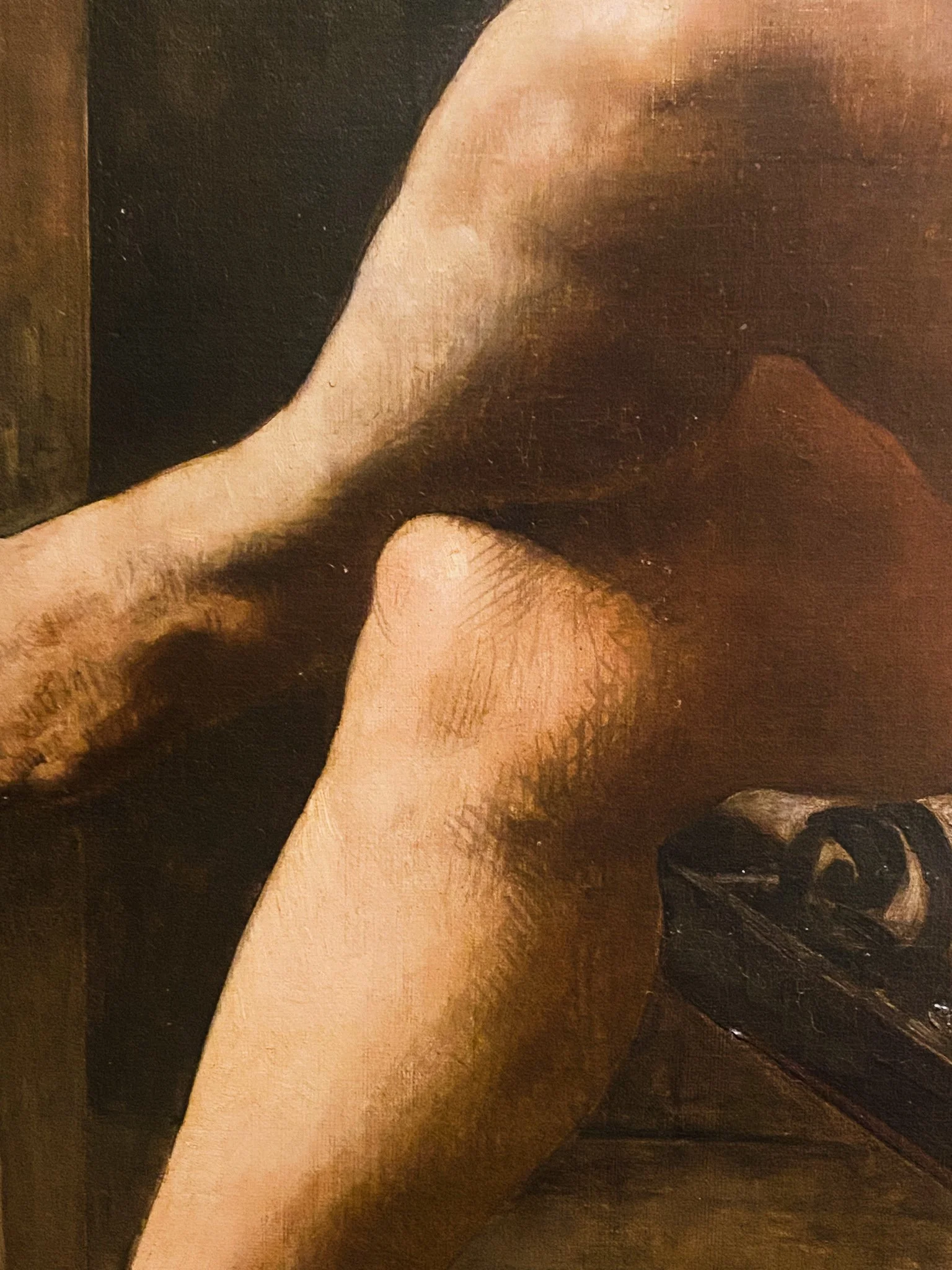
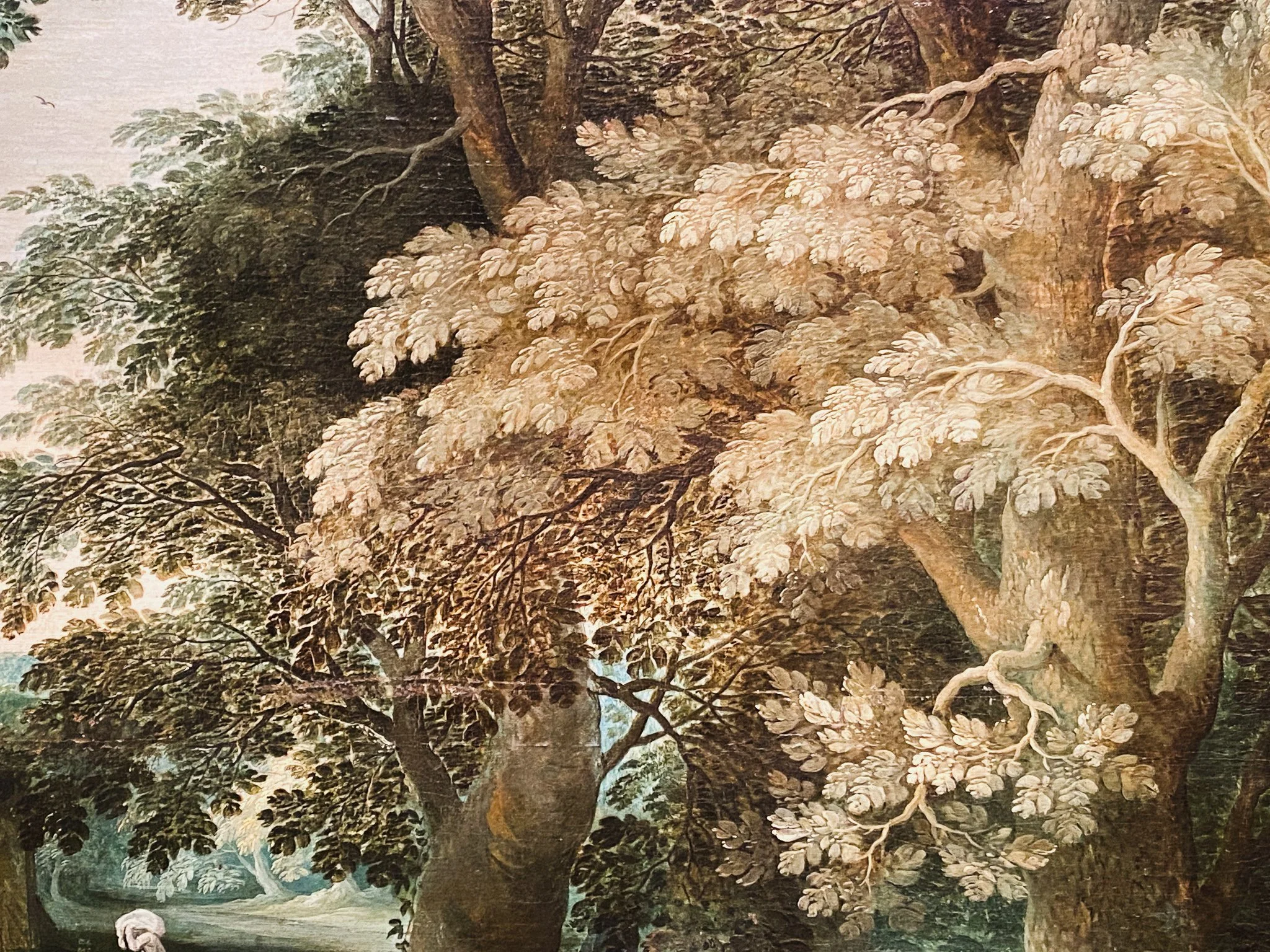
I keep returning to the same periods. Seventeenth and nineteenth century work. The Dutch masters with their impossible observation. The Impressionists with their perfect reductive form. I could stand for hours looking at how they recreated the translucency in a halved orange, the sheen of silk embroidery against a velvet frock coat, light passing through trees to bounce off a stream and highlight a cart horse. Petals in mud. Wisps of clouds. Distant hills.

I see these things through an artist's eyes. I study them. I think about what it must have been like to recreate the image and how I can use that information. Sometimes I'll see a simpler, more modern painting and think—that's almost like a picture book illustration, how could I adapt that approach?

Pelando la pava by Pedro Figari

Pelando la pava by Pedro Figari

Which makes me wonder: do I appreciate these pieces for what they are, or do I just like what I can learn from them? Is there a difference? Does it matter?

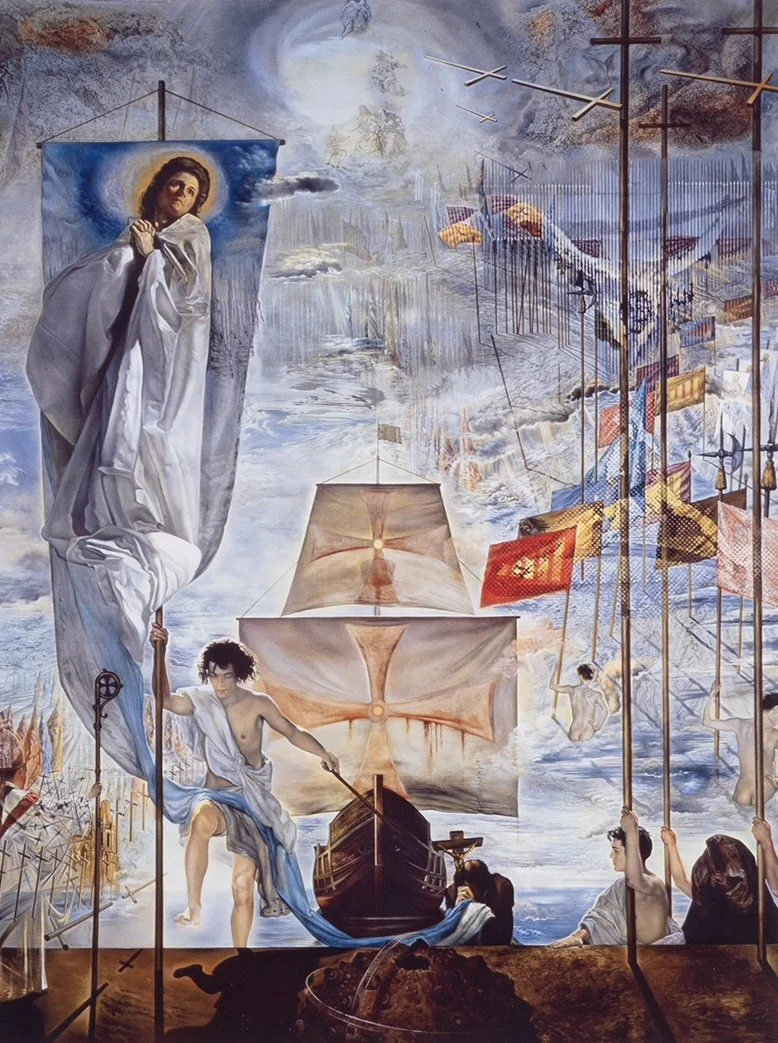
My taste has changed completely since high school. Back then I liked modern art—Warhol, Pollock, Lichtenstein. I think I was drawn to work that looked simple, easy to create. I was impatient and impulsive. Dalí was my first step toward appreciating real craftsmanship. I got to see his work at the Salvador Dalí Museum in Florida. I went for the melting clocks and stayed for "The Discovery of America by Christopher Columbus." The man could draw.

The Discovery of America by Christopher Columbus by Salvador Dali

The Discovery of America by Christopher Columbus by Salvador Dalí

I've been thinking about this in relation to my art. With illustration and licensing, I don't have much control over price—the market decides what a book should cost. With fine art, if a piece takes a hundred hours, I can price it accordingly. Theoretically. In practice, that means choosing between functional work priced for everyday use (books, cards, dishes) and art pieces priced for collectors. Functional has limits. Art doesn't, or at least less so.

Part of being an artist is navigating that tension—straddling the line between the time you want to spend on a piece and the time you can afford to spend on it. There's no one right path. Quick and affordable or slow and expensive. I think an artist can find success in either.

I wonder how many hours went into these pieces I admire.

Photo of a room at the Museo Nacional de Bellas Artes

Museo Nacional de Bellas Artes

I'm drawn to the slow path, toward craftsmanship that takes time. I'll experiment with techniques to speed up the process, but I don't think I'll ever abandon the detail I love. All these details I get lost in. Maybe someday someone will get lost in my work the same way.

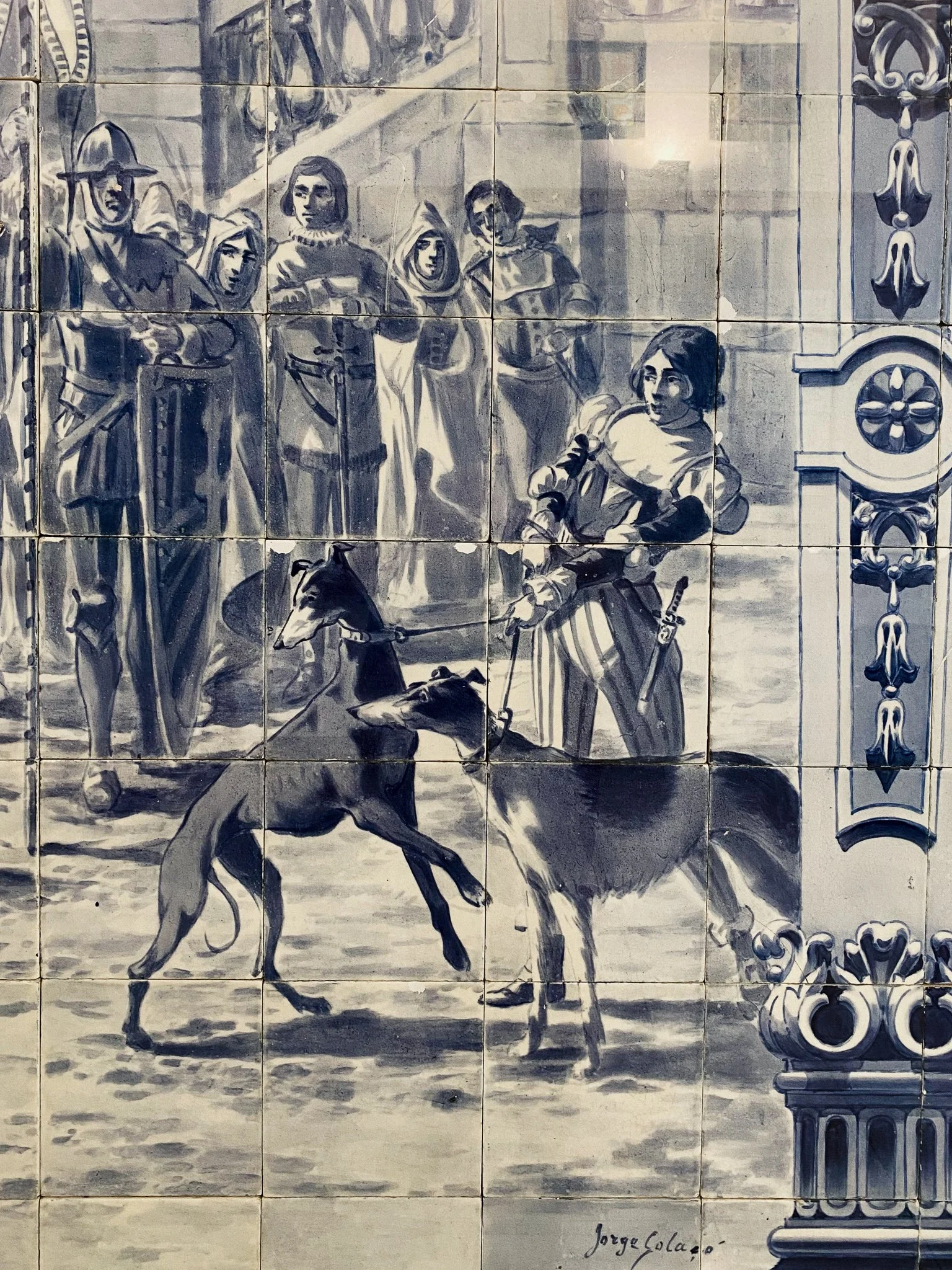
Detail of a tile mural by Jorge Colaço

Detail of a tile mural by Jorge Colaço

I've been stressing about sixteen-hour vases that need to cost what they cost. But at least the choice exists.

Prototypes (or Something Like That)

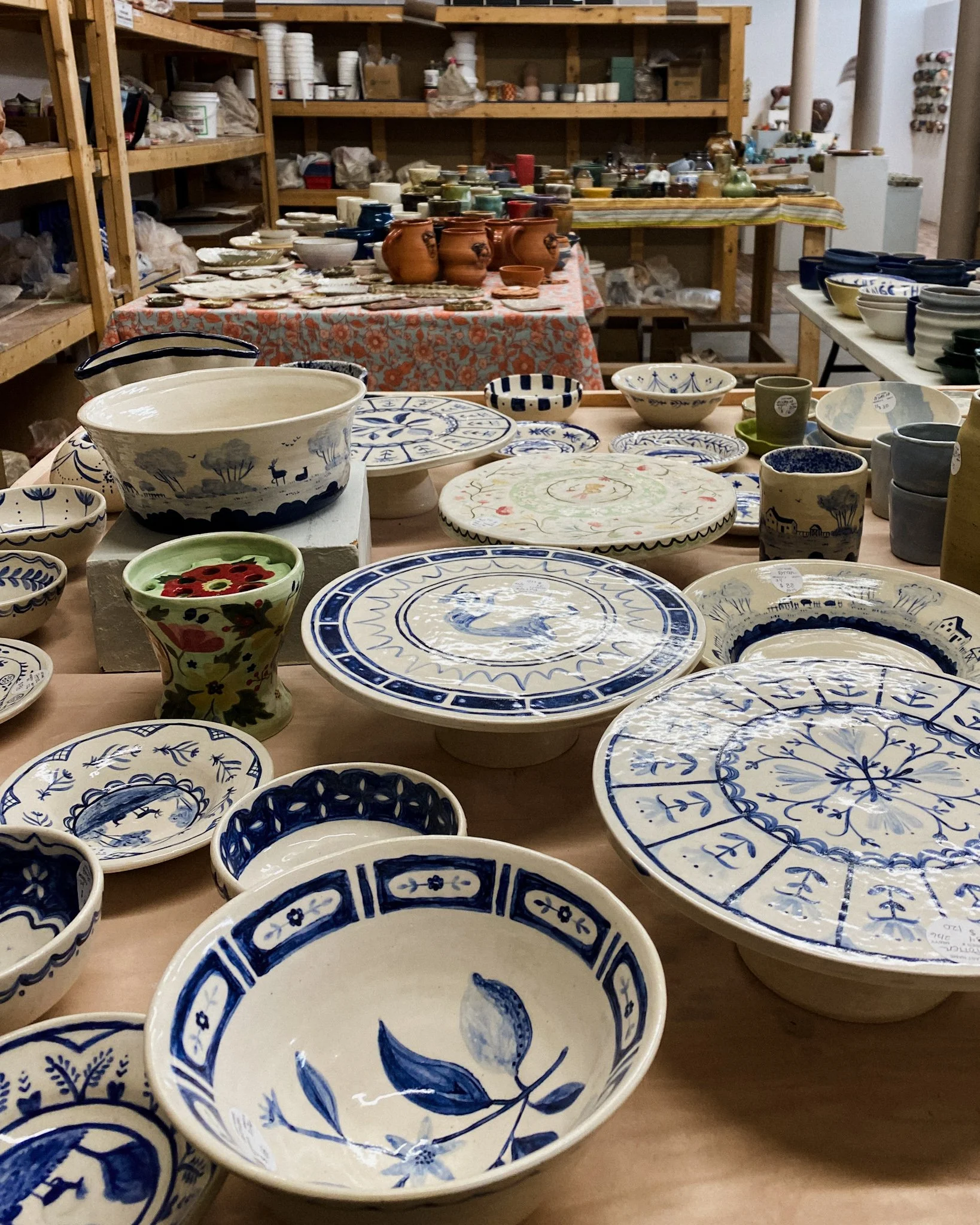
Over the summer I applied and was accepted as a member of the Potters Guild, the ceramics studio I've been taking classes at for the past few years. Their winter market is in a few weeks and as a member, I get to join in, so I'll be selling my pottery for the first time. I’ve been decorating pieces for it—last weekend I sat down with no plan for a bowl and left with a goose wearing wellies. Maybe six hours work from wheel to final glaze.

Work in progress of a goose painted on a ceramic bowl in underglaze

Before that I made a vase that took at least sixteen hours. As an illustrator I'm used to spending hours on a piece, so that doesn't sound like so much. But just to make minimum wage I'd have to price the vase at $240 and that doesn't even cover supplies and studio fees.

work in progress of a scene with a fox carrying a basket of apples in underglaze on a vase

I’m trying to see these time-intensive pieces as prototypes. Hand painting everything in three solid layers of underglaze is neither efficient nor cost effective. But I follow the inspiration and pay attention to what is and isn't worth the time. Some things can be streamlined with faster techniques, but some things will just need to be hand painted with all three layers to get the effect I'm after. It’s R&D.

Both the goose bowl and the fox vase are heading into the glaze kiln soon. I probably should have bisqued them again, just to set the underglaze before applying the clear gaze, but I didn’t. I was trying to save energy—but now I’m second-guessing it. Hopefully they won't bleed.

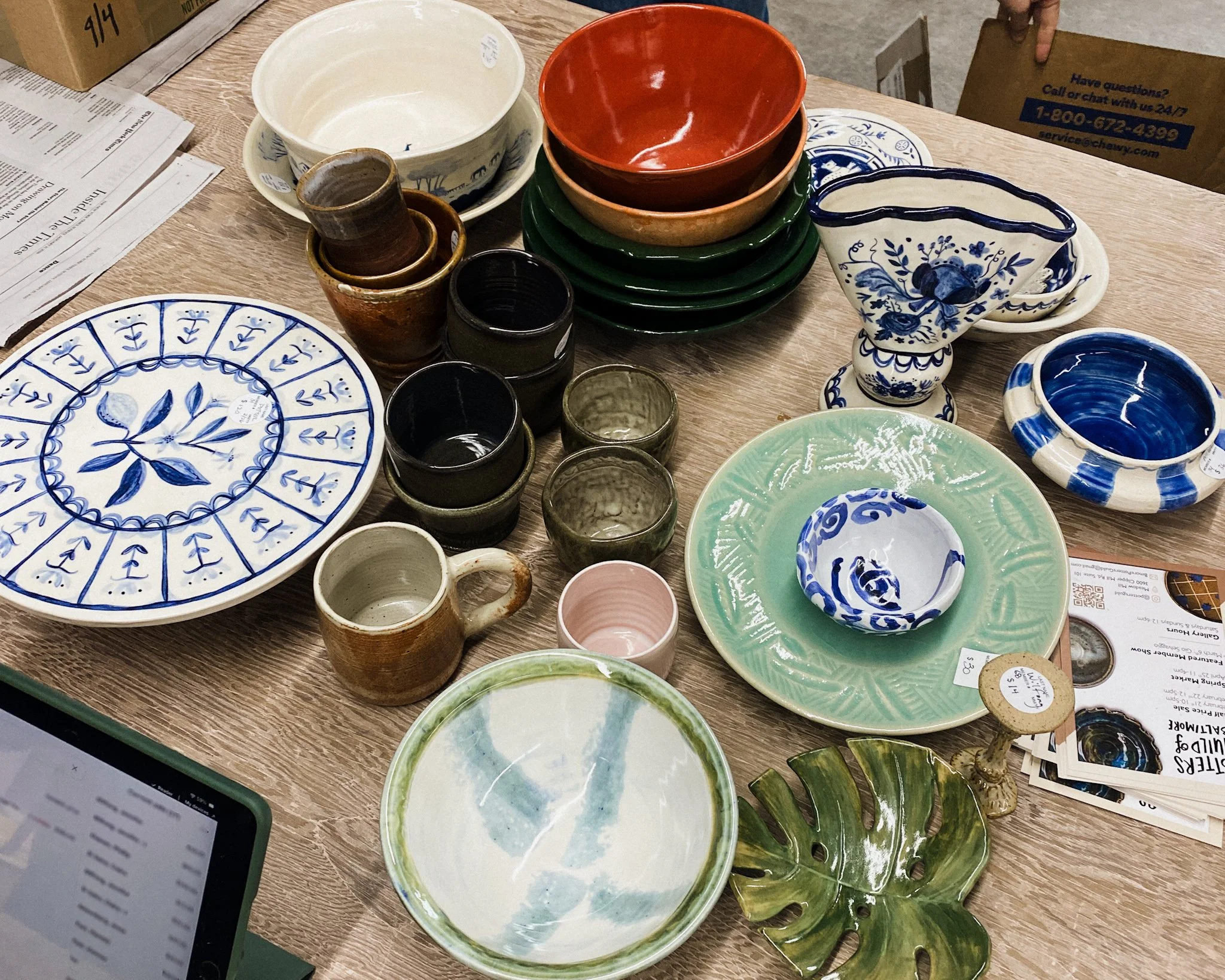
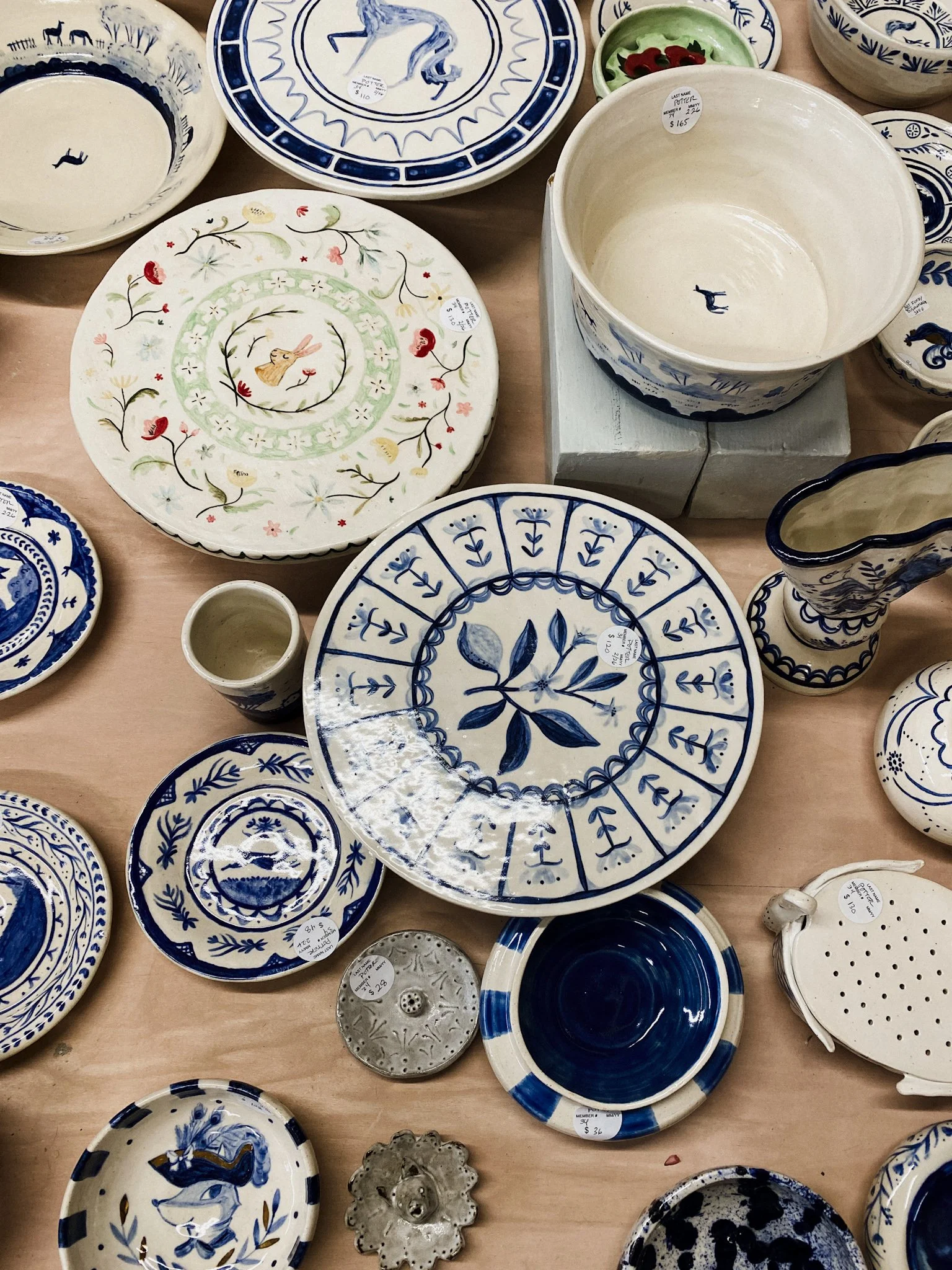
I’ve been going through my early pieces to add more things to sell. A lot of them are wonky—slightly warped, not as smooth as I’d make them now, a little too heavy. But they’re decorated with care, and that means something. Most of them are blue illustrations on white, little scenes and motifs I painted with the same attention I give my illustration work. I worry that they're not perfect, but my teacher said if you want perfect, go to Pottery Barn and that stuck with me.

Collection of blue and white ceramics by Jennifer M Potter

All of these pieces will have to be priced. I want something that values my time but stays within reach. At the same time, I'm not confident I can price these at what they’re worth. But I’ll learn to work faster, and that will bring the prices down. Or not.

I went to the Potters Guild winter market years ago, back when I first moved to Baltimore. During the pandemic, before I was even taking classes. Outdoors, very cold, but joyful anyway. It's hard to believe I'll be participating from the other side this year. I'm nervous, but excited. I’ll be sharing a table with my friend Van. And I’ll know the other vendors, so it's sure to be a good time, and I'll probably learn a lot.

I'll probably make a lot of mistakes, too. My prices will either be too high or too low. I don't have any signage or fancy displays so it might just be dishes on a table. But that's okay. It’s just a beginning—I’ll get better.

I guess I’m treating the market as a prototype too.

A Mushroom Cap and a Jackal Mask
Me and Paul in our paper mache costumes

The idea was to keep it simple. Paul’s never been big on dressing up, but we had a Halloween party to go to, so I figured fancy masks with regular clothes would be a good compromise. A paper mache jackal mask for him, and a mushroom hat for me. Why a mushroom hat? Because I wanted to play with LEDs and I wasn’t sure how to work them into a rabbit mask.

I went to the art store weeks before Halloween because I really couldn't put it off any longer. Bought supplies, but didn’t actually start anything on account of being knocked out with flu and covid vaccines.

When I finally did start, I got to work with sculptural mesh for the first time. It’s like fine chicken wire you can shape and fold.

shaping sculptural mesh

And like chicken wire, the edges are really sharp. It wasn’t long before I put on my gardening gloves. I probably should’ve watched tutorials, but I dove right in, making little origami folds to create the jackal's snout. I shaped the rest of the head and then affixed mesh ears with aluminum wire.

The mesh frame for the jackal mask

Then I made the mushroom cap using bowls to give it shape. I went on intuition, using the part of my brain that's good at form and mechanics. I got the hang of it quickly.

shaping the mushroom mesh

The paper mache came next. I cooked up some paste with flour and water, then used it to adhere torn newspaper strips to the mesh. Very elementary school. The mushroom cap was a breeze.

paste newspaper strips onto the mushroom frame

The jackal was a little tricky around the ears, but I quickly found smaller strips made for smoother corners.

the jackal frame covered in newspaper

It seemed to work fine, but when I painted a coat of white acrylic on the mushroom cap, every crease and buckle showed up. I did some research and discovered I could smooth it with drywall compound. I also learned I could make my own paperclay, which should eliminate the problem altogether, so I’ll try that method next time.

I applied a thin layer of drywall compound to both headpieces, then used a damp washcloth to smooth it down. Once dry, I painted the mushroom cap again. Not perfect but better.

The painted mushroom hat

The jackal mask was still rough, but all the painted details concealed it a bit.

painting over the drywall compound on the jackal mask
painted details on the jackal mask
side view of the jackal mask

For Paul's mask, I wasn't sure about the eye holes. I considered them in the very beginning, but decided it would be safer to add them after everything was formed and painted, and I think that was the right call. I had Paul try it on to figure out where his eyes actually were. Turns out they were right about where the jackal’s eyebrows could be. I used an awl to punch small holes, then shaped them by cutting through the mesh and paper mache with an exacto knife. Added nose holes too, to make it more breathable, though I'm not sure it ever became super comfortable.

munching out eye holes on the jackal mask

But really, it just needed to be wearable for a few minutes at a time. Halloween masks get old quickly when there’s beer at hand.

Paul wearing the jackal mask

The mushroom hat got LEDs. I took the awl and made holes all over the cap, threaded lights through, then capped each one with hot glue. The whole time I was thinking I hope the batteries don’t die before the night is through.

punching holes in the mushroom hat
gluing the LEDs on the mushroom hat

At the base of the mushroom hat, I made a cardboard frame which I covered in chiffon to resemble gills—this part sat on my head, attached to the cap with double-sided carpet tape. Then I added a white chiffon veil to cover my face, and ribbon ties out of old tulle so that it wouldn’t fall off the moment I leaned over.

making the frame for the mushroom gills/headrest
the cardboard frame for the mushroom hat
adding chiffon to the underside of the cardboard frame
the mushroom hat lit up
the mushroom costume in all her glory

At the party, I met a neighbor dressed as a voodoo doll. Her costume was fabulous. Pins sticking out everywhere, full outfit, mismatched shoes, elaborate headpiece. I thought it looked like exactly the amount of work I was trying to avoid. Meanwhile she thought mine sounded like a ton of work because of the paper mache and LEDs.

Her partner came as JP Prewitt—David Duchovny's character from Zoolander. He crafted his homemade hyperbaric chamber from a plastic display dome and an LED strip. He had my vote for the costume contest.

my favorite costume from the party

The world’s greatest hand model. And a pixellated flasher.

He tied for second. I came in third. There were four people tied for second, so take that as you will.

Most people knew I was a mushroom. Some thought I was a samurai. One trick or treater asked if I was an angel. Another asked if I was a forest maiden, which struck me as very funny—forest maiden was in his vernacular. One kid informed me that mushrooms are red. One man said he knew what I was because "I eat a lot of mushrooms."

I'll definitely do more mask making in the future. Maybe not until next halloween, but certainly at some point. It’s always nice to have an excuse to play with a different medium. Working with sculptural mesh felt inspiring in a way I didn't expect, despite the fact that I now know what they mean by “death from a thousand paper cuts.” And there's something satisfying about making costumes that are fully one-of-a-kind, even if they're a little uncomfortable and take too long and some kid thinks you're a samurai.

hanging out on the back deck

One of the people who tied for second was at another party I went to on Saturday. It was nice to have that connection, to recognize each other from the Halloween party. Small neighborhood moments like that are why you spend weeks making a mushroom hat in the first place.